Read the comic reflection
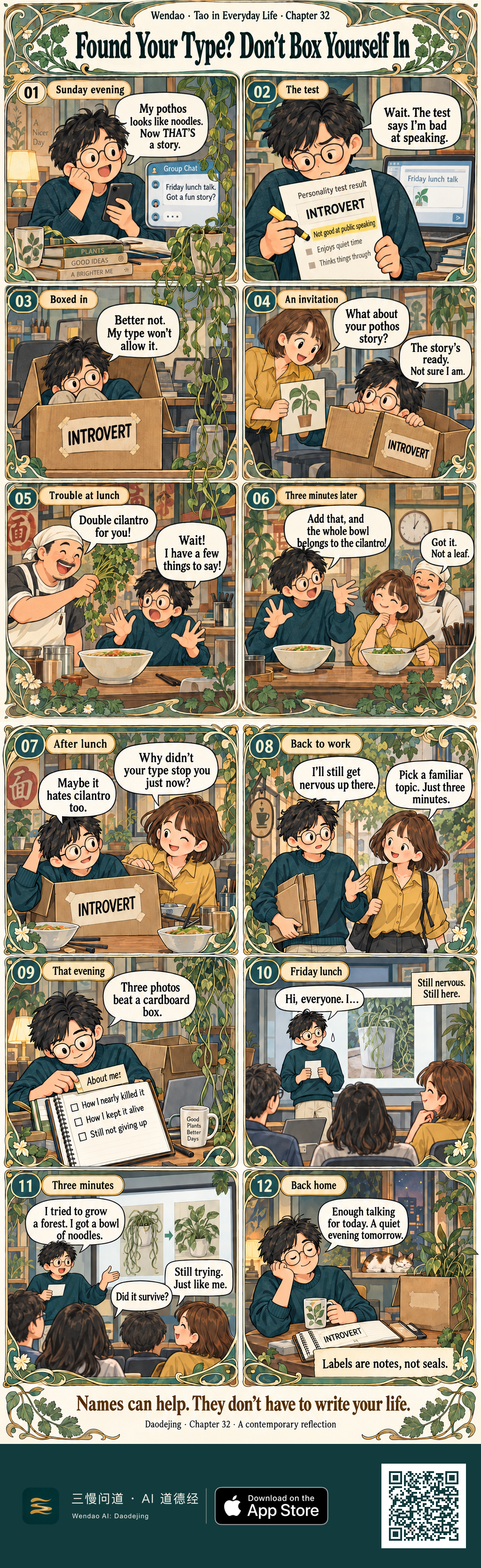
The opening page makes Lin's hesitation visible through objects. On Sunday evening he is smiling at his phone beside books, a mug and the long trailing pothos, joking, "My pothos looks like noodles. Now THAT'S a story." The group chat is asking for a fun Friday lunch story, so he clearly has something he wants to share. Then the test sheet appears with INTROVERT in large type and "Not good at public speaking" highlighted. By the next panel, the metaphor has become physical: Lin is crouched inside a cardboard box marked INTROVERT, saying, "Better not. My type won't allow it." The joke works because the label has shifted from a description on paper into a container he is treating as a rule.
Cilantro provides the comic turning point. At lunch, the cook cheerfully raises a large bunch and announces, "Double cilantro for you!" Lin reacts instantly: "Wait! I have a few things to say!" Three minutes later he is gesturing energetically over the noodles and explaining, "Add that, and the whole bowl belongs to the cilantro!" while the cook answers, "Got it. Not a leaf." Yuan is laughing beside him. The scene does not prove that Lin is secretly some other personality type, and it does not erase his nervousness. It simply gives him a funny piece of evidence that his willingness to speak changes with the subject, the situation and how much he cares about what is being discussed.
The lower page keeps that discovery modest. After lunch, Yuan points back to the contradiction with, "Why didn't your type stop you just now?" Lin replies, "Maybe it hates cilantro too," keeping the joke on the situation rather than turning it into a personality verdict. Walking back to work, he admits, "I'll still get nervous up there." Yuan does not tell him to become outgoing; she suggests a smaller task: "Pick a familiar topic. Just three minutes." That evening, the cardboard box is still in the room, but Lin is now preparing instead of hiding. His line, "Three photos beat a cardboard box," sits beside a notebook listing how he nearly killed the plant, kept it alive, and is still not giving up.
Friday's presentation deliberately shows that progress and discomfort can coexist. Lin stands in front of coworkers with a pothos photo behind him and begins, "Hi, everyone. I..." A small narration box says, "Still nervous. Still here." The next panel is labeled "Three minutes," and the visual payoff returns to the noodle joke: "I tried to grow a forest. I got a bowl of noodles." Someone in the audience asks, "Did it survive?" and Lin answers, "Still trying. Just like me." He has not transformed into a fearless speaker. What has changed is narrower and more believable: he prepared something familiar, stayed through the awkward opening, found a joke that belonged to his real experience, and completed the short share.
The ending does not ask Lin to abandon quietness. Back home, he sits with tea while a cat sleeps by the window, plants fill the room, and he says, "Enough talking for today. A quiet evening tomorrow." The word INTROVERT is now kept in his notebook rather than worn as the front of a box, while the cardboard box has returned to being an ordinary object beside the pothos. The banner says, "Labels are notes, not seals," and the closing line adds, "Names can help. They don't have to write your life." Read alongside the supplied Chapter 32 excerpt, the comic is a contemporary reflection rather than a literal translation: names can help us notice and organize experience, while "knowing when to stop" can also mean noticing the point where a useful name starts becoming a boundary that experience itself does not support.
As things are first defined, names arise. Once names exist, one must also know where to stop. Knowing where to stop is how one avoids danger.
Daodejing · Chapter 32
English rendering of the Silk B base reading excerpt
Think of one small thing you have postponed because you told yourself, "I'm just not that kind of person." Try a version small enough to give you new information rather than a new identity: choose a familiar topic, give yourself three minutes, or tell one trusted person. Afterwards, write down what actually happened, including both the awkward parts and the easier ones, without rushing to replace the old label with a new one.