Read the comic reflection
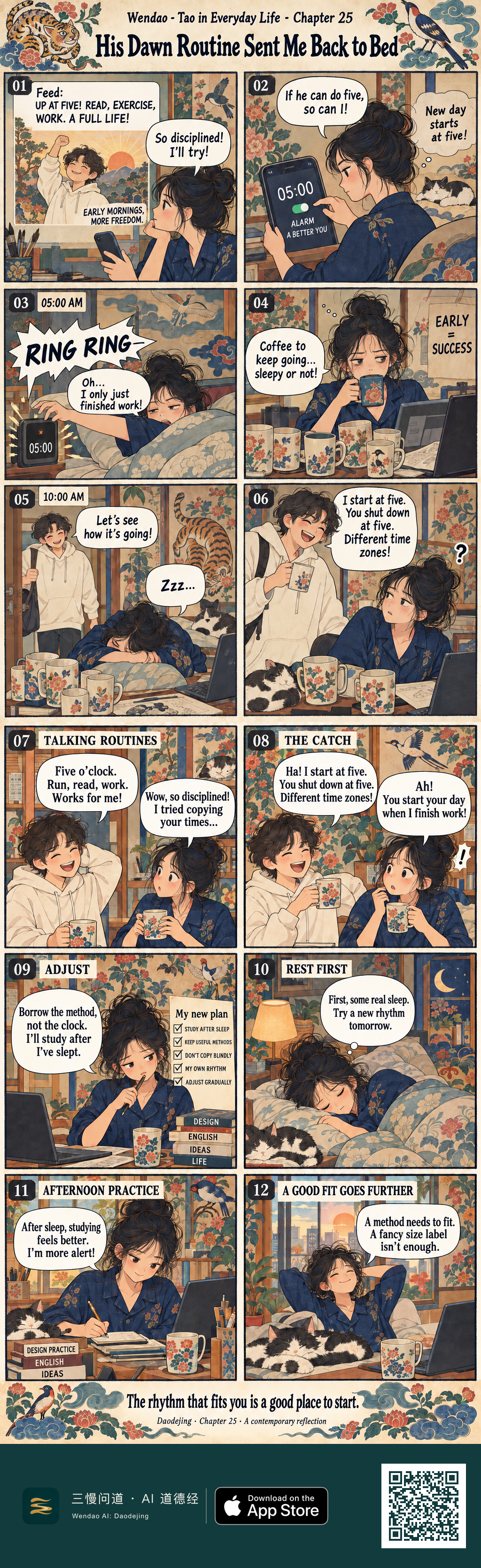
The opening joke is built around a very specific misunderstanding. On her phone, the curly-haired man in the cream hoodie appears against a bright sunrise with the message, "UP AT FIVE! READ, EXERCISE, WORK. A FULL LIFE!" and the poster beneath him promises, "EARLY MORNINGS, MORE FREEDOM." Sitting in her navy pajamas, the woman looks genuinely inspired and says, "So disciplined! I'll try!" She immediately sets her phone to 05:00, complete with "ALARM" and "A BETTER YOU." The black-and-white cat is already lounging nearby, which makes the enthusiasm feel even funnier: she is treating one attractive schedule as if the useful idea and the exact clock time must come as a package.
Panel 03 reveals the missing piece. At 05:00 AM the alarm explodes into "RING RING," but instead of beginning a heroic morning, the woman reaches out from under the floral quilt and says, "Oh... I only just finished work!" The next panel turns that mismatch into a visual gag. She sits at her laptop looking exhausted, gripping another floral mug while several more cups crowd the desk like evidence of an increasingly complicated plan. Behind her, the wall still declares "EARLY = SUCCESS." Nothing in the comic says early rising itself is wrong; the humor comes from watching a slogan remain perfectly confident while her actual work schedule makes that borrowed timetable absurd.
By 10:00 AM, the cream-hoodie man arrives cheerfully with "Let's see how it's going!" only to find her asleep at the desk beside the laptop, mugs, papers, and the unbothered cat. The key joke lands in the next panel when he explains, "I start at five. You shut down at five. Different time zones!" Her floating question mark makes the realization visible before the second page spells it out. During "TALKING ROUTINES" he describes what five o'clock means in his own day—"Run, read, work. Works for me!"—and in "THE CATCH" she finally answers, "Ah! You start your day when I finish work!" The problem was never a lack of effort; they had been using the same number on the clock to describe opposite ends of their days.
The turning point is practical rather than dramatic. In "ADJUST," the woman sits back at her desk with a pen, laptop, floral mug, and a new written plan. Her sentence, "Borrow the method, not the clock. I'll study after I've slept," keeps the useful part of the experiment while dropping the copied timing. The checklist makes that change concrete: "STUDY AFTER SLEEP," "KEEP USEFUL METHODS," "DON'T COPY BLINDLY," "MY OWN RHYTHM," and "ADJUST GRADUALLY." Even the stacked books—"DESIGN," "ENGLISH," "IDEAS," and "LIFE"—show that her interests and intentions have not disappeared. She is not abandoning study; she is rearranging when it happens. The next panel, "REST FIRST," simply shows her asleep under the quilt with the cat nearby and the thought, "First, some real sleep. Try a new rhythm tomorrow."
The ending quietly shows what that adjustment looks like. In "AFTERNOON PRACTICE," she is upright at the desk, writing beside her laptop, pencil cup, floral mug, sleeping cat, and books labeled "DESIGN PRACTICE," "ENGLISH," and "IDEAS." She says, "After sleep, studying feels better. I'm more alert!" The final panel relaxes even further: she leans back with the cat stretched across the desk, the city glowing outside, and says, "A method needs to fit. A fancy size label isn't enough." The closing line—"The rhythm that fits you is a good place to start."—connects naturally with Chapter 25's image of following larger conditions rather than forcing an abstract template onto reality. That is one contemporary reflection on the passage, not a claim that the ancient text prescribes a particular sleep schedule.
People follow Earth; Earth follows Heaven; Heaven follows the Dao; the Dao follows what is naturally so.
Daodejing · Chapter 25
English rendering of the Silk B base reading excerpt
If you are copying a routine that works well for someone else, try separating the useful method from its exact clock time. You might keep one small element—such as a regular study block—but place it after you have slept and at a time that fits your own workday. Try that version for a few days, notice how workable it feels, and adjust without turning the alarm itself into a test of discipline.