Read the comic reflection
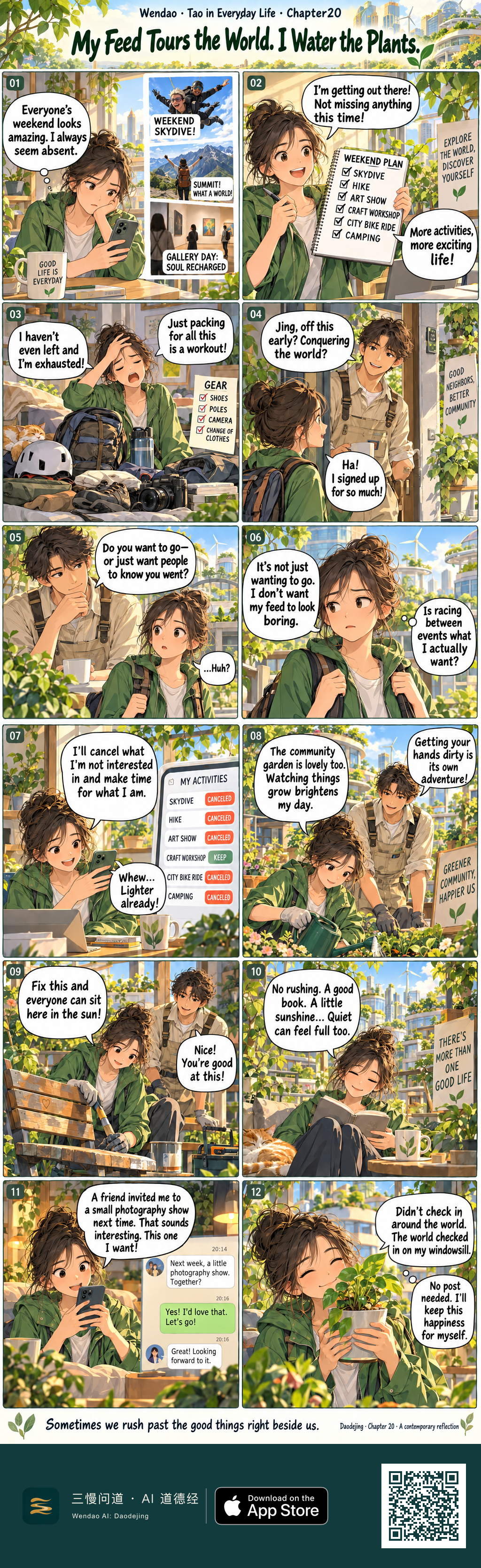
The opening joke is wonderfully concrete: Jing is sitting in a bright, plant-filled room with her phone while her feed seems to be speed-running the planet. One post says "WEEKEND SKYDIVE!", another celebrates a summit, and another announces a gallery day with a "soul recharged." Even her mug quietly insists that "GOOD LIFE IS EVERYDAY," yet she feels as though everyone else's weekend is happening somewhere she forgot to attend. Her answer is immediate and comic: she creates a "WEEKEND PLAN" packed with skydiving, hiking, an art show, a craft workshop, a city bike ride, and camping, as if a sufficiently long checklist could manufacture a more exciting life.
The plan becomes funny in a different way once preparation begins. Jing has not even stepped outside, but the room is already buried under a backpack, helmet, water bottle, camera, shoes, clothes, and other gear while the orange cat sleeps through the entire logistical crisis. With one hand on her head, she admits that packing alone feels like a workout. Then the beige-overalls neighbor appears with a mug and jokes, "Jing, off this early? Conquering the world?" The real turn arrives in the next panel when he asks, "Do you want to go—or just want people to know you went?" Jing's small "...Huh?" lands because the question interrupts the momentum without mocking travel itself.
The lower page shows the change through actions rather than a dramatic rejection of activity. Jing opens "MY ACTIVITIES" and cancels skydiving, hiking, the art show, the city bike ride, and camping, while deliberately keeping the craft workshop. Her relieved "Whew... Lighter already!" makes the point visible: she is editing the schedule, not abandoning the world. Soon she is outside in the community garden with a green watering can, gloves, flowers, and her neighbor beside her. His line, "Getting your hands dirty is its own adventure!", gently shifts the joke from collecting impressive destinations to noticing that effort, novelty, and pleasure can also exist close to home.
The slower rhythm still contains plenty of doing. Jing and her neighbor work on a wooden bench so other people can sit there in the sun; later she reads with a mug nearby while the orange-and-white cat curls up beside her. The sign behind her says, "THERE'S MORE THAN ONE GOOD LIFE," which matches what the pictures are showing rather than turning quietness into a superior lifestyle. Most importantly, she remains open to invitations: when a friend messages about a small photography show next week, Jing replies, "Yes! I'd love that. Let's go!" She accepts because the invitation genuinely interests her, not because every empty slot needs to become evidence of an exciting life.
The ending brings the idea back to attention. Jing hugs a leafy potted plant by the sunny window and says, "Didn't check in around the world. The world checked in on my windowsill." Her thought, "No post needed. I'll keep this happiness for myself," is not an argument against sharing or traveling; it is a small change in who gets to define the value of the moment. That makes a useful contemporary connection with the supplied line from Chapter 20: Jing stops measuring her weekend by the public rhythm around her and listens more closely to what actually nourishes her. The comic is an imaginative modern reflection on that possibility, not a claim that the ancient sentence has only one fixed lifestyle meaning.
I alone wish to differ from others, and I value being nourished by the Mother.
Daodejing · Chapter 20
English rendering of the Silk B base reading excerpt
When your next free day starts filling up, try sorting the plans into two groups: "I genuinely want this" and "I mainly don't want to miss out." Keep what still feels interesting, leave some space, and notice what you naturally choose next. It might be a workshop, a photography show, watering a plant, fixing something useful, or simply reading in the sun.