Read the comic reflection
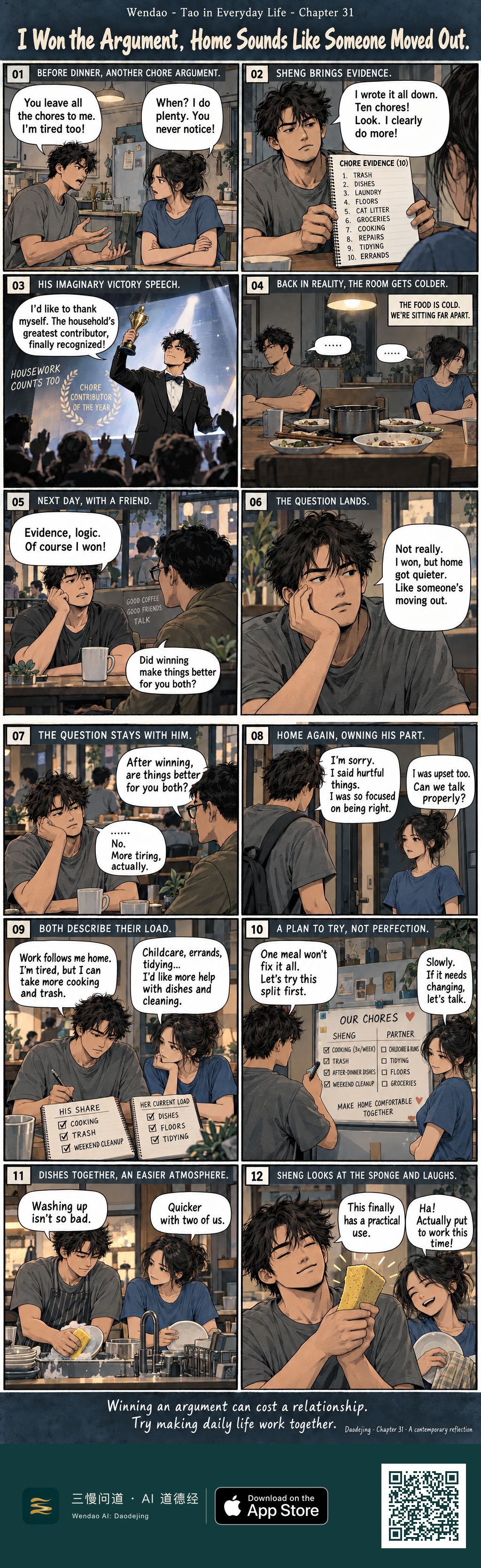
The opening joke is wonderfully concrete: Sheng is not merely arguing about chores; he is presenting a case. At the kitchen table, his partner sits with folded arms as they argue over whose work goes unnoticed, and in the next panel he produces a spiral notebook headed "CHORE EVIDENCE (10)." Trash, dishes, laundry, floors, cat litter, groceries, cooking, repairs, tidying, errands—the ordinary mess of shared life has suddenly become courtroom material. Both people look tired, but instead of comparing what each needs, they begin comparing who has suffered more. The comedy comes from watching a home conversation acquire the seriousness of a project review.
Panel 03 pushes Sheng's sense of victory into full fantasy. He appears in a tuxedo under spotlights, trophy raised above his head, while "CHORE CONTRIBUTOR OF THE YEAR" and "HOUSEWORK COUNTS TOO" decorate an imaginary awards stage. The grandeur lasts exactly one panel. Back in the real dining room, the food is cold, the couple sit far apart, and both speech balloons contain only dots. That cut from applause to silence is the page's sharpest visual turn: the argument may have produced a winner, but the actual room has become less comfortable for both people.
The turning point comes through the friend in the olive shirt and glasses. At the café, with mugs on the table and "GOOD COFFEE / GOOD FRIENDS / TALK" behind them, he asks whether winning made things better for the couple. Sheng first admits that it did not; on the next page he answers even more plainly, "No. More tiring, actually." He then goes home and begins somewhere different: not with another list, but with an apology for the hurtful things he said and for being so focused on proving himself right. His partner does not instantly erase the conflict either; she says she was upset too and asks whether they can talk properly.
Their next conversation stays deliberately practical. Sheng says work follows him home and offers to take more cooking and trash; his partner names childcare, errands, tidying, dishes, and cleaning. Two notebooks make those loads visible without pretending they are mathematically equivalent, and the whiteboard in the following panel turns the conversation into a trial arrangement: cooking three times a week, trash, after-dinner dishes, weekend cleanup, childcare and runs, tidying, floors, groceries. Crucially, they describe it as something to try and adjust. The comic does not claim that a chore chart fixes a relationship; it shows two people replacing a contest with a workable next experiment.
The ending brings the earlier trophy joke back down to household scale. Sheng and his partner wash dishes side by side, the mood visibly lighter, and then Sheng holds up an ordinary yellow sponge with mock ceremony. "This finally has a practical use," he says, and she laughs that it is actually being put to work this time. The supplied line, "When victory is won, treat it with funeral rites," is not a literal description of the scene, but it offers a useful lens for it: some victories deserve restraint rather than celebration, especially when defeating the other person leaves the shared life colder. Here, the comic's final image replaces symbolic triumph with a sponge, a sink, and two people doing the work together.
When victory is won, treat it with funeral rites.
Daodejing · Chapter 31
English rendering of the Silk B base reading excerpt
In the next argument, try setting aside "who is more right" for a moment. Each person can name one specific thing that has been exhausting lately, then choose one small responsibility that could be redistributed or tested differently. The goal does not have to be instant harmony; it can simply be making the next ordinary evening a little easier to share.