Read the comic reflection
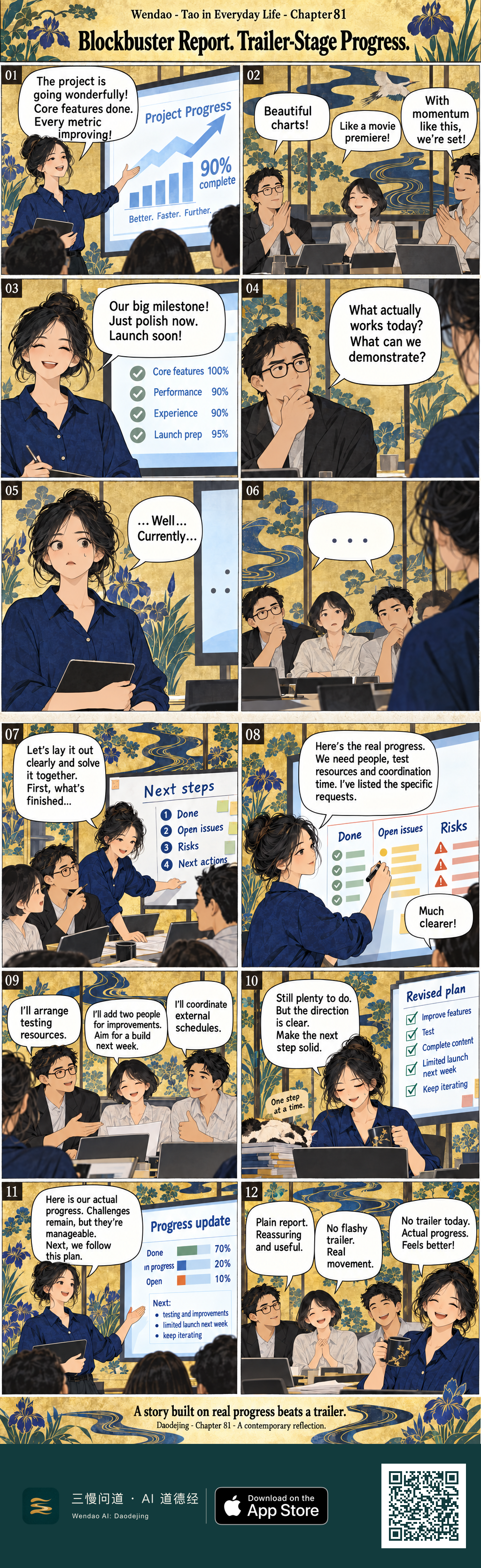
The opening joke is wonderfully concrete. The dark-haired presenter in an indigo blouse stands beside a rising chart labeled Project Progress, with 90% complete displayed in enormous type and the slogan Better. Faster. Further. Her colleagues applaud beneath the gold-leaf ground, indigo irises, blue streams and crane imagery. The glasses man praises the "Beautiful charts!", the short-haired woman says it is "Like a movie premiere!", and the man in white declares that with momentum like this, they are set. The meeting looks so spectacular that the polished presentation itself becomes part of the joke.
The turn comes when the glasses man stops admiring the presentation and asks two plain questions: "What actually works today? What can we demonstrate?" He is not attacking the presenter; he simply asks the chart to connect with something observable. Her confident rhythm immediately collapses into "...Well... Currently...", followed by a panel where the three colleagues sit beneath a speech bubble containing only "...". The shift from applause to silence is the comic hinge, and the empty pause says more than another impressive percentage could.
Instead of decorating the old story with another chart, the presenter changes the structure of the conversation. In panel 07 she introduces a simple board titled Next steps, divided into Done, Open issues, Risks and Next actions. In panel 08 she states the real needs directly: people, test resources and coordination time, with specific requests listed on the board. That clarity gives the team something concrete to respond to. The glasses man offers to arrange testing resources, the woman in cream will add two people for improvements and aim for a build next week, and the man in white will coordinate external schedules.
The second page keeps the humor gentle rather than triumphant. While the presenter works at her laptop on the revised plan, a black-and-white cat is asleep on a stack of documents beside the caption "One step at a time." The cat quietly performs the pacing advice nobody needs to say aloud. The revised board now lists Improve features, Test, Complete content, Limited launch next week and Keep iterating. At the next presentation, the screen is deliberately less glamorous: Progress update shows Done 70%, In progress 20% and Open 10%, followed by the next steps. The unfinished portion is no longer hidden; it has been given a visible place in the plan.
The ending completes the reversal without turning it into a lecture. Around the meeting table, the glasses man calls it a "Plain report. Reassuring and useful." The short-haired woman adds, "No flashy trailer. Real movement." Holding her mug, the presenter laughs and says, "No trailer today. Actual progress. Feels better!" The closing line, A story built on real progress beats a trailer, connects naturally with the supplied Daodejing sentence. Read as a contemporary reflection rather than a literal translation, the comic suggests that information does not need to look impressive to become useful: when the team can see what is done, what remains open and what support is needed, trust can turn into coordinated action.
Trustworthy words are not beautiful; beautiful words are not trustworthy.
Daodejing · Chapter 81
English rendering of the Silk B base reading excerpt
Before your next progress report, try writing four sections first: Done, Open issues, Risks and Next actions. If something is moving more slowly than expected, state the reason and the support you need as plainly as you can, then see whether the team can respond more easily to the next step.