Read the comic reflection
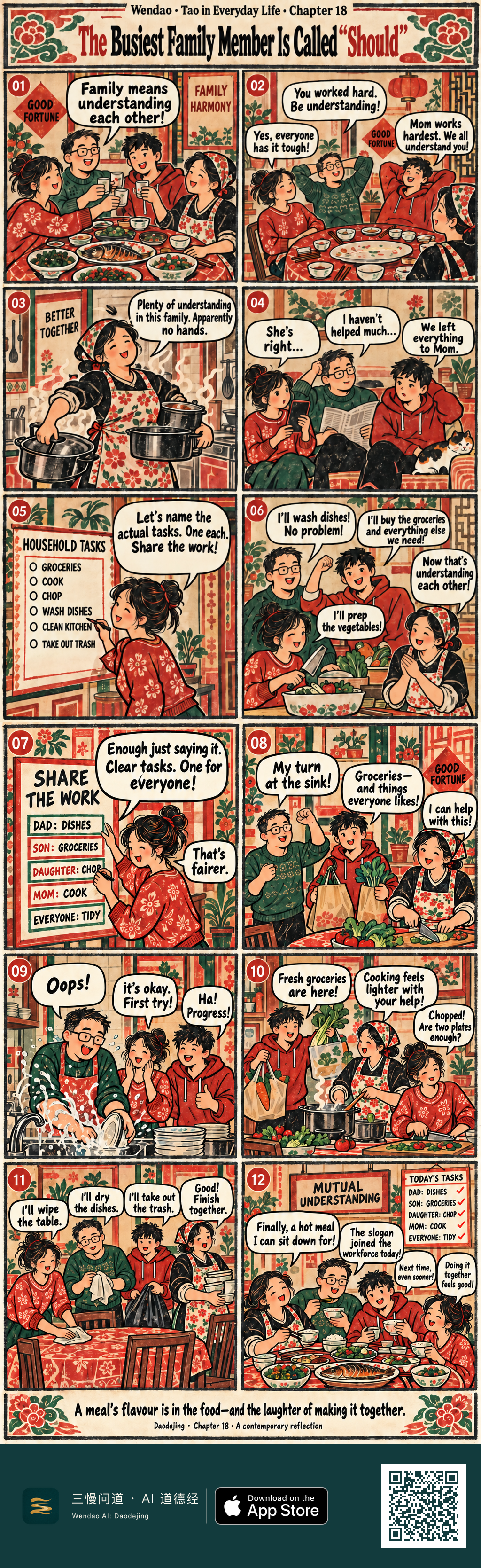
The opening joke comes from the gap between the family's words and the work visible around them. In Panel 01, all four family members raise cups over a crowded dinner table framed by red floral patterns, a GOOD FORTUNE diamond, and a FAMILY HARMONY sign while the father declares, "Family means understanding each other!" Panel 02 pushes the contrast further: the father relaxes with his hands behind his head, the son lounges beside him, and everyone warmly agrees that Mom works hardest. Their affection looks genuine, but the nearly cleared table quietly asks who will deal with everything afterward. The comic does not turn anyone into a villain; it lets the comfortable poses, used dishes, and enthusiastic speeches create the contradiction.
Panel 03 delivers the sharpest visual punch line. Mom stands in the kitchen surrounded by steam, holding multiple pieces of cookware while saying, "Plenty of understanding in this family. Apparently no hands." The BETTER TOGETHER sign beside her makes the joke even drier. In the next panel, the daughter looks at her phone, the father scratches his head over a newspaper, and the son looks sheepish while they admit, "She's right...", "I haven't helped much...", and "We left everything to Mom." The turning point is small but important: nobody argues about whether they care. They notice that expressing sympathy has been easier than noticing the actual labor sitting underneath dinner.
The daughter then changes the conversation from a virtue to a list of visible jobs. In Panel 05 she writes HOUSEHOLD TASKS on a board and names groceries, cooking, chopping, washing dishes, cleaning the kitchen, and taking out the trash. The lower page makes that structure even more concrete with SHARE THE WORK: Dad gets dishes, the son gets groceries, the daughter chops, Mom cooks, and everyone tidies. The joke continues through action rather than accusation. Dad's first turn at the sink sends water splashing everywhere, but the daughter answers, "It's okay. First try!" and the son laughs, "Ha! Progress!" Nobody grabs the chore back from him simply because he is inexperienced.
After that, the panels become a sequence of ordinary hands doing ordinary things. The son returns carrying grocery bags and announces, "Fresh groceries are here!" Mom works at a steaming pot and says cooking feels lighter with help, while the daughter keeps chopping at the counter. The cleanup panel spreads responsibility across the whole group at once: the daughter wipes the table, Dad dries dishes, the son holds the trash bag, and Mom carries stacked bowls while saying, "Good! Finish together." These props matter because the comic's change is measurable: bags arrive, vegetables are cut, dishes are dried, rubbish is removed, and the table is reset. Mutual understanding becomes something the viewer can actually see.
The final panel completes the joke without pretending that family life has become perfectly efficient. Mom is finally seated with everyone at a table of hot food and says, "Finally, a hot meal I can sit down for!" Behind them, MUTUAL UNDERSTANDING hangs beside a TODAY'S TASKS board with every role checked off. Dad's line, "The slogan joined the workforce today!", neatly connects the ending to the earlier wall slogans. Read beside Chapter 18, this works best as a contemporary association rather than a literal illustration of the ancient text: the supplied line notices how named family virtues become conspicuous when natural harmony has faltered. The comic explores a modest household version of that tension, suggesting that care becomes more visible when it enters specific shared actions instead of remaining only a word everyone agrees with.
When the six family relationships are not in harmony, there is filial devotion and parental affection.
Daodejing · Chapter 18
English rendering of the Silk B base reading excerpt
The next time someone says, "We should all be more understanding," try the daughter's move from the comic: write down the actual tasks that are waiting and let each person claim one small job. Leave room for an imperfect first attempt, like Dad's splashy dishwashing, and notice what changes when a shared value becomes a shared action.