Read the comic reflection
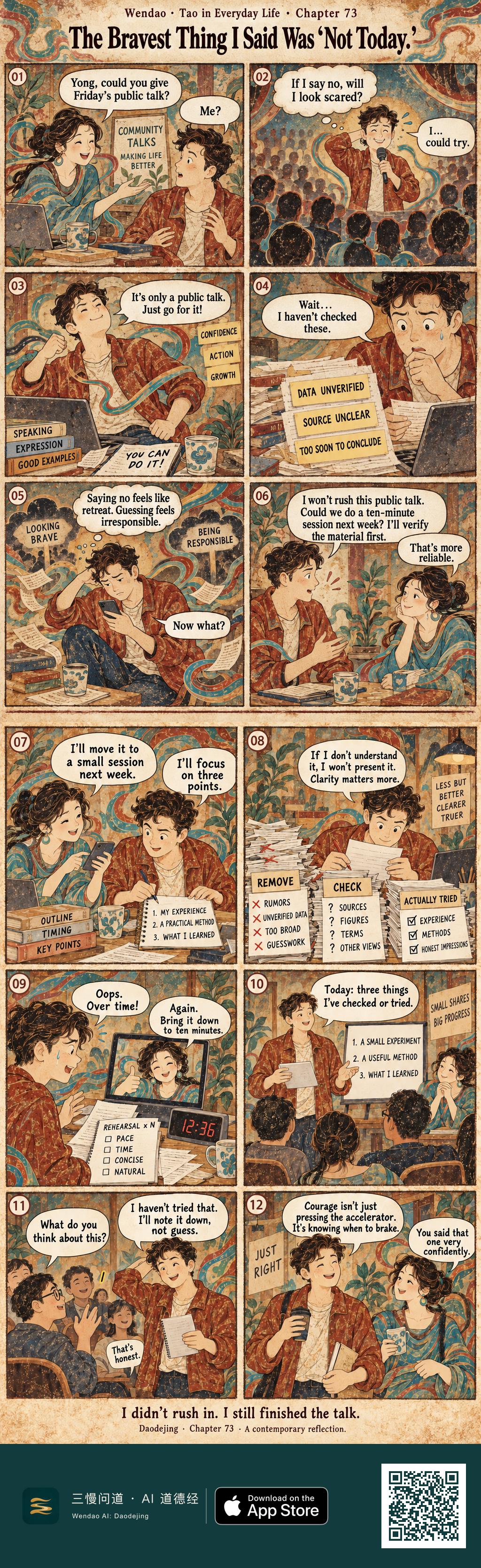
The opening joke happens before Yong has really done anything at all. His friend is still sitting beside him at the table when she asks whether he could give Friday’s public talk, and Yong simply answers, ‘Me?’ Yet the next panel has already blown the invitation into a packed auditorium: he is holding a microphone, sweating under the attention of a dark crowd, wondering whether saying no would make him look scared. Back at the desk, he swings in the opposite direction and pumps himself up with ‘It’s only a public talk. Just go for it!’ Beside him are books labeled SPEAKING, EXPRESSION, and GOOD EXAMPLES, notes reading CONFIDENCE, ACTION, and GROWTH, and a handwritten YOU CAN DO IT! Courage, at this point, looks a lot like pressing the accelerator harder.
The turning point is not that Yong suddenly becomes fearless. It is that the material on his desk starts making the problem more concrete. In panel 04, he leans over a messy stack marked DATA UNVERIFIED, SOURCE UNCLEAR, and TOO SOON TO CONCLUDE and says, ‘Wait… I haven’t checked these.’ The next panel makes his conflict visible as two labels floating around him: LOOKING BRAVE and BEING RESPONSIBLE. His thought is equally direct: saying no feels like retreat, but guessing feels irresponsible. Instead of disappearing or bluffing his way through, he returns to his friend and proposes a smaller plan: he will not rush the public talk, he will verify the material first, and they can do a ten-minute session the following week. Her reply, ‘That’s more reliable,’ shifts the standard from appearing bold to preparing something he can actually stand behind.
The second page shows what that brake pedal looks like in practice. His friend moves the event to a small session, while Yong writes three points in his notebook: MY EXPERIENCE, A PRACTICAL METHOD, and WHAT I LEARNED. Then the desk becomes a miniature editing room. One stack says REMOVE and crosses out RUMORS, UNVERIFIED DATA, TOO BROAD, and GUESSWORK. Another says CHECK and lists SOURCES, FIGURES, TERMS, and OTHER VIEWS. A third says ACTUALLY TRIED, with EXPERIENCE, METHODS, and HONEST IMPRESSIONS checked off. Even the wall joins the edit with LESS BUT BETTER, CLEARER, TRUER. The humour stays practical when his rehearsal timer reaches 12:36 and he groans, ‘Oops. Over time!’ His friend appears on the laptop and tells him to bring it down to ten minutes, while a checklist reminds him to work on PACE, TIME, CONCISE, and NATURAL. Slowing down has not stopped the work; it has finally given the work a usable shape.
When the real session arrives, it is much smaller than the giant stage Yong imagined. He stands in front of a modest group with a simple board and says, ‘Today: three things I’ve checked or tried.’ The board mirrors his narrowed preparation: A SMALL EXPERIMENT, A USEFUL METHOD, and WHAT I LEARNED. The most important test comes afterward, when an audience member asks what he thinks about something outside his experience. Yong does not manufacture an answer. Scratching the back of his head and holding his notes, he says, ‘I haven’t tried that. I’ll note it down, not guess.’ Another audience member answers, ‘That’s honest.’ The moment turns not knowing from an embarrassment to hide into a perfectly workable ending to a question.
The final panel relaxes into conversation. Yong and his friend are standing together with cups in hand, the sweating stage fantasy, towering paper stacks, and red digital timer now behind them. Yong sums up the experience with, ‘Courage isn’t just pressing the accelerator. It’s knowing when to brake.’ His friend immediately undercuts the grandness of the line with a warm joke: ‘You said that one very confidently.’ A small wall note reads JUST RIGHT, and the closing caption says, ‘I didn’t rush in. I still finished the talk.’ Read beside the Chapter 73 line about daring and not daring, the comic offers a contemporary reflection rather than a literal retelling: sometimes restraint is not the opposite of action. It can be the choice that makes careful, truthful action possible.
Bravery in daring leads to death; bravery in not daring leads to life.
Daodejing · Chapter 73
English rendering of the Silk B base reading excerpt
If you are about to agree to something simply because refusing feels timid, try Yong’s smaller questions first: What am I genuinely ready to speak or act on now? What still needs checking, practice, or clearer limits? You may not need to abandon the task. Shrinking the scope, moving the date, or separating what you know from what you are still checking can be a practical way to keep moving.