Read the comic reflection
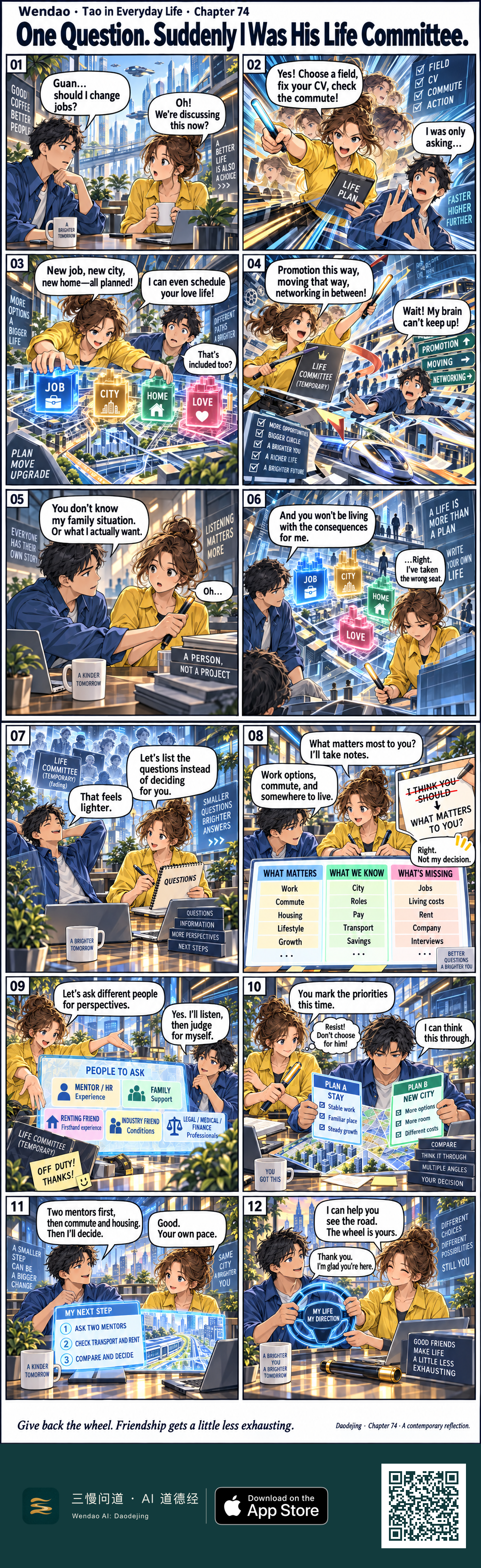
The opening joke is that Guan hears an ordinary question as if it were a full delegation of authority. Her blue-shirted friend asks, "Guan... should I change jobs?" and she instantly accelerates from coffee-table conversation into command mode: "Choose a field, fix your CV, check the commute!" Speed lines, repeated images of Guan, a LIFE PLAN tablet, and the glowing FIELD / CV / COMMUTE / ACTION checklist turn her enthusiasm into a miniature futuristic operations center. By panel 03, JOB, CITY, HOME, and LOVE have become luminous blocks on a holographic city, and her friend can only ask, "That's included too?"
The escalation peaks when Guan is effectively carrying a LIFE COMMITTEE (TEMPORARY) portfolio while pointing him toward PROMOTION, MOVING, and NETWORKING as trains and arrows rush through the city around them. His protest, "Wait! My brain can't keep up!" lands because the visual world really is moving faster than he is. The turning point arrives at the café table rather than in the spectacle: he tells her, "You don't know my family situation. Or what I actually want," and then adds that she will not be living with the consequences for him. Beside them, A PERSON, NOT A PROJECT and LISTENING MATTERS MORE quietly reinforce what Guan finally recognizes when she says, "...Right. I've taken the wrong seat."
The second page does not turn that realization into withdrawal. Guan stays beside him, but changes jobs from decision-maker to question-keeper. The oversized life plan becomes a notebook simply labeled QUESTIONS, and she says, "Let's list the questions instead of deciding for you." The clearest visual correction appears in panel 08, where "I THINK YOU SHOULD" is crossed out and replaced by "WHAT MATTERS TO YOU?" Their board then separates WHAT MATTERS, WHAT WE KNOW, and WHAT'S MISSING, giving work, commute, housing, lifestyle, growth, city, roles, pay, transport, savings, jobs, living costs, rent, company, and interviews their proper places instead of pretending one confident answer can cover everything.
From there, the comic makes supportive collaboration concrete. Guan suggests asking different people for perspectives, while her friend answers, "Yes. I'll listen, then judge for myself." The PEOPLE TO ASK board assigns different kinds of help to different sources: a mentor or HR for experience, family for support, a renting friend for firsthand experience, an industry friend for conditions, and legal, medical, or finance professionals for specialist questions. The warmest joke is tucked beside the board: the old LIFE COMMITTEE (TEMPORARY) has an OFF DUTY! THANKS! note stuck to it. Guan's enthusiasm is not treated as foolish; it has simply been reassigned from choosing for him to helping him gather useful viewpoints.
By the last three panels, the friend is visibly doing the choosing. Guan tells him, "You mark the priorities this time," while her thought bubble reminds herself, "Resist! Don't choose for him!" He compares STAY with NEW CITY, then writes his own next steps: ask two mentors, check transport and rent, compare, and decide. Finally the glowing steering wheel marked MY LIFE / MY DIRECTION is in his hands, while Guan's baton lies unused on the table. Her closing line, "I can help you see the road. The wheel is yours," and his reply, "Thank you. I'm glad you're here," give the ending its balance: companionship remains, control returns to its owner. The final caption, "Give back the wheel. Friendship gets a little less exhausting," offers a contemporary echo of the supplied Daodejing line—not as its only possible interpretation, but as a reminder that helping can cross a boundary when it becomes living someone else's life for them.
To kill in place of the one who presides over killing is to hew in place of the master carpenter.
Daodejing · Chapter 74
English rendering of the Silk B base reading excerpt
The next time someone asks for your opinion, try giving one fewer answer and asking two more questions: "What matters most to you?" and "What information are you still missing?" If the issue needs specialist knowledge, help identify the right person to ask, then leave the final comparison and decision with the person who will live with the consequences.