Read the comic reflection
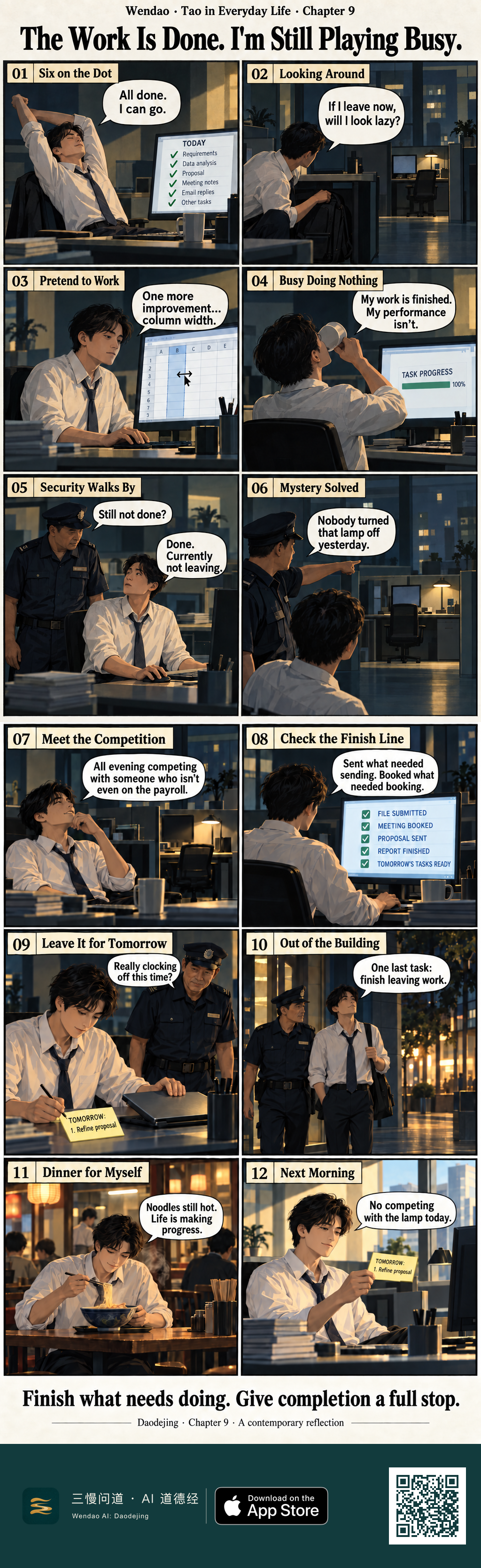
The opening joke is built from very concrete evidence that the day is already finished. In Panel 01, the man stretches back in his chair beside a monitor where every item under "TODAY" carries a green check: requirements, data analysis, proposal, meeting notes, email replies and other tasks. He even says, "All done. I can go." But in the next panel he notices a warmly lit desk across the otherwise dark office and immediately wonders, "If I leave now, will I look lazy?" The contrast between a completed checklist and his sudden hesitation turns an ordinary office light into a silent competitor.
The comic then makes his performance of busyness deliberately small and ridiculous rather than dramatic. He reopens a spreadsheet, but the visible task is merely adjusting a column width. Another screen already reads "TASK PROGRESS 100%" while he sits drinking from his mug and admits, "My work is finished. My performance isn't." When the older uniformed security guard asks, "Still not done?" the man gives the funniest possible accurate answer: "Done. Currently not leaving." Nothing new needs doing; staying itself has become the activity.
The turning point arrives through the guard rather than through a lecture. In Panel 06, he points toward the distant illuminated workstation and says, "Nobody turned that lamp off yesterday." The desk is visibly empty: there is a chair, monitor and glowing lamp, but no heroic coworker working into the night. Panel 07 lets the man recognize the absurdity himself with, "All evening competing with someone who isn't even on the payroll." The joke stays gentle because the rival was never another person at all; it was a lamp plus the story he built around it.
The lower page shows him creating an actual finish line instead of simply escaping. He checks a monitor listing "FILE SUBMITTED," "MEETING BOOKED," "PROPOSAL SENT," "REPORT FINISHED" and "TOMORROW'S TASKS READY." He then writes a yellow note reading "TOMORROW: 1. Refine proposal" while the guard asks whether he is really clocking off this time. Outside the building, shoulder bag on and tie still loose, he jokes, "One last task: finish leaving work." The cold blue office gives way to the warm restaurant, where a steaming bowl of noodles becomes the evening's real unfinished business.
The ending makes the change visible through rhythm rather than a grand transformation. At dinner he lifts hot noodles and says, "Noodles still hot. Life is making progress." Then Panel 12 is unmistakably a new morning: daylight fills the office as he calmly holds the same yellow note, still visibly marked "TOMORROW: 1. Refine proposal," and says, "No competing with the lamp today." The supplied line from Chapter 9 can be connected to this as a contemporary reflection rather than a literal translation of the comic: once something has been completed, stepping away can also belong to the completion. The footer makes that idea concrete: "Finish what needs doing. Give completion a full stop."
When the work is accomplished, withdraw; this is the Way of Heaven.
Daodejing · Chapter 9
English rendering of the Silk B base reading excerpt
When your work is finished but you still feel pulled to look busy, try the sequence shown here: verify what has actually been delivered, write down the first task for tomorrow, and give today's work a visible ending. The point is not to force yourself to leave at a particular minute, but to notice whether anything still needs doing or whether only the performance of busyness remains.