Read the comic reflection
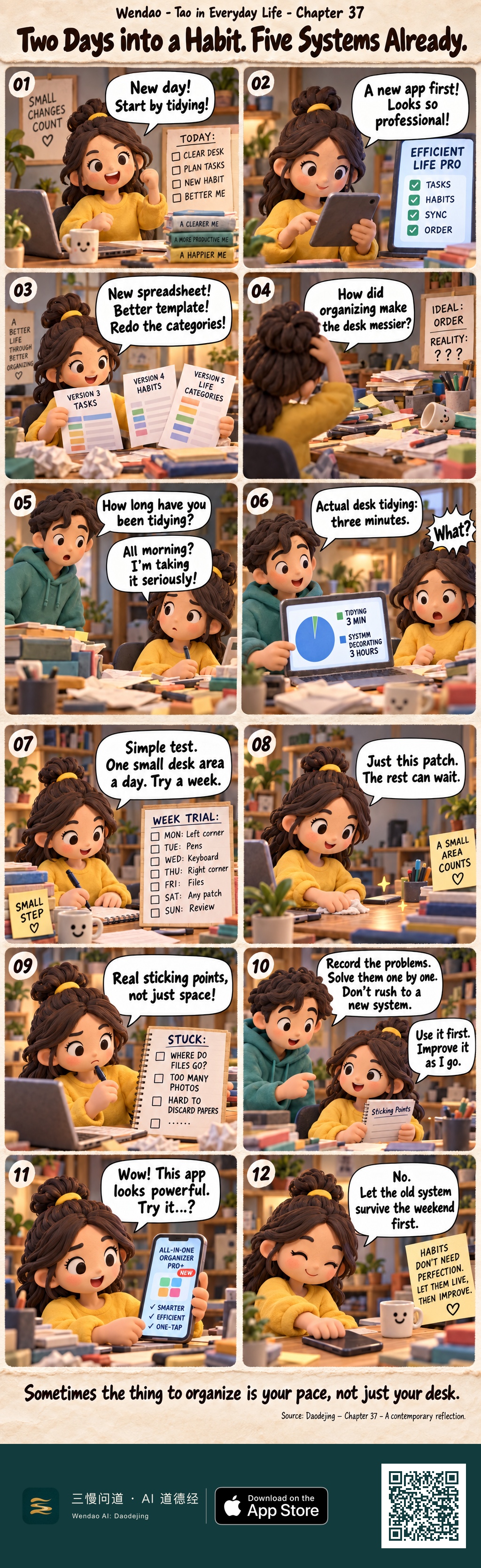
The opening joke is visible before the desk has changed much. The woman in the mustard sweater raises a determined fist beside her smiling mug, laptop, books, and a checklist headed "TODAY," where "CLEAR DESK" sits alongside planning tasks, building a new habit, and becoming a "BETTER ME." A wall note says "SMALL CHANGES COUNT," yet the next panel already has her studying "EFFICIENT LIFE PRO" on a screen. The contrast is affectionate: a modest cleaning task has immediately acquired the equipment and ambition of a full productivity project.
The system then becomes more elaborate than the thing it was meant to support. In panel 03 she cheerfully holds three sheets labeled "VERSION 3 TASKS," "VERSION 4 HABITS," and "VERSION 5 LIFE CATEGORIES," while papers, pens, notebooks, and crumpled scraps spread across the desk. Panel 04 turns that escalation into the clearest visual punchline: she grips her head in front of the increasingly cluttered workspace while a sign reads "IDEAL: ORDER / REALITY: ???" Her problem is not a lack of effort; the effort has simply migrated from moving objects to redesigning the method.
Her friend in the teal hoodie creates the turning point by asking a plain question: "How long have you been tidying?" She answers, "All morning? I'm taking it seriously!" The next panel replaces that feeling of busyness with a concrete chart. The laptop shows a tiny slice labeled "TIDYING 3 MIN" beside the dominant "SYSTEM DECORATING 3 HOURS," and her startled "What?" lands the joke without humiliating her. The friend is not presented as the clever winner; he simply gives the pair a clearer picture of where the morning actually went.
The lower page changes the scale of the experiment instead of introducing another grand solution. She writes a "WEEK TRIAL" that assigns one small area to each day—left corner, pens, keyboard, right corner, files, any patch, then review—and the nearby note says "SMALL STEP." In the next panel she wipes one visible patch of tabletop and says, "Just this patch. The rest can wait," while another note answers, "A SMALL AREA COUNTS." She then records the actual sticking points in a notebook: where files should go, too many photos, and papers that are hard to discard. The visible shift is from designing an ideal system to observing specific friction.
The ending tests whether that smaller rhythm can survive temptation. Her friend advises, "Record the problems. Solve them one by one. Don't rush to a new system," and she replies, "Use it first. Improve it as I go." Almost immediately, a phone offers "ALL-IN-ONE ORGANIZER PRO+" with promises of being "SMARTER," "EFFICIENT," and "ONE-TAP." She is visibly tempted, but the last panel shows the phone placed face-down beside the smiling mug as she says, "No. Let the old system survive the weekend first." The sticky note—"HABITS DON'T NEED PERFECTION. LET THEM LIVE, THEN IMPROVE."—and the closing line about organizing one's pace make a contemporary connection with the supplied passage: instead of repeatedly naming, packaging, and remaking everything, the comic imagines what it might look like to hold to a simple practice long enough for change to develop through use. That is a modern reflection, not a claim that the ancient text has only this meaning.
The Way is forever nameless. If lords and kings could hold to it, the myriad things would transform of themselves.
Daodejing · Chapter 37
English rendering of the Silk B base reading excerpt
If you are starting a new habit, give your current method a short fixed trial before replacing it. Do one very small piece today and write down the specific thing that actually slows you down. After several real obstacles have appeared, decide whether the tool needs changing—or whether the existing method simply needs another day of use.