Read the comic reflection
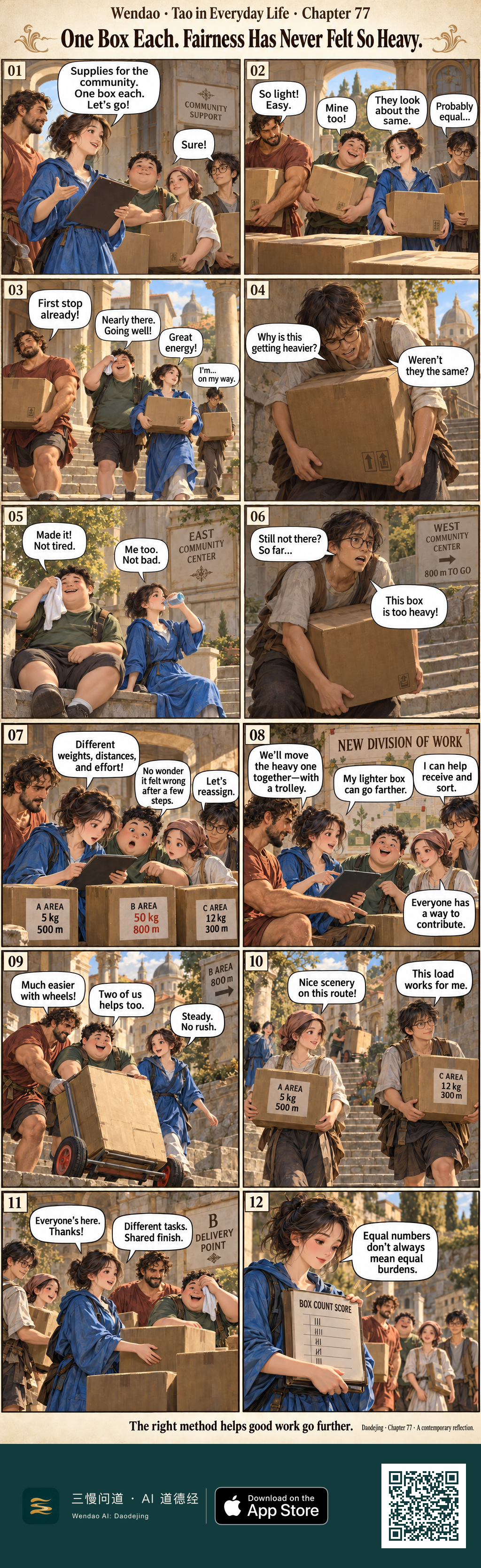
The opening joke is hidden in the phrase "about the same." In the first page, the blue-clad organizer cheerfully sends the adult volunteers out with community supplies, one box each, beside a COMMUNITY SUPPORT sign. The muscular man in rust and the stocky man in green immediately find their boxes light, while the organizer observes that they look similar and the slim volunteer with glasses adds, "Probably equal..." That confidence lasts only until the stone steps begin separating appearance from experience: the strong man reaches the first stop quickly, the others keep a lively pace, and the glasses-wearing volunteer trails behind with an increasingly unhappy box.
The comic lets the mismatch become physical before explaining it. In panels 04 and 06, the glasses-wearing volunteer is bent over, sweating and gripping the carton while asking, "Why is this getting heavier?" and later, "Still not there? So far..." Meanwhile, the stocky volunteer and the organizer are already resting at the EAST COMMUNITY CENTER, saying they made it without much trouble. The WEST COMMUNITY CENTER sign beside the struggling volunteer adds the punch line without needing anyone to tease him: he still has 800 m to go, and his box really is too heavy.
The turning point comes when the group finally opens up the information that the first page had hidden. In panel 07, three cartons are labeled A AREA: 5 kg and 500 m, B AREA: 50 kg and 800 m, and C AREA: 12 kg and 300 m. The organizer states the obvious only after everyone can see it: "Different weights, distances, and effort!" The stocky volunteer realizes why the earlier arrangement felt wrong, and the glasses-wearing volunteer proposes, "Let's reassign." What looked like a question of who was stronger or faster becomes a practical question about how the work itself is structured.
The new division of work is concrete rather than heroic. Under the heading NEW DIVISION OF WORK, the muscular man proposes moving the heavy box together with a trolley, the headscarf-wearing woman takes a lighter box farther, and the glasses-wearing volunteer offers to receive and sort. The next panels make the change gently funny: the 50 kg load becomes "Much easier with wheels!" and "Two of us helps too," while the organizer reminds them, "Steady. No rush." On another route, the headscarf-wearing woman enjoys the scenery with the 5 kg box, and the glasses-wearing volunteer finally carries the 12 kg load comfortably enough to say, "This load works for me."
At the B DELIVERY POINT, the ending does not pretend that everyone performed the same task. Instead, the group arrives together, smiling, with the lines "Everyone's here. Thanks!" and "Different tasks. Shared finish." In the final panel, the organizer holds a BOX COUNT SCORE board and concludes, "Equal numbers don't always mean equal burdens." That image creates a contemporary echo of the supplied passage: rather than forcing every person into the same visible quota, the group notices where the load is excessive and where support can be added. The closing line, "The right method helps good work go further," keeps the emphasis on adjustment and cooperation rather than on declaring one single interpretation of the ancient text.
What is high is brought down; what is low is raised. What has excess is reduced; what lacks is supplemented.
Daodejing · Chapter 77
English rendering of the Silk B base reading excerpt
If a shared task today feels strangely exhausting even though everyone received the same number of items, stop counting portions for a moment. Compare weight, distance, time, tools, and what each person can reasonably take on, then adjust the division of work together.