Read the comic reflection
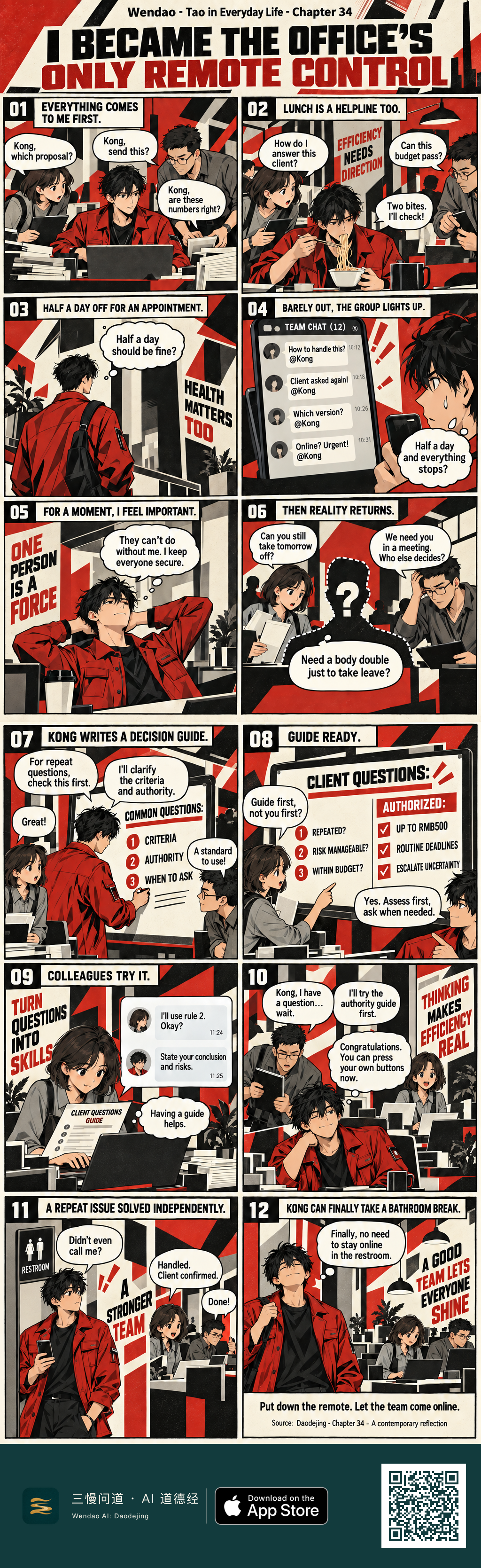
The opening joke is wonderfully literal. Kong, in his bright red jacket, sits at his laptop while the gray-blazer woman and the glasses-wearing man crowd in from both sides with questions: "Kong, which proposal?", "Kong, send this?", and "Kong, are these numbers right?" The composition makes him look less like a colleague than the single control panel for the whole office. Panel 02 pushes the gag into lunch: Kong already has noodles hanging from his chopsticks, yet one coworker needs help answering a client and the other wants a budget checked. His reply, "Two bites. I'll check!", is funny because even a mouthful of noodles has become a tiny scheduling window. The wall slogan "EFFICIENCY NEEDS DIRECTION" adds an ironic backdrop to an office where all direction currently comes from one person.
The first real turn comes when Kong takes half a day off for an appointment. In panel 03 he walks away with a backpack under the wall message "HEALTH MATTERS TOO", thinking, "Half a day should be fine?" Panel 04 immediately answers him: his phone fills with a TEAM CHAT (12) stream asking how to handle something, reporting that a client asked again, requesting a version choice, and finally calling "Online? Urgent! @Kong." The visual joke is that Kong has barely left before the office seems to lose its operating system. His thought, "Half a day and everything stops?", mixes alarm with a strange sense of importance. That feeling peaks in panel 05, where he leans back beneath "ONE PERSON IS A FORCE" and thinks, "They can't do without me. I keep everyone secure."
Panel 06 punctures that flattering interpretation. The woman asks whether Kong can still take tomorrow off, while the glasses-wearing man says, "We need you in a meeting. Who else decides?" Between them stands a black silhouette marked with a question mark, turning the missing backup into a visual character of its own. Kong's thought — "Need a body double just to take leave?" — makes the cost of being indispensable concrete. The lower page does not solve this by having Kong simply refuse to help. Instead, panel 07 shows him at a board writing a shared decision guide with three headings: "CRITERIA", "AUTHORITY", and "WHEN TO ASK." His coworkers react positively, and the joke quietly changes direction: the office's human remote control starts documenting what the buttons actually do.
The guide becomes more specific in panel 08. Under "CLIENT QUESTIONS", the team is asked whether an issue is repeated, whether the risk is manageable, and whether it is within budget; the authorized side lists "UP TO RMB500", "ROUTINE DEADLINES", and "ESCALATE UNCERTAINTY." The woman captures the new logic with, "Guide first, not you first?" and Kong answers, "Yes. Assess first, ask when needed." Panel 09 then shows the method being tested rather than merely admired. The woman messages, "I'll use rule 2. Okay?" and Kong replies, "State your conclusion and risks." Her thought, "Having a guide helps," matters because she is no longer sending an empty problem upward. The poster "TURN QUESTIONS INTO SKILLS" makes the change visible: judgment is becoming something the team can practice, not something stored only inside Kong.
The warmest punchline arrives when the habit finally starts changing on its own. In panel 10 the glasses-wearing man begins, "Kong, I have a question... wait," then stops himself and says, "I'll try the authority guide first." Kong, relaxed at his desk, thinks, "Congratulations. You can press your own buttons now." Soon after, panel 11 places him beside a RESTROOM sign, staring at his phone in surprise: "Didn't even call me?" Behind him, the woman reports, "Handled. Client confirmed," and the man adds, "Done!" By panel 12 Kong can finally walk away thinking, "Finally, no need to stay online in the restroom." The closing line, "Put down the remote. Let the team come online.", fits the supplied Chapter 34 excerpt as a contemporary echo: work can move through someone without requiring that person to remain the permanent master of every decision.
All things return to it, yet it does not act as their master; it may be called great.
Daodejing · Chapter 34
English rendering of the Silk B base reading excerpt
Choose one small question that repeatedly comes back to you. Write down the criteria for deciding it, what others may handle without approval, and the point where uncertainty really should be escalated. Let someone try the guide once, then improve the guide from what happens instead of immediately taking the decision back.