Read the comic reflection
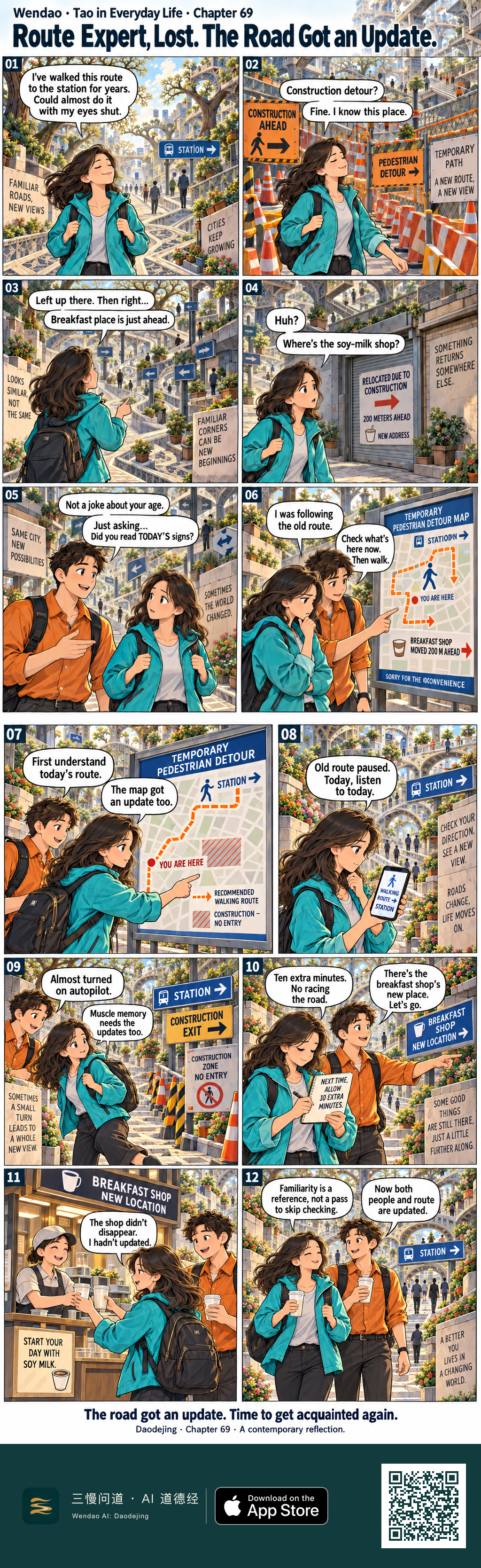
The opening joke is built around being "too familiar." The woman in the teal jacket walks confidently through a spectacular branching city of stairs, arches, terraces, trees, and repeating pathways, telling herself that she has taken the route to the station for years and could almost do it with her eyes shut. But the page is already contradicting her confidence: construction barriers, pedestrian-detour signs, temporary paths, and arrows fill the scenery. In panel 02 she simply answers the detour with, "Fine. I know this place." The more certain she sounds, the more the recursive city resembles a map that has quietly rewritten itself around her.
The first real interruption is not an argument but a closed shutter. After confidently narrating the remembered sequence — left, then right, with the breakfast place just ahead — she arrives in panel 04 and asks, "Where's the soy-milk shop?" A notice on the shutter says it has been relocated because of construction and gives a new address 200 meters ahead. Her orange-shirted friend then arrives with the warmest joke on the page: "Not a joke about your age. Just asking... Did you read TODAY'S signs?" That question shifts the problem away from whether her memory is good or bad. Her memory may be perfectly accurate about yesterday's city; the important fact is that today's city has changed.
The second page turns that realization into visible actions. In panel 07 the woman points directly at the temporary pedestrian-detour map as the conversation notes, "The map got an update too." The board clearly marks "YOU ARE HERE," the station, a recommended walking route, and a construction area marked "NO ENTRY." In panel 08 she stops rather than walking blindly and checks a phone showing a walking route to the station, saying, "Old route paused. Today, listen to today." At the next junction she still nearly turns by habit, which prompts another gentle punch line: "Muscle memory needs the updates too." The construction-exit and no-entry signs make the joke concrete rather than abstract.
Instead of trying to prove that she still knows the neighborhood, the woman changes how she moves through it. In panel 10 she writes "NEXT TIME, ALLOW 10 EXTRA MINUTES" in a small notebook and says, "Ten extra minutes. No racing the road." Her friend immediately points toward a sign for the breakfast shop's new location. Panel 11 pays off the running breakfast thread: they reach the counter, the woman receives a cup of soy milk, and she laughs, "The shop didn't disappear. I hadn't updated." The side sign, "START YOUR DAY WITH SOY MILK," gives the recovery a pleasantly ordinary ending rather than turning it into a grand revelation.
The final panel keeps that lightness. Both travelers are walking again with cups in hand, backpacks still on, and a station sign visible farther along the branching path. The woman sums up what happened with, "Familiarity is a reference, not a pass to skip checking," and her friend answers, "Now both people and route are updated." Read beside Chapter 69, the comic becomes a contemporary reflection on the risk of letting confidence remove the habit of checking what is actually present. It does not reject experience: the familiar route still gives the woman useful orientation. It simply leaves room for new signs, changed streets, relocated landmarks, and a few extra minutes when the world no longer matches the version stored in memory.
There is no greater calamity than having no counterpart; having no counterpart comes close to losing my treasures.
Daodejing · Chapter 69
English rendering of the Silk B base reading excerpt
The next time you take a route you know extremely well, check the day's signs, construction notices, or walking directions before relying entirely on memory, and leave yourself a few extra minutes. The point is not to distrust what you know, but to let today's information participate in the decision too.