Read the comic reflection
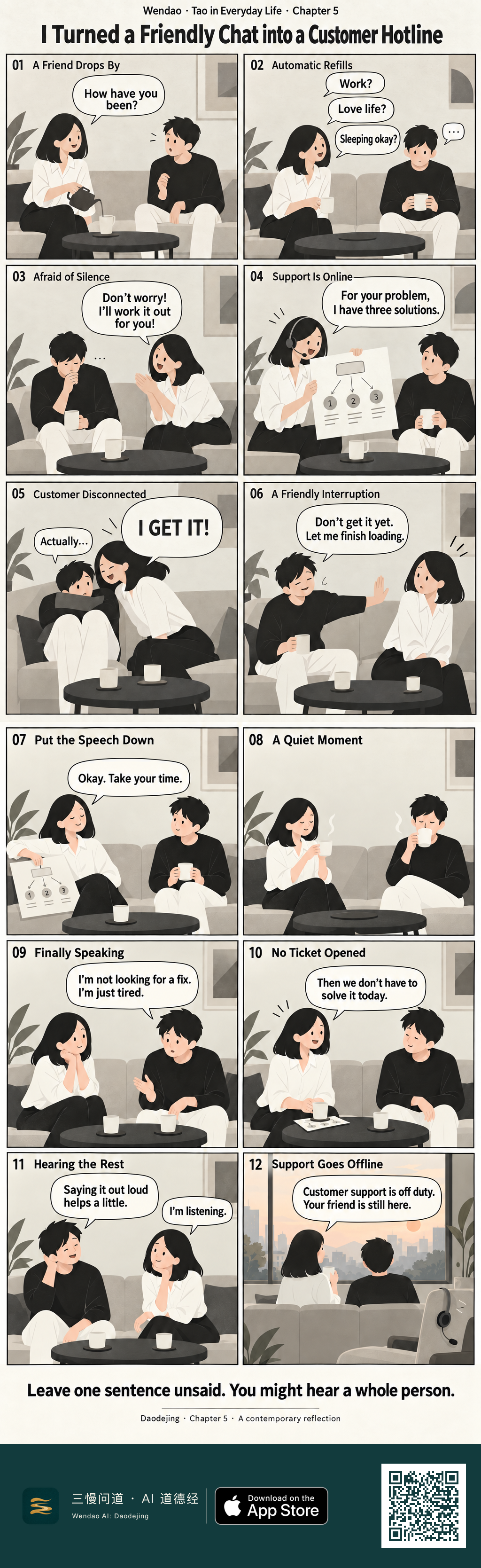
The opening joke is built from escalation. The woman begins warmly with "How have you been?" while pouring tea, but the next panel stacks three bubbles above the man: "Work?", "Love life?", and "Sleeping okay?" His tiny "..." makes the imbalance visible. By panel 3 she is already promising, "Don't worry! I'll work it out for you!" before he has explained anything. The care itself is not mocked; the comedy comes from how quickly a casual visit starts behaving like an intake form.
Panel 4 makes that metaphor literal. The woman appears with a headset and holds up a flowchart offering three numbered routes while announcing, "For your problem, I have three solutions." The man is still simply holding his mug. In panel 5 he tries to begin with "Actually...", only to be overtaken by the enormous "I GET IT!" beside him. The visual gag is precise: the more confidently the conversation gets solved, the less room he has to finish a sentence.
The turning point arrives when the man raises his hand and says, "Don't get it yet. Let me finish loading." The computer-language joke keeps the correction light, but the boundary is clear. On the second page, the woman's response is not another improved technique or a fourth solution. She lowers the chart and says, "Okay. Take your time." Then panel 8 contains no dialogue at all: both characters simply sit on the sofa and drink steaming tea. The comic lets the pause itself become part of the action.
Only after that quiet panel does the man explain, "I'm not looking for a fix. I'm just tired." The woman answers, "Then we don't have to solve it today." A small prop change carries the idea further: the once-important flowchart is now lying flat on the coffee table underneath her cup. In panel 11, he says that saying it aloud helps a little, while she answers only, "I'm listening." The story does not turn her into a distant observer; it shows her staying engaged without turning every sentence into a task.
The supplied line from Chapter 5 offers a useful image for reading this ending without making the comic a literal translation of the text. Something can remain open without being useless, and movement can allow more to emerge. Here, conversational space works in that spirit: once every silence is no longer filled with questions, diagnosis, or advice, the man's actual words have somewhere to appear. The final panel makes the joke concrete again: the headset hangs on an empty chair beside the sunset window while the two friends sit together facing the view. "Customer support is off duty. Your friend is still here." The closing line, "Leave one sentence unsaid. You might hear a whole person.", turns the abandoned hotline into a quieter form of companionship.
Empty, yet it is not exhausted; set in motion, it brings forth ever more.
Daodejing · Chapter 5
English rendering of the Silk B base reading excerpt
The next time someone brings up a difficulty, you might first ask, "Would you like me to listen, or would you like us to think through options together?" If they pause, try leaving that pause open for a moment before adding your own experience. The point is not to say less at all costs, but to give their next sentence room to arrive.