Read the comic reflection
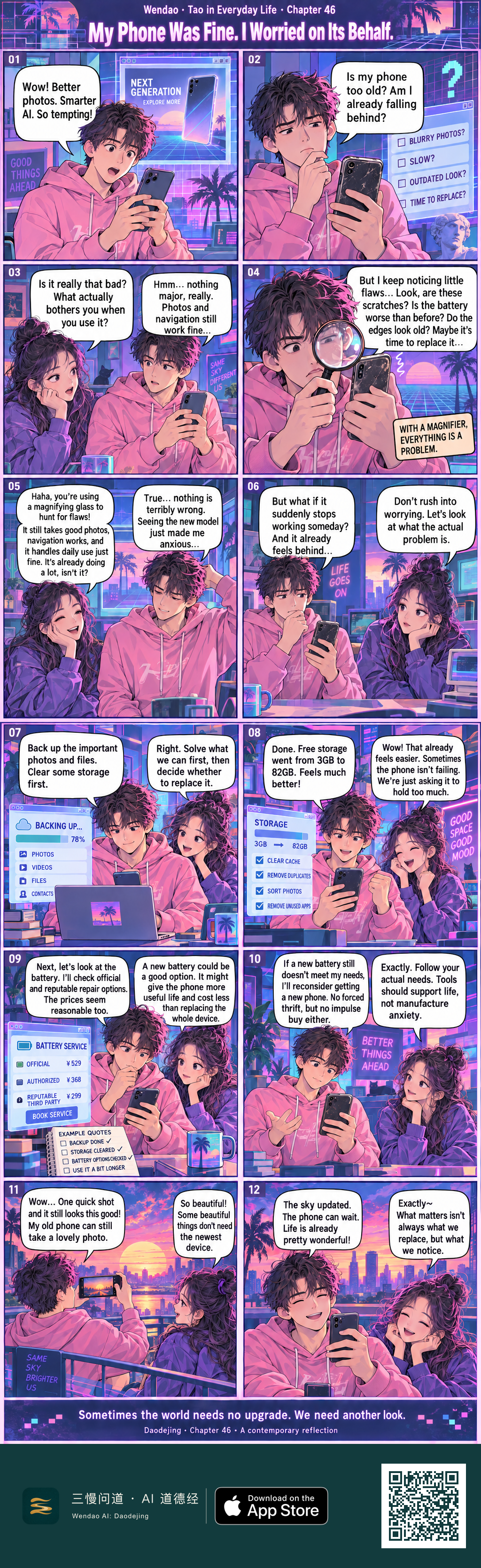
The opening joke is that the phone has done almost nothing wrong before it is put on trial. In the neon-purple first panel, the man in the pink hoodie lights up at an ad promising "Better photos" and "Smarter AI," then immediately turns suspicious of the scratched phone already in his hand. A floating checklist escalates the mood with "BLURRY PHOTOS?," "SLOW?," "OUTDATED LOOK?," and "TIME TO REPLACE?" Yet when the woman in purple asks what actually bothers him during use, he admits that photos and navigation still work fine. The visual punch line peaks when he literally raises a magnifying glass to inspect scratches, battery worries, and old-looking edges while a caption declares, "WITH A MAGNIFIER, EVERYTHING IS A PROBLEM."
The woman does not try to win an abstract argument about whether buying a new phone is good or bad. Instead, she keeps bringing the conversation back to observable problems. After teasing him for "using a magnifying glass to hunt for flaws," she points out that the phone still takes photos, navigates, and handles daily use. Panel 06 ends with her asking them to look at "what the actual problem is," and the lower page turns that sentence into action: they sit together at a laptop, back up photos, videos, files, and contacts, and watch the backup indicator reach 78 percent. The comedy shifts from inspecting cosmetic defects to doing very ordinary maintenance.
That maintenance produces the first concrete surprise. In panel 08, the storage display changes from 3GB free to 82GB free after they clear cache, remove duplicates, sort photos, and remove unused apps. The man looks delighted rather than worried, while the woman laughs beside him and says that sometimes the phone is not failing; they are simply asking it to hold too much. The comic does not pretend that storage cleanup magically solves every hardware concern. Instead, it shows why separating one specific problem from the general feeling of "my phone is old" can change the decision from a vague replacement impulse into something testable.
Battery life receives the same practical treatment rather than a command to keep suffering with the old device. Panel 09 shows a "BATTERY SERVICE" interface with fictional illustrative quotes for official, authorized, and reputable third-party options, plus a notebook labeled "EXAMPLE QUOTES" and checked steps such as backup completed, storage cleared, and battery options checked. The man says he will consider a battery replacement first, and the woman notes that it could extend the phone's useful life for less than replacing the whole device. In the next panel they explicitly leave the door open to buying a new phone if a fresh battery still does not meet his needs: "No forced thrift, but no impulse buy either."
The final two panels move attention away from settings screens and back toward the world outside them. At a glowing orange-and-pink sunset, the man raises the same old phone that was previously examined through a magnifying glass and discovers that one quick photo still looks lovely. The woman answers that some beautiful things do not require the newest device. In the last panel both characters are smiling, the man jokes that "The sky updated. The phone can wait," and the closing line says, "Sometimes the world needs no upgrade. We need another look." Read alongside the supplied excerpt, this works as a contemporary reflection on sufficiency rather than a literal translation: the comic does not say that nothing should ever be replaced, only that noticing what is already sufficient can create more room for a deliberate choice.
Therefore, when you know the sufficiency of enough, you will always have enough.
Daodejing · Chapter 46
English rendering of the Silk B base reading excerpt
The next time you suddenly want to replace something that still works, try writing down three specific things that are actually bothering you. Pick one that can be checked, cleaned up, repaired, or tested now. If those concrete steps still leave the item unable to meet your needs, replacing it can then be a considered choice rather than a reaction to the feeling of being behind.