Read the comic reflection
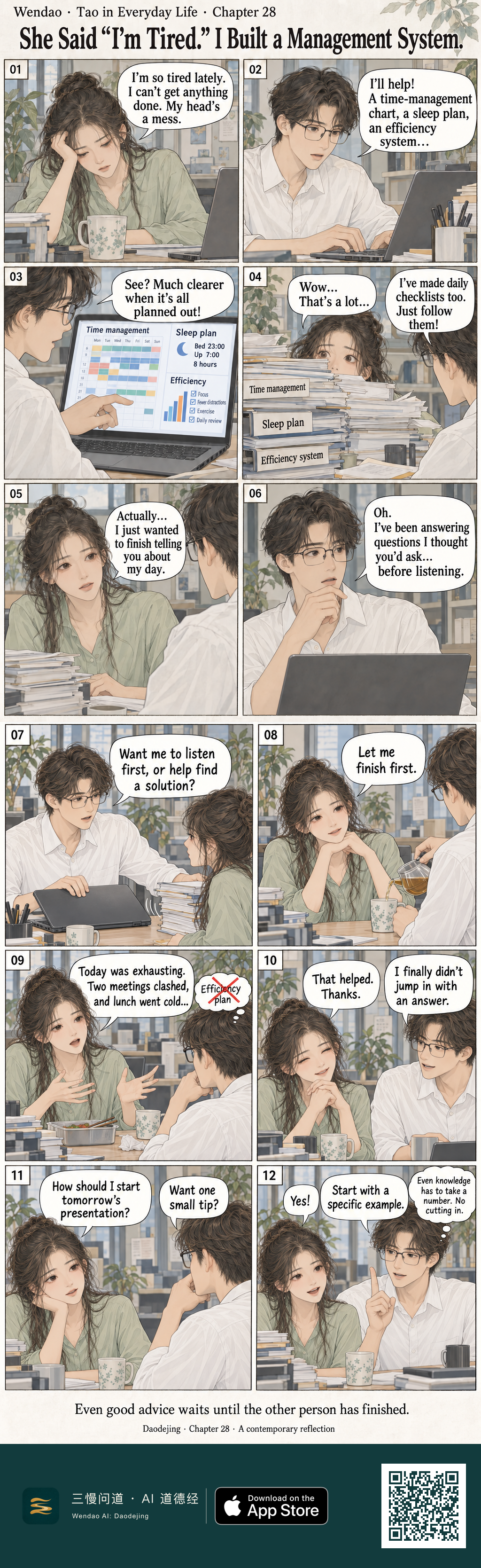
The opening joke is visible before the advice even arrives. The woman in the loose green blouse is slumped at the desk with one hand against her head, a floral mug and laptop beside her, saying she is tired, cannot get anything done and feels mentally scattered. Across from her, the man in glasses and a white shirt is already typing. She has offered a description of how her day feels; he reacts as though she has handed him a project brief. That mismatch gives the first page its gentle comic tension.
His response then becomes wonderfully excessive. The laptop fills with a color-coded time-management chart, a sleep plan specifying Bed 23:00, Up 7:00 and 8 hours, plus an efficiency section listing Focus, Fewer distractions, Exercise and Daily review. In the next panel, the screen has effectively escaped into the room: huge stacks of binders labeled Time management, Sleep plan and Efficiency system rise across the desk until only the woman's eyes are visible behind them. The more complete the system becomes, the less space she seems to have.
The turning point comes when the woman finally says, "Actually... I just wanted to finish telling you about my day." The man stops and recognizes the mistake himself: he has been answering questions he imagined before listening to what she was actually saying. On the lower page, the change is concrete rather than abstract. He closes the laptop and asks, "Want me to listen first, or help find a solution?" She answers, "Let me finish first." In the next panel he pours tea into her floral mug instead of opening another spreadsheet.
Panel 09 shows what listening looks like in this story. The woman gestures as she explains that two meetings clashed and her lunch went cold; the lunch container is still sitting on the desk as a small, specific proof of the exhausting day she meant to describe. The man listens with his chin resting on his hand. A thought bubble marked "Efficiency plan" appears beside him, but a bold red X crosses it out. The joke is affectionate: the urge to optimize has not vanished, but this time he notices it and lets it pass without interrupting.
The ending shows that the story is not against advice; it changes the timing and permission around it. After the woman says the conversation helped, she later asks how to begin tomorrow's presentation. The man does not unload another system. He first asks, "Want one small tip?" Only after she says yes does he suggest, "Start with a specific example." His final thought—"Even knowledge has to take a number. No cutting in."—turns the lesson into a queueing joke. Read alongside the chapter line about knowing the masculine and keeping to the feminine, the comic can be seen as a contemporary reflection on holding capability without always pushing it forward: strength can include making room, receiving what another person is saying, and waiting until help is actually invited. That is one possible connection, not the only meaning of the ancient text.
Know the masculine, keep to the feminine, and become the valley of the world.
Daodejing · Chapter 28
English rendering of the Silk B base reading excerpt
The next time someone says, "I'm tired," you might try one small question before offering a fix: "Do you want me to listen first, or help think through a solution?" If they choose listening, consider closing the laptop, setting the advice aside and letting them finish before deciding what comes next.