Read the comic reflection
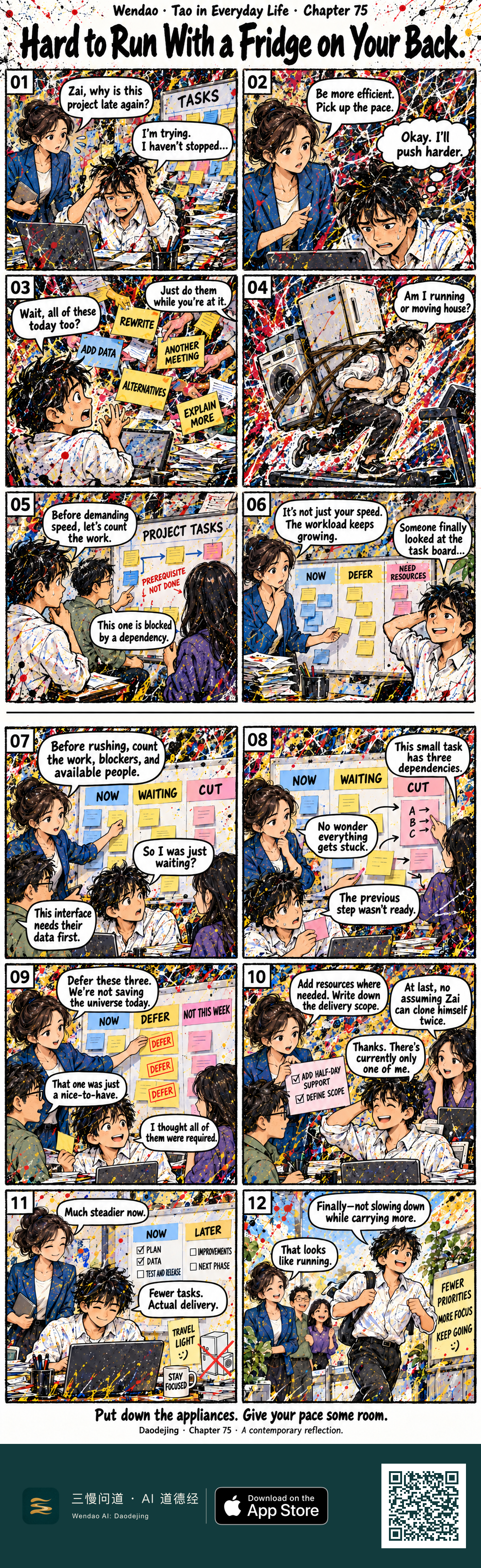
The opening makes Zai's pressure visible before anyone explains it. He sits at a desk buried under papers and sticky notes while the blue-blazer manager asks, "Zai, why is this project late again?" He grips his messy hair and answers, "I'm trying. I haven't stopped…" Yet the next panel still turns immediately to speed: "Be more efficient. Pick up the pace." Zai agrees to push harder, even though the TASKS board behind him is already crowded. The joke begins in the mismatch between the advice and the evidence: the room itself looks overloaded.
Panels 03 and 04 turn that mismatch into physical comedy. More work arrives from every direction—REWRITE, ADD DATA, ANOTHER MEETING, ALTERNATIVES, EXPLAIN MORE—and Zai stares at the pile asking, "Wait, all of these today too?" Then the metaphor becomes literal: he is sprinting on a treadmill with a refrigerator and washing machine strapped to his back. His line, "Am I running or moving house?" is funny because the demand for speed has not replaced the extra weight; both are happening at once.
The turning point comes when the team stops measuring Zai alone and starts examining the work. At the PROJECT TASKS board, a colleague identifies a "PREREQUISITE NOT DONE," and the second page makes the diagnosis more concrete. The manager says, "Before rushing, count the work, blockers, and available people." The glasses-wearing coworker explains that an interface needs someone else's data first, while the purple-shirt coworker points out that one small-looking task actually has three dependencies, marked A, B, and C with arrows. Zai's question changes from "Why am I slow?" to "So I was just waiting?" That shift turns individual frustration into a shared investigation.
The team then changes the structure instead of simply asking for a better attitude. Work is separated into NOW, WAITING, CUT, DEFER, and NOT THIS WEEK. The manager moves three items out of the immediate queue with the dry line, "We're not saving the universe today." One coworker admits that a task was only a nice-to-have, while Zai says he thought everything was required. In panel 10, the team adds half-day support and defines the delivery scope. The clone joke—"At last, no assuming Zai can clone himself twice"—lands because the solution finally acknowledges that there is, as Zai replies, "currently only one of me."
By panels 11 and 12, the visual language has changed as much as the dialogue. The board is shorter and clearer: PLAN and DATA are checked under NOW, TEST AND RELEASE remains visible, while IMPROVEMENTS and NEXT PHASE sit under LATER. A crossed-out refrigerator and washer appear beside the note TRAVEL LIGHT. Zai says, "Fewer tasks. Actual delivery." In the final panel he is no longer hauling appliances; he runs with an ordinary backpack while the manager and coworkers smile behind him. The nearby sign reads FEWER PRIORITIES / MORE FOCUS / KEEP GOING, and the closing line—"Put down the appliances. Give your pace some room."—connects the workplace joke to the supplied passage without claiming that the comic is a literal interpretation of the ancient text: when usable resources are continually consumed by added burdens, apparent slowness may come from the structure around the work.
People are hungry because too much of their food is taken in taxes; that is why they are hungry.
Daodejing · Chapter 75
English rendering of the Silk B base reading excerpt
When work feels slower the harder you push, make the load visible before asking for more speed. Sort current tasks into NOW, WAITING, and CUT or DEFER; mark dependencies such as missing data or unfinished prerequisites; identify any resource gaps; and write down the delivery scope. Then decide what truly needs acceleration and what should simply come off the runner's back.