Read the comic reflection
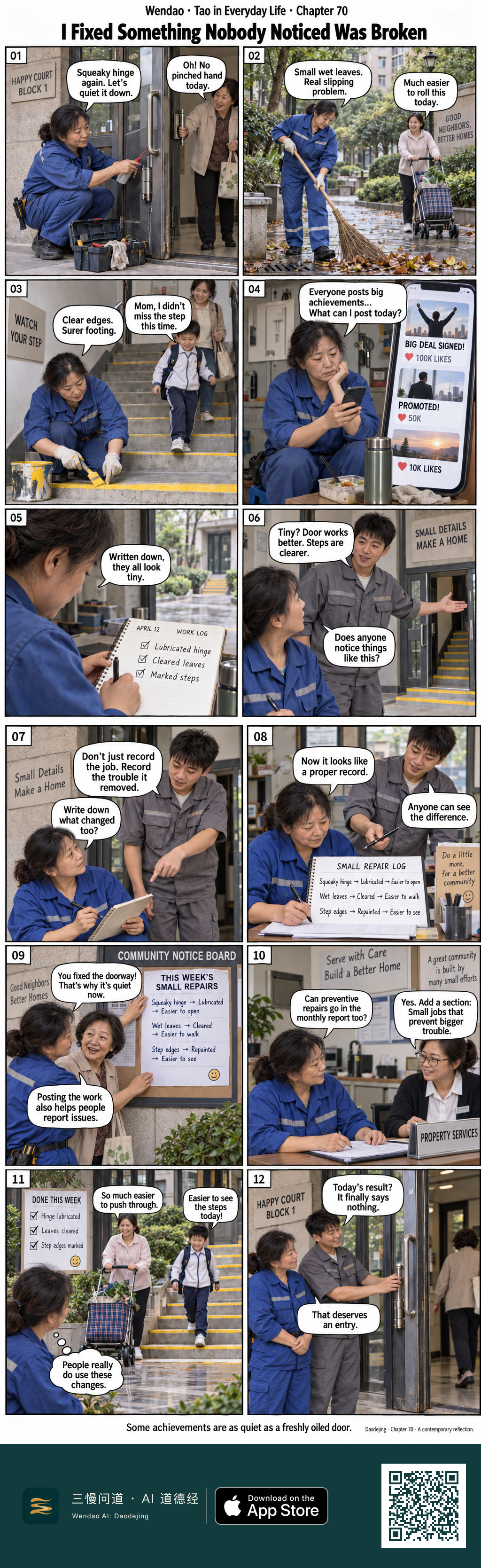
The opening joke is hidden inside problems disappearing. The maintenance worker kneels beside the entrance with her toolbox open and lubricates a squeaky hinge; the older resident does not praise the repair, she simply notices, "Oh! No pinched hand today." Outside, the worker sweeps wet leaves while another resident pushes a shopping cart more easily, and on the stairwell she repaints the yellow step edges while a child tells his mother, "I didn't miss the step this time." Each repair succeeds by making the next ordinary moment less troublesome, so the better she does her job, the less dramatic the result looks.
The tension becomes visible during her break. Sitting beside a metal thermos and lunchbox, the worker scrolls through a phone filled with conspicuous achievements: "BIG DEAL SIGNED!" with 100K likes, "PROMOTED!" with 50K, and another post with 10K likes. Then she looks at her own April 12 work log: "Lubricated hinge," "Cleared leaves," and "Marked steps." The three neat check marks are real accomplishments, yet beside the oversized social-media milestones they suddenly seem tiny. The visual joke is gentle but pointed: one screen celebrates what can be displayed, while her notebook records inconveniences that no longer exist.
The turning point comes from the young coworker in the gray uniform, not from anyone telling her to stay invisible. He says, "Don't just record the job. Record the trouble it removed." When she asks, "Write down what changed too?" the idea becomes practical rather than inspirational. Her new "SMALL REPAIR LOG" connects each action to its effect: "Squeaky hinge → Lubricated → Easier to open," "Wet leaves → Cleared → Easier to walk," and "Step edges → Repainted → Easier to see." The work has not become bigger; the record has simply become more truthful about what the work actually changed.
Once the changes are written clearly, other people can recognize them. At the community notice board, the older resident realizes, "You fixed the doorway! That's why it's quiet now," while the worker notes that posting the work also helps residents report issues. She then brings the same logic into the property office and asks whether preventive repairs can appear in the monthly report. The manager agrees and proposes a section called "Small jobs that prevent bigger trouble." Later, the cart rolls through more easily and the child can see the marked steps, while the worker thinks, "People really do use these changes." She is not transformed into a celebrated hero; she is still watching the building, and doing the same practical work, but now its effects are visible without being exaggerated.
The ending returns to the same doorway where the story began. The coworker tests the handle and delivers the warmest joke in the comic: "Today's result? It finally says nothing." The worker answers, "That deserves an entry." A silent door becomes the final proof of successful work. This creates a contemporary echo of the line about coarse clothing concealing jade: something ordinary and outwardly unremarkable can still contain real value. The comic uses that image as a way to think about everyday work, not as a claim that this modern maintenance story is the only meaning of the classical passage.
Thus the sage wears coarse cloth and carries jade within.
Daodejing · Chapter 70
English rendering of the Silk B base reading excerpt
Choose one small piece of work you did today and add one more line to the record. After writing what you did, write either what trouble became less likely or what became easier for someone else. Do not inflate the result, but do not erase it either; let the concrete change speak for itself.