Read the comic reflection
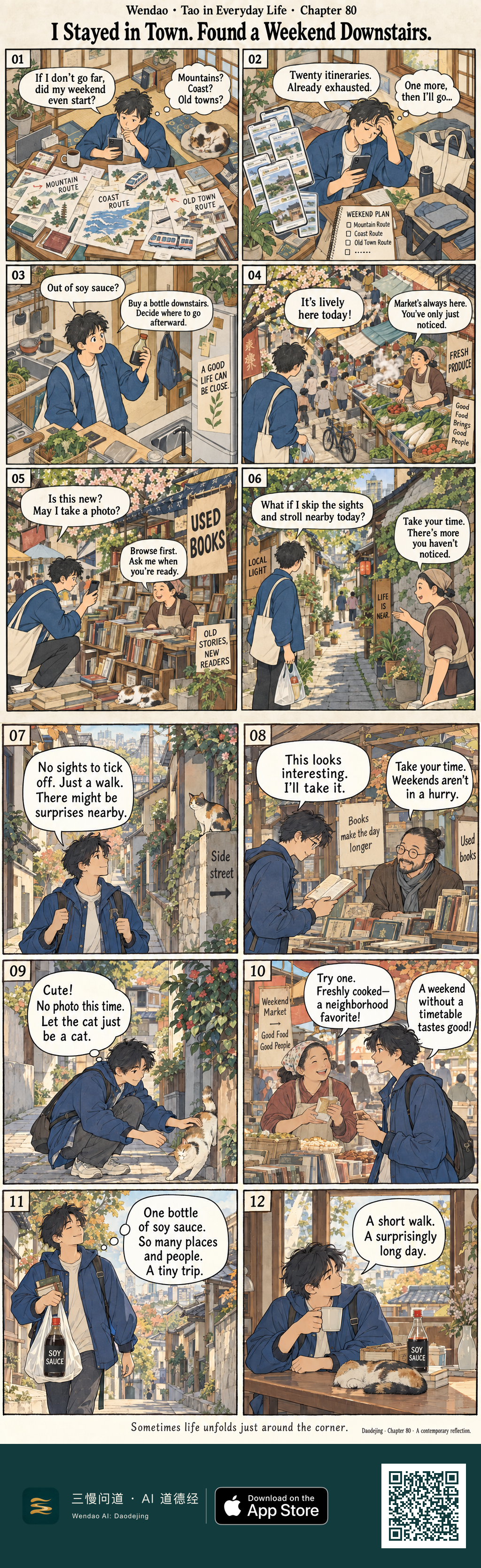
The opening joke is wonderfully concrete: the dark-haired man in the blue shirt has turned his table into a travel command center, with MOUNTAIN ROUTE, COAST ROUTE, and OLD TOWN ROUTE maps spread around his phone while a calico cat sleeps beside the chaos. He wonders, "If I don’t go far, did my weekend even start?" and then scrolls through so many options that Panel 02 finds him slumped over the same phone, surrounded by itinerary screens and a WEEKEND PLAN notebook. "Twenty itineraries. Already exhausted" is the punch line: the trip has not begun, but the planning has already used up the traveler.
The turning point arrives through the least glamorous object in the story: soy sauce. In the kitchen he notices the bottle is empty, decides to buy one downstairs, and postpones the grand question of where to go until afterward; beside him, a small sign reads A GOOD LIFE CAN BE CLOSE. That ordinary errand changes the scale of the day. At the neighborhood market he looks genuinely surprised by the crowd and produce, only for the vendor to answer, "Market’s always here. You’ve only just noticed." The joke is gentle but precise: nothing new had to be built for the weekend to become interesting; his attention simply had to arrive.
The comic then lets curiosity replace the itinerary. At the first bookstall, the man raises his phone and asks, "Is this new? May I take a photo?" while the vendor replies, "Browse first. Ask me when you’re ready." By Panel 06 he is already revising the day aloud: "What if I skip the sights and stroll nearby today?" The lane marked LOCAL LIGHT and LIFE IS NEAR opens in front of him, and the next page carries that choice further: he follows a SIDE STREET, finds another used-book stall, actually opens a book, and tells the bearded bookseller, "This looks interesting. I’ll take it." The shift is small but visible—from collecting possible destinations to spending time with what is physically in front of him.
The cat provides the warmest little reversal. Earlier, his instinct at the bookstall was to photograph what caught his eye; in Panel 09 he crouches beside a calico cat, reaches toward it, and thinks, "Cute! No photo this time. Let the cat just be a cat." Nothing dramatic happens, which is exactly why the moment works. Soon afterward he stops at a food stall, where the vendor offers something freshly cooked and calls it a neighborhood favorite. His reply—"A weekend without a timetable tastes good!"—turns the earlier travel-planning anxiety into a food joke, while also showing that the day has become participatory rather than performative: he walks, browses, eats, chats, and notices.
The ending neatly brings the soy sauce back. Walking home with the bottle visible in his bag and books tucked under his arm, he thinks, "One bottle of soy sauce. So many places and people. A tiny trip." In the final panel he is indoors by the window with a book, the soy sauce bottle, a mug, and a sleeping calico cat sharing the quiet frame, and he sums up the day with, "A short walk. A surprisingly long day." The closing line, "Sometimes life unfolds just around the corner," echoes the supplied Daodejing passage without turning the comic into a literal translation: savoring nearby food, ordinary surroundings, familiar streets, and simple company becomes one possible form of abundance. The story does not argue against traveling far; it shows that distance is not the only thing that can make a day feel spacious.
Let them savor their food, find beauty in their clothing, delight in their customs, and live contentedly in their homes.
Daodejing · Chapter 80
English rendering of the Silk B base reading excerpt
Next time you go out for one small errand, give yourself twenty extra minutes. Choose no attraction and no checklist; take one street you do not usually take, pause at one place that catches your attention, and if you want to photograph a person or stall, ask first. See what appears when the errand is allowed to become a small walk.