Read the comic reflection
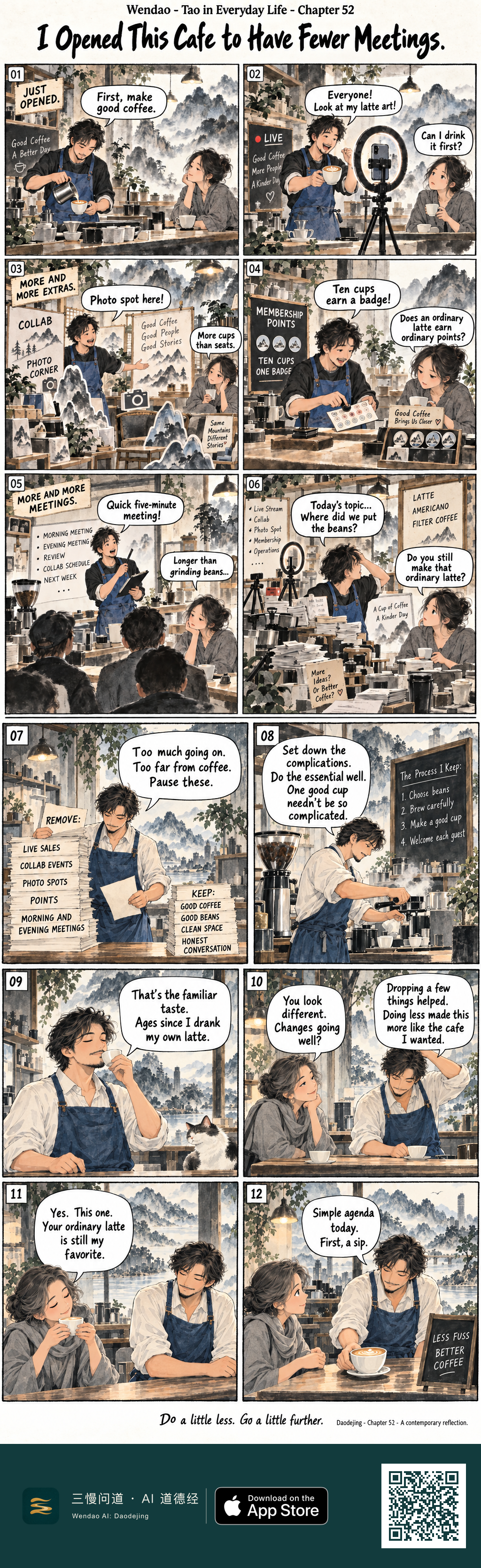
The opening joke is how little the cafe originally needs. In panel 01, the stubbled, dark-haired owner in his blue apron quietly pours milk into a cup beneath a "JUST OPENED" sign and says, "First, make good coffee." The woman in grey sits comfortably at the counter, surrounded by ceramic cups, coffee gear, plants, and misty mountains beyond the windows. One panel later, a large ring light and phone have appeared between the coffee and the customer. He beams at the livestream, "Everyone! Look at my latte art!" while she asks, "Can I drink it first?" Nothing disastrous has happened; the comedy comes from a simple cup already having to wait for its own publicity.
By panels 03 through 05, the shop has accumulated an entire second job. A "MORE AND MORE EXTRAS" sign hangs above a mountain-themed photo installation, alongside "COLLAB" and "PHOTO CORNER" displays, camera props, and a board promising "Good Coffee / Good People / Good Stories." The woman's dry observation, "More cups than seats," neatly punctures the spectacle. Then come "MEMBERSHIP POINTS" and a ten-cup badge scheme, prompting her wonderfully literal question, "Does an ordinary latte earn ordinary points?" Finally, the owner is holding a clipboard in front of an agenda packed with morning meetings, evening meetings, reviews, a collab schedule, and next week. His "Quick five-minute meeting!" is answered with "Longer than grinding beans..." while several people are visibly seated as if the tiny cafe has become a conference room.
The turning point is panel 06, where all those additions become physically visible as clutter. Papers cover the counter, the ring light is still standing, and a side list now includes livestreaming, collaborations, photo spots, membership, and operations. In the middle of it, the owner scratches his head and asks, "Today's topic... Where did we put the beans?" Behind him, the original menu is almost comically plain: "LATTE / AMERICANO / FILTER COFFEE." The woman does not answer with a strategy framework. She asks, "Do you still make that ordinary latte?" Her repeated question brings the story back to the practical thing that has been buried under all the activity.
The lower page makes the change concrete rather than turning it into a dramatic rejection of everything new. In panel 07, the owner sorts the excess into a tall "REMOVE" stack containing live sales, collab events, photo spots, points, and morning and evening meetings, while a smaller "KEEP" stack names good coffee, good beans, a clean space, and honest conversation. Panel 08 reduces his operating system even further: choose beans, brew carefully, make a good cup, welcome each guest. Then panel 09 slows down completely. He finally drinks his own latte beside a quietly seated cat and says, "That's the familiar taste. Ages since I drank my own latte." After so many boards, lists, cameras, and documents, the small cup becomes the clearest piece of evidence in the story.
The ending shows the difference through behavior and atmosphere. The woman notices that he looks different, and he admits, "Dropping a few things helped. Doing less made this more like the cafe I wanted." In panel 11 she finally gets to sip the drink she has been asking about all along: "Yes. This one. Your ordinary latte is still my favorite." The last panel turns the old meeting language into the final joke as he slides over a fresh latte and says, "Simple agenda today. First, a sip," beside a board reading "LESS FUSS / BETTER COFFEE." The supplied line, "Having found the mother, one thereby knows the child," connects to this story as a limited contemporary reflection rather than a literal translation of the comic: recovering the originating purpose of the cafe helps the owner examine which later additions still belong to it and which have carried him away from it.
Having found the mother, one thereby knows the child.
Daodejing · Chapter 52
English rendering of the Silk B base reading excerpt
Choose one small thing that has recently become more complicated than it began. Write down what it was originally meant to accomplish, then look at the current steps, tools, meetings, or extras around it. Try removing just one item that no longer helps the original purpose, and notice whether the work becomes clearer rather than merely emptier.