Read the comic reflection
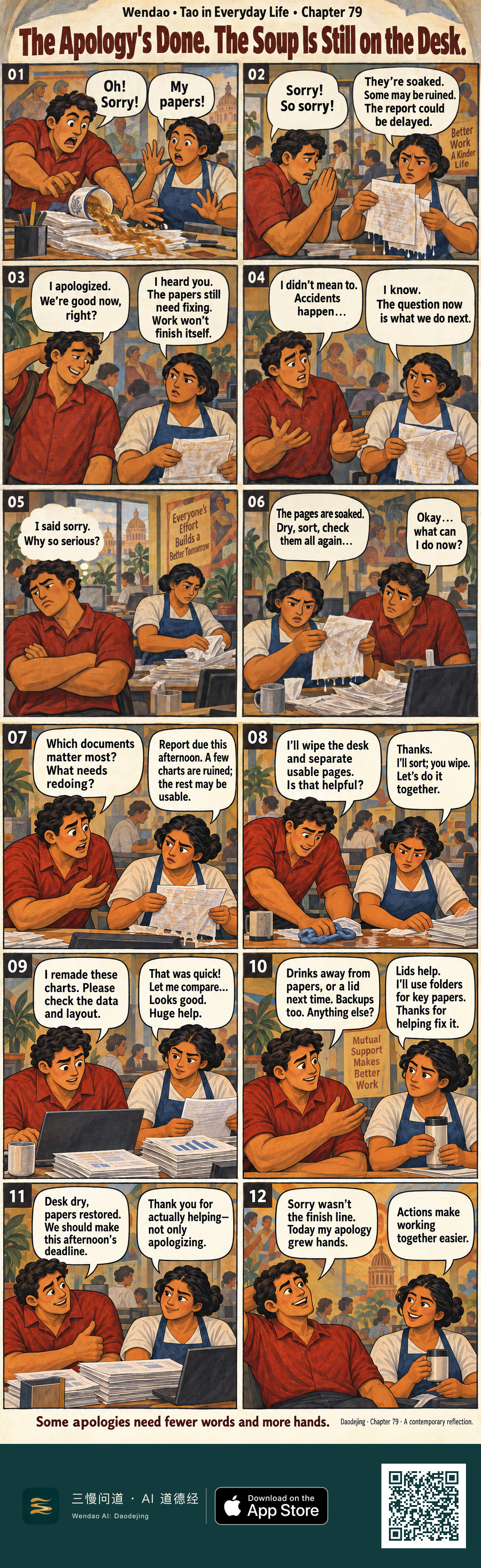
The opening joke is wonderfully physical. In panel 01, the black-haired man in the red shirt reaches across the desk just as a cup tips over, sending brown liquid across a thick stack of papers. His coworker, in a white shirt and blue apron, throws up her hands as he blurts out an apology and she cries over her papers. By panel 02, the comedy has already acquired consequences: she is holding visibly soaked, dripping pages and explaining that some may be ruined and the report could be delayed. His repeated Sorry! So sorry! is sincere, but the wet documents sitting between them make it obvious that sincerity alone cannot dry a page.
The real disagreement becomes clear in panels 03 through 05. The man scratches the back of his head and asks whether they are good now because he has apologized, while his coworker keeps holding the stained papers and points out that the work still has to be repaired. In panel 04 he falls back on the familiar defense that he did not mean to do it and that accidents happen; she does not argue about his intention, but redirects the conversation toward what happens next. Panel 05 makes the misunderstanding funny without making either person into a villain: he sits with his arms folded, thinking that the matter has become unnecessarily serious, while she is still physically cleaning the mess behind him. Even the background slogan about everyone’s effort building a better tomorrow becomes an accidental visual punch line.
The turning point begins in panel 06 and becomes explicit in panel 07. Faced with a dripping sheet, tissues, stacks of damaged pages, a mug, and the open laptop, the man finally asks what he can do now. On the next page, he stops defending the apology and starts asking useful questions: which documents matter most and which need to be redone. His coworker explains that the report is due that afternoon, that a few charts are ruined, and that other pages may still be usable. From there, repair becomes concrete. In panel 08 he wipes the desk with a blue cloth while she sorts the papers, and their dialogue turns from argument into coordination: she sorts, he wipes, and they do it together.
The second half shows the relationship changing through objects rather than speeches. In panel 09 the man works at the laptop and presents remade charts for his coworker to check, while orderly stacks of papers begin replacing the earlier soaked mess. She compares the data and layout instead of simply accepting his fix, and then acknowledges that it is a huge help. Panel 10 turns the accident into a small design review of their habits: keep drinks away from papers, use a lid, make backups, and store key documents in folders. She is even holding a lidded tumbler as they talk, so the prop itself becomes part of the joke. By panel 11 the desk is dry, the papers are restored, and the deadline looks reachable; her thanks is specifically for helping, not merely for apologizing.
Panel 12 lands the story with its warmest joke. The man smiles and says that Sorry was not the finish line and that today his apology grew hands, turning an abstract social gesture into a literal image of useful action. His coworker, now relaxed and holding the lidded cup, answers that actions make working together easier. The closing line, Some apologies need fewer words and more hands, connects naturally with the supplied passage about holding one’s own part of an obligation without demanding from others. The comic does not turn an ancient sentence into a workplace rule; it simply offers a contemporary echo of the same direction of attention. After harm is acknowledged, there may still be something concrete to restore, redo, dry, check, or carry together.
Therefore the sage holds the right-hand tally and makes no demand of others.
Daodejing · Chapter 79
English rendering of the Silk B base reading excerpt
After saying sorry, add one practical question: What needs me most right now? The answer may be to dry something, redo a page, resend a file, replace what was damaged, or change a small habit for next time. Repair what can be repaired first, and leave the other person free to decide when the matter feels settled.