Read the comic reflection
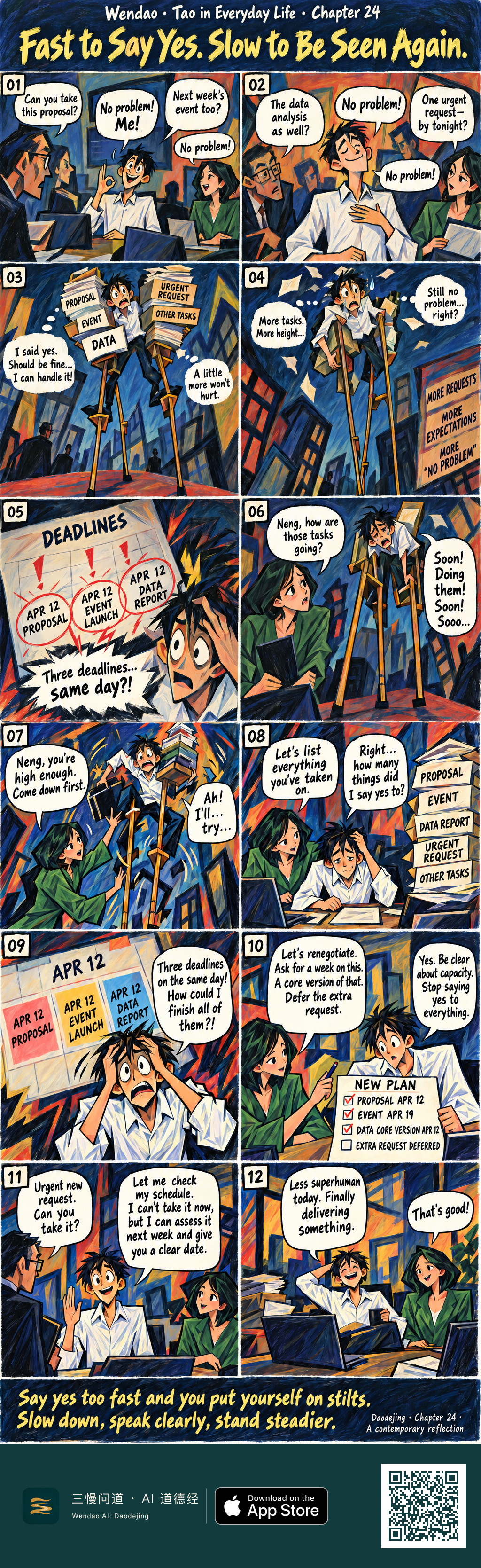
The opening joke is built around repetition. The dark-suited manager asks Neng to take a proposal, the green-shirted colleague adds next week's event, then data analysis and an urgent request arrive in quick succession. Neng answers almost every bubble with some version of "No problem!" and even throws in an enthusiastic "Me!" The comic then turns that verbal confidence into a visual object: labeled stacks for PROPOSAL, EVENT, DATA, URGENT REQUEST, and OTHER TASKS rise around him while his feet are placed on long wooden stilts. His smile disappears as the stilts grow taller. The angular buildings, flying papers, and tilted perspective make the gag clear without needing an abstract lecture: every effortless yes adds another layer beneath someone who is already trying to balance.
The conflict becomes concrete in the deadline panel. A huge sheet marked DEADLINES shows PROPOSAL, EVENT LAUNCH, and DATA REPORT all circled for APR 12. Neng grabs his head, eyes wide, and asks, "Three deadlines... same day?!" The comedy comes from how late the obvious arithmetic reaches him. In the next panel, his colleague asks how the tasks are going while he is still stranded high on the stilts. His answer stretches into "Soon! Doing them! Soon! Sooo..." That elongated "Sooo..." is the visual and verbal punch line: he still sounds as though delivery is just around the corner, but the picture shows someone physically separated from a normal working height by the commitments he has accumulated.
The lower page does not solve the problem by magically removing the workload. In panel 07, the green-shirted colleague reaches upward and tells Neng, "You're high enough. Come down first," while he nervously replies, "Ah! I'll... try..." Once he is back at the desk, they make the work visible instead of leaving it as one intimidating tower. The same categories are stacked beside them—PROPOSAL, EVENT, DATA REPORT, URGENT REQUEST, OTHER TASKS—and Neng finally asks how many things he actually agreed to. The turning point is practical rather than heroic: they look at the commitments, notice the three APR 12 deadlines again, and replace vague confidence with a list that can be discussed.
Panel 10 shows the most important change through a physical prop: a board titled NEW PLAN. The proposal stays on APR 12, the event moves to APR 19, the data work becomes a CORE VERSION due APR 12, and EXTRA REQUEST DEFERRED is left unchecked. His colleague proposes renegotiating, while Neng answers, "Be clear about capacity. Stop saying yes to everything." The idea is tested immediately in panel 11 when the manager brings another urgent request. This time Neng does not repeat "No problem!" He says, "Let me check my schedule," explains that he cannot take it now, and offers to assess it next week and provide a clear date. The change is small, specific, and visible in his words.
The ending deliberately brings Neng back to an ordinary height. In panel 12 he is seated at a normal desk among laptops and papers, smiling with one hand behind his head as he says, "Less superhuman today. Finally delivering something." His colleague answers, "That's good!" Work has not vanished; the joke has simply stopped requiring stilts. The closing line makes the visual metaphor explicit: saying yes too fast puts you on stilts, while slowing down and speaking clearly helps you stand steadier. Read alongside the supplied excerpt, the connection is limited rather than literal: the comic is not illustrating an ancient scene, but it does play with the image of standing and not standing securely. Its office version asks what happens when appearing capable lifts you higher than your actual capacity can support.
One who stands on tiptoe does not stand firm.
Daodejing · Chapter 24
English rendering of the Silk B base reading excerpt
The next time an unexpected task arrives, you might borrow Neng's second-page move instead of his first-page reflex. Before saying "No problem," name the two or three commitments already taking most of your time, check the dates, and offer one realistic option: a later deadline, a smaller core version, or a specific time when you can assess the request.