Read the comic reflection
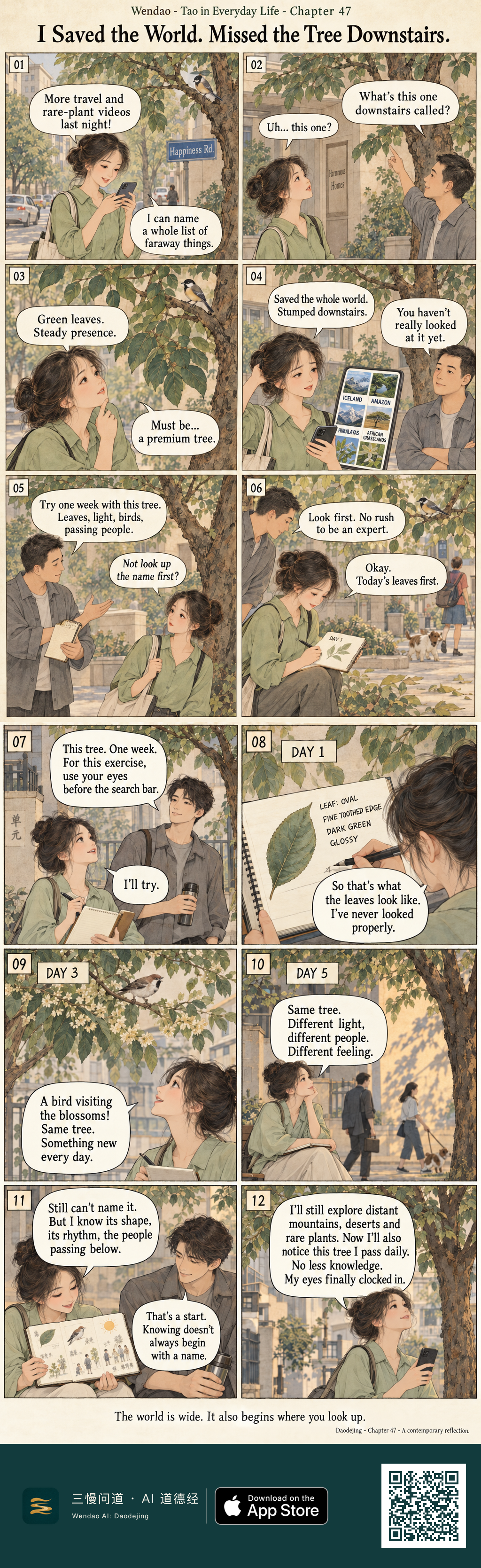
The opening joke lands gently because the contrast is already visible. Walking beneath a leafy neighborhood tree, the woman scrolls through travel and rare-plant videos and proudly says she can name a whole list of faraway things. Then the man simply points above them and asks what the tree downstairs is called. She freezes, studies it with great seriousness, and produces the wonderfully vague diagnosis: green leaves, steady presence, therefore it must be a premium tree. Her phone makes distant places feel specific, while the living thing directly over her head has remained almost anonymous.
The man does not rescue her with a species name. Instead, he changes the task: this tree, one week, and for this exercise, use your eyes before the search bar. That becomes the turning point of the comic. She agrees, opens a notebook, and begins with the leaves. On DAY 1 the page records an oval shape, a fine toothed edge, dark green color and a glossy surface. Her surprise is modest but important: she realizes she has passed these leaves many times without ever really looking at them.
The following panels make observation visible rather than abstract. On DAY 3, a bird appears among the blossoms and she delights in finding something new on the same tree. By DAY 5, she is no longer looking only at leaves or flowers: she notices changing light, people walking beneath the branches, and even a passerby with a dog. The tree has not moved, yet the scene keeps changing because her attention now includes time, light and the small stream of neighborhood life around it.
After a week, she still cannot name the tree, and the comic deliberately refuses to turn that into failure. Holding open a journal filled with leaves, a bird, sunlight and tiny sketches of people, she tells the man that she now knows the tree's shape, its rhythm and the people passing below. He is still carrying his drink as he answers that this is a start, because knowing does not always begin with a name. The humor stays warm: she has not suddenly become a botanical expert; she has simply stopped treating a label as the whole of understanding.
The ending does not ask her to trade distant curiosity for local attention. She still holds her phone and says she will continue exploring mountains, deserts and rare plants, but now she will also notice the tree she passes every day. Her final joke, that her eyes have finally clocked in, keeps the insight light. Read alongside the supplied line from Chapter 47, the story becomes a contemporary reflection on distance and attention: learning more about the wider world does not have to make the nearby world disappear. The closing image leaves her looking upward, while the page reminds us that the world is wide and also begins where we look up.
The farther one goes, the less one knows.
Daodejing · Chapter 47
English rendering of the Silk B base reading excerpt
Today, while walking along a familiar route, choose one small thing you usually overlook: a tree, a window or a sign. Do not look up its name and do not rush to a conclusion. Just look for one minute and write down one detail you had never noticed before.