Read the comic reflection
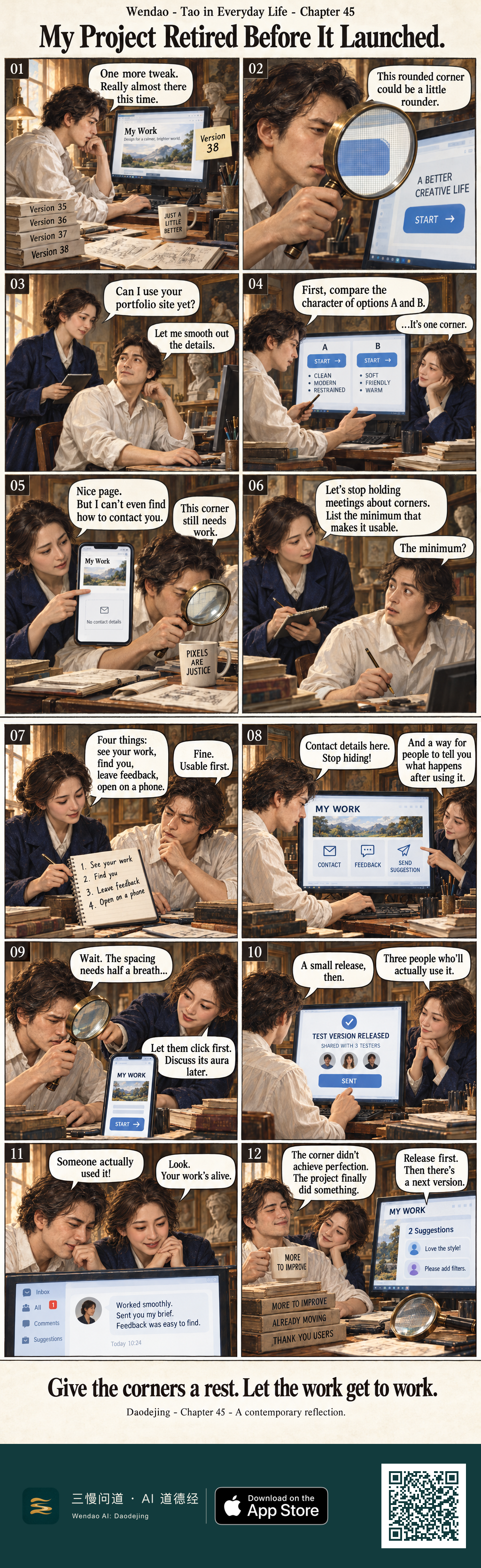
The opening joke is built from wonderfully specific evidence of endless revision. Beside the man are books labeled Version 35, Version 36, Version 37, and Version 38, while a sticky note announces Version 38 again and his mug says "JUST A LITTLE BETTER." He is already staring at a polished "My Work" page, yet his speech bubble promises "One more tweak." The absurdity peaks in panel 02, where a large brass magnifying glass nearly fills the scene as he studies a blue START button and decides its rounded corner "could be a little rounder." The solemn, oil-painted studio, antique books, sculpture busts, and warm academic atmosphere make this microscopic design crisis feel comically monumental.
The woman does not argue that visual polish is worthless; she tests whether the page can do its job. In panel 03 she asks, "Can I use your portfolio site yet?" and the man answers, "Let me smooth out the details." His definition of "details" becomes the next joke: he presents two nearly identical buttons as options A and B, complete with competing personalities—"CLEAN / MODERN / RESTRAINED" versus "SOFT / FRIENDLY / WARM." Her dry reply, "...It’s one corner," punctures the presentation without turning it into a fight. The comic keeps the disagreement practical: he is looking at subtle visual distinctions, while she is trying to find out whether another person can actually move through the site.
Panel 05 supplies the turning point with a phone instead of another aesthetic debate. The woman holds up the portfolio page and says, "Nice page. But I can’t even find how to contact you." The phone itself confirms the problem with the visible notice "No contact details." Meanwhile, the man is still bent over his magnifying glass and the nearby mug now declares "PIXELS ARE JUSTICE," extending the visual joke. In panel 06, she changes the question completely: "Let’s stop holding meetings about corners. List the minimum that makes it usable." His surprised "The minimum?" matters because, for the first time, attention moves away from how finished the interface feels and toward what another person must actually be able to do.
The lower page turns that new question into concrete action. The notebook in panel 07 lists four visible checks: "See your work," "Find you," "Leave feedback," and "Open on a phone." The man agrees: "Fine. Usable first." The website then gains clear CONTACT, FEEDBACK, and SEND SUGGESTION areas, and a phone is used to check the mobile version. His old habit has not vanished: in panel 09 the magnifying glass returns and he starts, "Wait. The spacing needs half a breath..." The woman answers, "Let them click first. Discuss its aura later." That line works because the comic lets perfectionism reappear once more, but this time it no longer gets to stop the release.
The ending stays deliberately small. Instead of a grand public launch, panel 10 shows "TEST VERSION RELEASED" and "SHARED WITH 3 TESTERS." Then something new appears in panel 11: an actual user message—"Worked smoothly. Sent you my brief. Feedback was easy to find." The man’s surprised "Someone actually used it!" is answered by the woman: "Look. Your work’s alive." In the final panel, the magnifying glass is lying unused on the desk, the screen shows two new suggestions—"Love the style!" and "Please add filters."—and the stacked books read "MORE TO IMPROVE," "ALREADY MOVING," and "THANK YOU USERS." Read alongside the supplied line from the Daodejing, this offers a limited contemporary connection: something can remain visibly unfinished and still begin to serve a real use. The comic does not celebrate carelessness; it distinguishes between what must work now and what can improve in the next version.
Great completion seems incomplete, yet its use is never exhausted.
Daodejing · Chapter 45
English rendering of the Silk B base reading excerpt
If you have something that keeps waiting for one more refinement, try writing four or five minimum-use checks like the notebook in the comic: Can people see it? Can they reach you? Can they complete the main action? Can they leave feedback? Does the key path work on the device they will actually use? Then consider sharing a small test version with two or three real users before deciding what the next revision needs.