Read the comic reflection
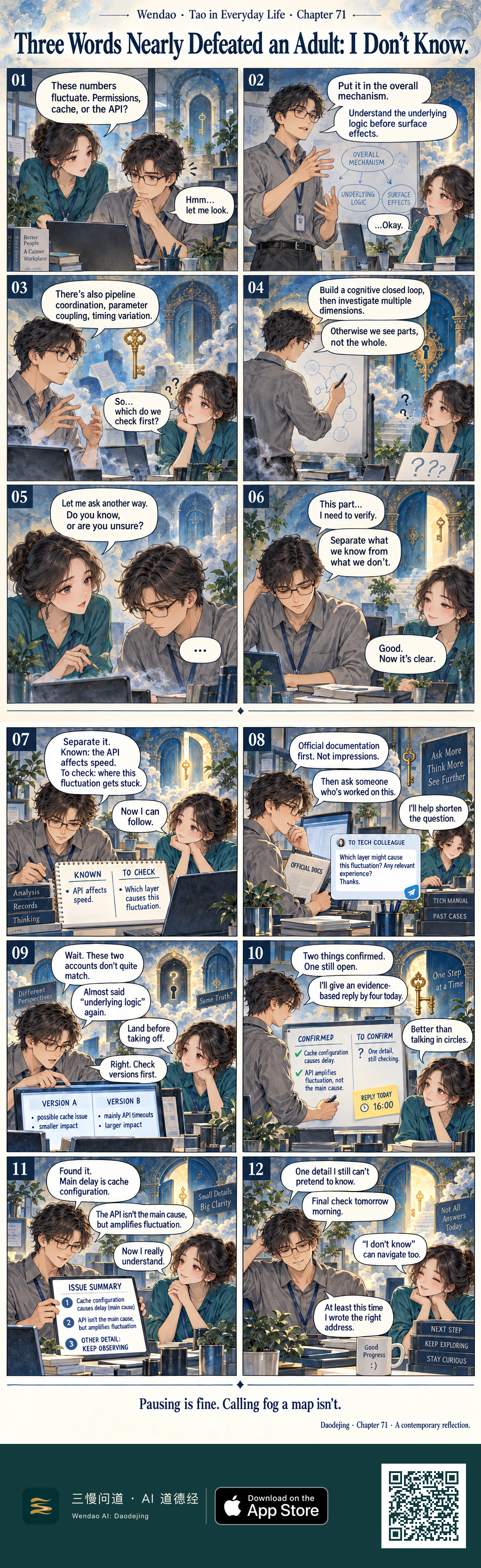
The opening joke is not that the man knows nothing, but that he is working very hard to sound as though he already knows enough. When the woman asks a concrete question about fluctuating numbers—permissions, cache, or the API—he begins with "the overall mechanism" and "the underlying logic," then adds pipeline coordination, parameter coupling, and timing variation. Around them, the ordinary office is woven into blue-and-gold doors, floating clouds, ornate keys, diagrams, laptops, and books. The imagery makes his explanation feel grander while the woman's growing question marks make the practical problem feel less clear: she wanted to know which door to try first, and instead they seem to have entered an entire palace of possibilities.
The turning point comes in panel 05, when the woman stops following the vocabulary and asks, "Do you know, or are you unsure?" The man answers first with silence, then in panel 06 with something much more precise: "This part... I need to verify. Separate what we know from what we don't." Her reply—"Good. Now it's clear."—changes the meaning of the surrounding symbols. The doors and keys are no longer just mysterious decoration; they begin to resemble specific questions that can actually be opened, checked, and labeled. On the next page, his notebook makes that shift visible with two columns: "KNOWN" and "TO CHECK."
The second page turns verification into concrete work. The man writes that the API affects speed while the unresolved question is which layer causes the fluctuation, and the woman says, "Now I can follow." He then chooses official documentation over impressions and asks someone with relevant experience, while she helps shorten the message to the tech colleague. The joke returns when two accounts do not match and he admits, "Almost said "underlying logic" again." Her response, "Land before taking off," keeps the humor warm while redirecting them toward the visible evidence on the laptop: Version A suggests a possible cache issue with smaller impact, while Version B points to mainly API timeouts with larger impact.
By panels 10 and 11, uncertainty has become organized rather than hidden. The whiteboard separates "CONFIRMED" from "TO CONFIRM," gives a reply time of 16:00, and records the story's qualified findings: cache configuration causes the delay, while the API amplifies fluctuation but is not the main cause. The man later holds up an "ISSUE SUMMARY" with those two findings and a third line, "OTHER DETAIL: KEEP OBSERVING." The woman says, "Now I really understand." These are conclusions inside this fictional office story, not general technical advice about APIs, and the comic keeps that limitation visible by leaving one detail open instead of turning a partial diagnosis into a universal answer.
The ending refuses the temptation to make uncertainty disappear. In panel 12, the man says, "One detail I still can't pretend to know. Final check tomorrow morning." The woman answers, ""I don't know" can navigate too," and he closes with the self-mocking line, "At least this time I wrote the right address." Behind them, the golden doorway is bright and open, while a sign says "Not All Answers Today," books read "NEXT STEP," "KEEP EXPLORING," and "STAY CURIOUS," and a mug says "Good Progress :)." The footer—"Pausing is fine. Calling fog a map isn't."—connects the office comedy with the supplied line from Chapter 71 without treating the comic as a literal translation: knowing the boundary of what is known becomes a workable starting point for checking, asking, and continuing.
To know that you do not know is best.
Daodejing · Chapter 71
English rendering of the Silk B base reading excerpt
The next time you face a question outside your certainty, try making two columns like the notebook in the comic: "What I know" and "What I still need to check." If you cannot answer everything yet, name the source you will verify, the person you may ask, and a realistic time for your reply. The goal is not to make "I don't know" the final answer, but to turn it into a clear next step.