Read the comic reflection
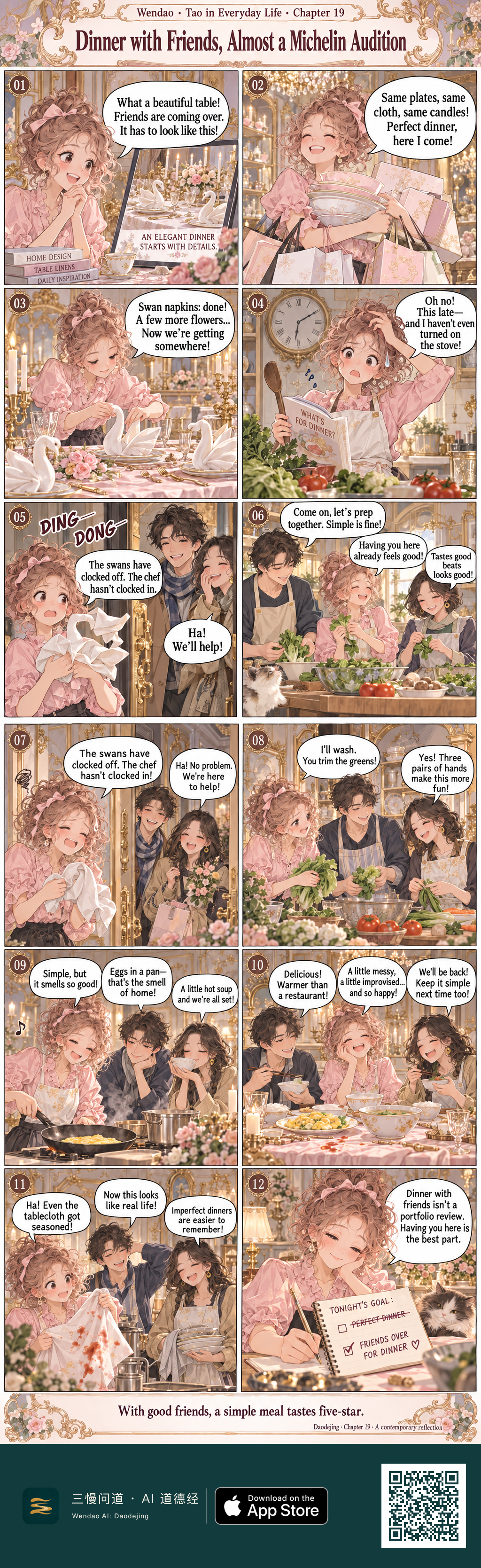
The opening joke is built from escalation. The curly-haired hostess begins by admiring an elegant table on a screen and declaring that her own dinner has to look just as polished. The scene surrounds her with HOME DESIGN, TABLE LINENS, and DAILY INSPIRATION books, while the display promises that an elegant dinner starts with details. She then returns carrying matching plates, boxes, and shopping bags, and spends more time folding white napkins into swans among candles, pink flowers, crystal glasses, and gold decoration. The visuals become increasingly luxurious while the practical purpose of the evening quietly disappears from view. By panel 03, she can proudly announce that the swan napkins are finished, which is funny precisely because the audience can already sense that the most edible part of dinner has not yet begun.
The wall clock provides the turning point. In panel 04, the hostess stands among piles of vegetables with a wooden spoon and a cookbook titled WHAT'S FOR DINNER?, suddenly realizing that she has not even turned on the stove. The elegant fantasy collapses further when the doorbell goes DING DONG. She meets her guests clutching a bundle of white napkins and jokes that "the swans have clocked off" while "the chef hasn't clocked in." The same doorway beat carries into the lower page, where her two friends answer with laughter rather than judgment: "No problem. We're here to help!" Nothing in their expressions suggests that they came to inspect the table. Their response changes the evening from a performance by one person into something the three of them can make together.
After that, the comic shifts its attention from decoration to hands doing ordinary things. The dark-haired man offers to wash while someone else trims the greens, and the brunette woman laughs that three pairs of hands make the work more fun. Soon the hostess is at the stove cooking eggs in a black frying pan, steam rises from nearby pots, and her friends lean in to watch and taste. The food is deliberately modest: eggs, hot soup, greens, rice, and simple shared dishes. That simplicity becomes the new source of warmth. The man calls the eggs "the smell of home," and the woman says a little hot soup will finish the meal. The joke has moved too: instead of admiring perfect swans, everyone is now enjoying the fact that dinner finally smells like dinner.
At the table, the Rococo setting never disappears; chandeliers, candles, flowers, porcelain bowls, and gold details remain in the background. What changes is the group's relationship to them. The pink tablecloth now has visible sauce marks, bowls and plates are actively being used, and all three friends are laughing while they eat. The man says the meal feels warmer than a restaurant, the hostess happily admits that the night is "a little messy" and "a little improvised," and the brunette friend is already promising to return. Panel 11 turns the remaining imperfection into the final visual gag: the hostess holds up a cloth covered with reddish stains and says even the tablecloth got seasoned. Her friends respond by laughing, stacking dishes, and calling the scene more like real life rather than treating the mess as a failure.
The last panel makes the change concrete with a prop rather than a speech about perfection. The hostess sits beside the fluffy cat and writes in a spiral notebook labeled TONIGHT'S GOAL. PERFECT DINNER has been crossed out beside an empty checkbox, while FRIENDS OVER FOR DINNER is checked and finished with a heart. Her final line says that dinner with friends is not a portfolio review and that having them there is the best part. Read alongside the supplied Chapter 19 excerpt, this can work as a contemporary association with "seeing the plain" and "embracing the uncarved": less effort spent turning hospitality into a display leaves more attention for the people actually present. The comic does not establish that as the only meaning of the ancient passage; it simply stages one everyday situation in which loosening attachment to form makes room for shared experience.
These three sayings, taken merely as formulations, are still insufficient; therefore let them have something to which they belong: see the plain, embrace the uncarved; lessen self-interest and reduce desire.
Daodejing · Chapter 19
English rendering of the Silk B base reading excerpt
For the next casual meal with people you know well, you might try making the first version of the plan deliberately small: one hot dish, one pot of soup, and enough places to sit. Flowers and folded napkins can stay optional. If the schedule slips, inviting everyone into the kitchen may become part of the evening rather than evidence that it went wrong.