Read the comic reflection
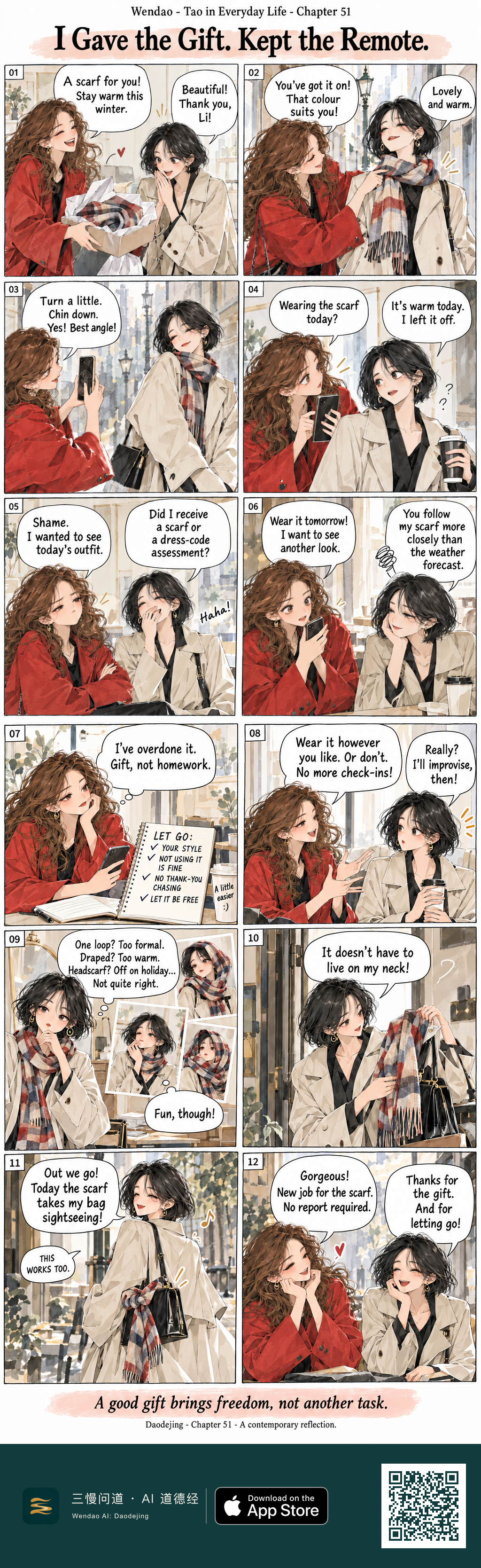
The opening makes Li's good intention easy to see. In panel 01, the red-coated, long-curly-haired Li presents the grey-and-red checked scarf in an open gift box and says, "A scarf for you! Stay warm this winter." Her friend, dressed in a cream trench with a black bob, looks genuinely delighted and answers, "Beautiful! Thank you, Li!" The fashion-illustration treatment lingers on the plaid, fringe, soft fabrics, handbag, and elegant coats, so the scarf really does feel like a thoughtful gift. The comedy begins when Li does not quite stop at giving it: in panel 02 she adjusts the scarf herself, and in panel 03 she raises her phone like an enthusiastic stylist, directing, "Turn a little. Chin down. Yes! Best angle!"
The invisible conditions become clearer on the rest of the first page. When Li asks, "Wearing the scarf today?" her friend is holding a takeaway cup and simply explains that the weather is warm, so she left it off. Li answers, "Shame. I wanted to see today's outfit," which turns a practical choice into something that suddenly seems to require an explanation. The recipient laughs instead of escalating the moment and asks, "Did I receive a scarf or a dress-code assessment?" Yet Li is still thinking ahead to another styled appearance: "Wear it tomorrow! I want to see another look." The friend's reply—"You follow my scarf more closely than the weather forecast"—lands because the object originally meant to provide warmth has started generating check-ins.
The real turning point is visible in panel 07, where Li sits with her phone beside an open notebook and admits, "I've overdone it. Gift, not homework." The notebook makes the shift concrete rather than merely implied: under "LET GO" it lists "YOUR STYLE," "NOT USING IT IS FINE," "NO THANK-YOU CHASING," and "LET IT BE FREE." In panel 08 she says the new boundary out loud: "Wear it however you like. Or don't. No more check-ins!" Her friend's surprised "Really? I'll improvise, then!" matters because it shows that freedom of use had not previously felt completely obvious. Li is not pretending she never cared; she is consciously giving up her role as supervisor of what happens next.
Once that pressure is removed, the recipient becomes much more playful with the same scarf. Panel 09 shows her experimenting in front of a mirror and through several inset looks: "One loop? Too formal. Draped? Too warm. Headscarf? Off on holiday... Not quite right." The joke is that none of these attempts produces a perfect answer, but she still concludes, "Fun, though!" That is a very different mood from having to present the correct outfit for inspection. In panel 10, holding the scarf beside her structured black handbag, she realizes, "It doesn't have to live on my neck!" Panel 11 delivers the visual payoff: the scarf is tied to the bag instead, and she walks out smiling while announcing, "Today the scarf takes my bag sightseeing!" The small caption "THIS WORKS TOO" confirms that usefulness has expanded rather than disappeared.
The final panel resolves the relationship as much as the accessory. Li and her friend sit together smiling, with no corrective gesture, phone camera, or styling instruction between them. Li simply says, "Gorgeous! New job for the scarf. No report required." Her friend answers, "Thanks for the gift. And for letting go!" The closing line beneath the comic—"A good gift brings freedom, not another task"—fits the visible change from supervision to trust. As a contemporary reflection on the supplied passage, the story suggests that giving, helping, or nurturing does not have to mean possessing the result or directing every later use. It does not claim that gifts must be repurposed or that thanks are unnecessary; its narrower point is that generosity can remain generous even after control is released.
They bring forth but do not possess; act but do not rely on it; nurture but do not rule. This is called profound virtue.
Daodejing · Chapter 51
English rendering of the Silk B base reading excerpt
Think of something you recently gave someone, or some help you offered. Notice whether you are still waiting for a particular use, reaction, or update. If so, try leaving one follow-up unasked and let the other person decide how that gift or help fits into their own life.