Read the comic reflection
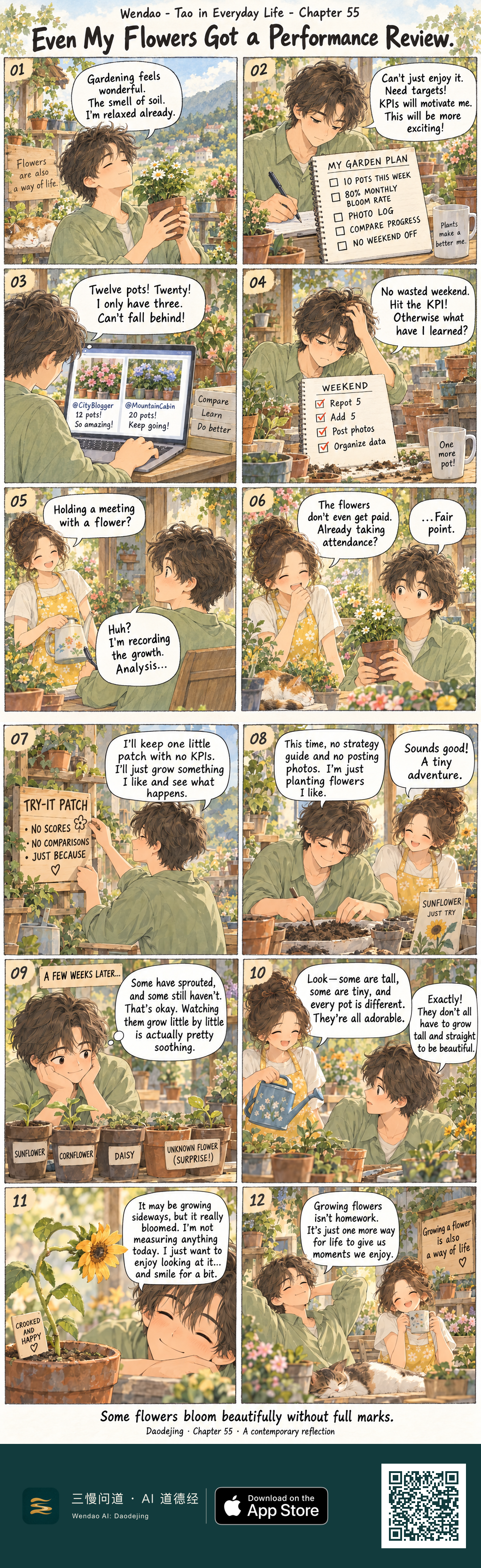
The joke begins because the green-shirted young man genuinely enjoys gardening. In panel 01 he holds a flowerpot with his eyes closed, surrounded by blossoms, sunshine, and a sleeping cat, saying that the smell of soil has already relaxed him. One panel later, however, pleasure has acquired paperwork. He opens a notebook titled "MY GARDEN PLAN" and gives himself ten pots for the week, an 80% monthly bloom rate, a photo log, progress comparisons, and no weekend off. Even the nearby mug declares, "Plants make a better me." The garden has barely had time to be restful before it starts resembling another job.
The absurdity grows when comparison enters the scene. On his laptop, posts from @CityBlogger and @MountainCabin announce twelve and twenty pots, and his response is not curiosity but alarm: he has only three and cannot fall behind. By panel 04, the weekend list has become "Repot 5," "Add 5," "Post photos," and "Organize data," while another mug urges, "One more pot!" The woman in the yellow floral apron finally catches him treating a flower like a project review. Her question, "Holding a meeting with a flower?" is followed by the sharper joke: "The flowers don't even get paid. Already taking attendance?" His embarrassed "...Fair point" becomes the story's turning point.
The second page does not swing to complete indifference. Instead, the man creates a deliberately limited experiment. He hangs a wooden "TRY-IT PATCH" sign with three rules: "NO SCORES," "NO COMPARISONS," and "JUST BECAUSE." He then plants without a strategy guide or a photo post, using a sunflower packet marked "JUST TRY," while the woman calls it a tiny adventure. A few weeks later, the pots are labeled SUNFLOWER, CORNFLOWER, DAISY, and even "UNKNOWN FLOWER (SURPRISE!)." Some seeds have sprouted and some have not, and for once he is content simply to watch what happens.
The change becomes most visible in the uneven plants themselves. While watering, the woman points out that some are tall, some tiny, and every pot looks different; the man realizes they do not all need to grow tall and straight to be beautiful. In panel 11, a sunflower is visibly leaning sideways but has still bloomed. Instead of reaching for measurements or another checklist, he rests beside it, smiling, while a small note reads "CROOKED AND HAPPY." The humor has shifted from watching him overmanage the flowers to watching him discover that the crooked one needs no correction to be worth enjoying.
The ending returns the garden to companionship rather than evaluation. The man leans back among the plants while the woman laughs over her mug and the cat sleeps comfortably between them. His final thought is that growing flowers is not homework but another way for life to give them moments they enjoy. That movement—from scoring and comparing toward observing and accompanying—echoes the supplied line about recognizing constancy and becoming clear about it. The comic does not present gardening as a formula for living; it simply shows how, once the urge to control every result softens, small differences, slow growth, and an ordinary pleasant moment become easier to notice.
[Knowing harmony is called] constancy; knowing constancy is called illumination.
Daodejing · Chapter 55
English rendering of the Silk B base reading excerpt
Give one small hobby a "try-it patch" today. Do not rank it, compare it, rush to show it, or set a completion target. Follow your interest for a little while, then notice whether there was one moment in the process that made you want to smile before judging the result.