Read the comic reflection
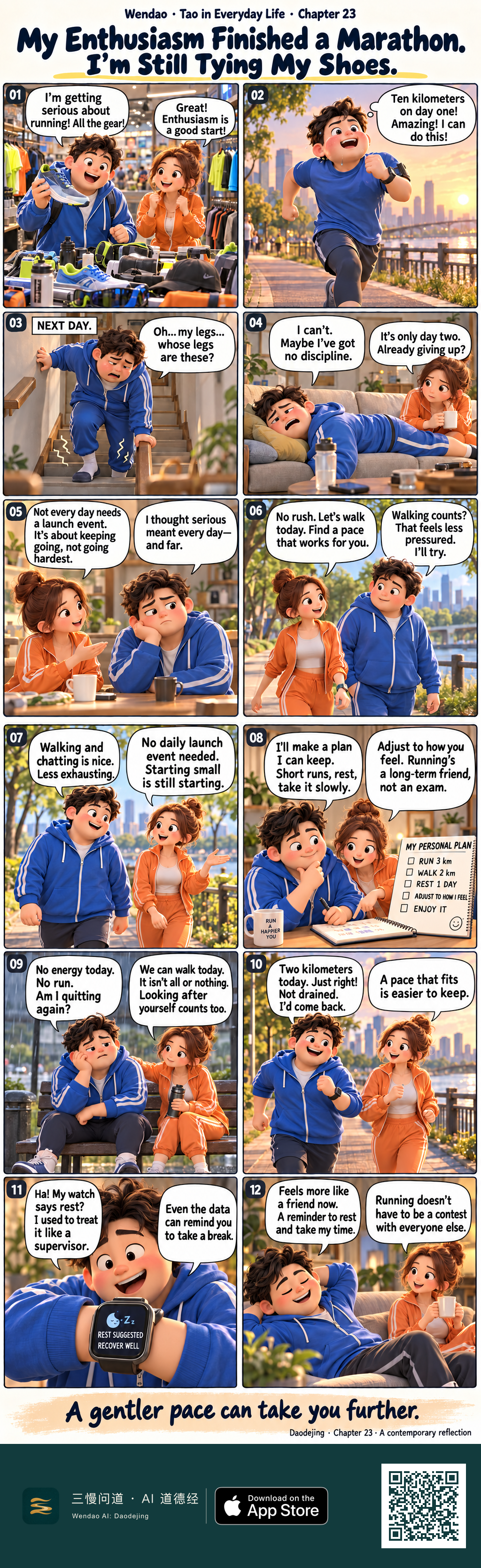
The opening joke is built from visible excess. In the running shop, the curly-haired man in blue proudly holds up a shoe while the table in front of him is crowded with footwear, bottles, a cap, bags, and other training gear. His friend in orange cheers him on, and the whole scene feels less like buying one pair of shoes than launching a new identity. The next panel immediately pushes that enthusiasm too far: he is sweating along the riverside while thinking, "Ten kilometers on day one! Amazing! I can do this!" The comic does not present that distance as sensible beginner advice. Its humor comes from showing how quickly excitement has turned into an oversized first attempt.
The next day supplies the physical punchline. On the stairs, the man is hunched over, gripping the railing, with little wavy marks around his legs and the caption "NEXT DAY." His line, "Oh... my legs... whose legs are these?" turns yesterday's confidence into a very ordinary comic complaint. On the sofa, however, he makes a second leap: from one overdone run to "Maybe I've got no discipline." His friend does not answer with a heroic training speech. She points out that it is only day two, and the conversation later reframes the problem more gently: not every day has to feel like a launch event.
The turning point becomes visible when they stop treating running as all-or-nothing. First, the two simply walk beside the river, chatting in the same blue and orange sportswear, and the man admits that it feels less exhausting. Then he sits down with a pen and makes a notebook plan. The page visibly includes "RUN 3 km," "WALK 2 km," "REST 1 DAY," "ADJUST TO HOW I FEEL," and "ENJOY IT." These distances belong to the character's example rather than a universal prescription. What matters in the story is the change in structure: effort, walking, rest, and adjustment are now all allowed to belong to the same plan.
The later panels test that new idea instead of merely stating it. On a day when he has no energy, the man sits slumped on a park bench and worries that skipping a run means he is quitting again. His friend, holding a bottle beside him, answers that they can walk and that it does not have to be all or nothing. Soon afterward, the two are running by the river again, but his line has changed completely: "Two kilometers today. Just right! Not drained. I'd come back." The joke is quieter here, but the visual contrast is strong: the earlier runner tried to solve the future in one exhausting burst, while this version finishes with enough willingness left to imagine returning.
The final joke belongs to the smartwatch. Earlier it is part of the man's serious running equipment; now he stares at its screen and laughs because it says "REST SUGGESTED / RECOVER WELL." He says he used to treat the watch like a supervisor, while his friend observes that even the data can remind him to take a break. The last panel deliberately leaves the running path behind. He is reclining comfortably on the sofa with his hands behind his head, while his friend sits nearby holding a mug, and he says the watch feels more like a friend now. The supplied line from the Daodejing observes that intense forces do not last indefinitely. The comic uses that idea loosely, not as a running manual, but as a way to question the habit of making every beginning maximally intense.
A fierce wind does not last through the morning; a downpour does not last through the day.
Daodejing · Chapter 23
English rendering of the Silk B base reading excerpt
If there is something you tend to begin at maximum intensity, try making the next round a little smaller. Do one shorter session, remove one optional demand, or put a rest day directly into the plan. Then notice which pace makes it easier to say, a few days later, "I'd come back."