Read the comic reflection
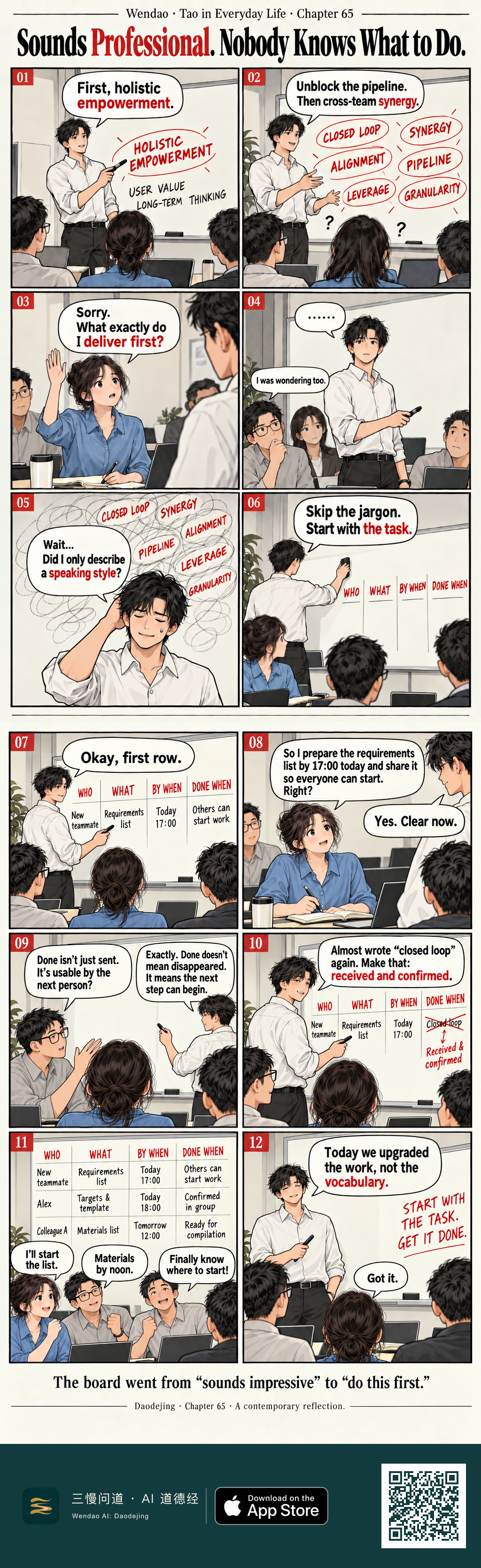
The opening joke is written all over the whiteboard. The black-haired leader in a white shirt begins confidently with "holistic empowerment," supported by "user value" and "long-term thinking." In the next panel, the language multiplies into red-circled terms: "closed loop," "synergy," "alignment," "pipeline," "leverage," and "granularity." He looks perfectly comfortable presenting them, while question marks appear over the seated team. Everyone is in the same room looking at the same board, yet the vocabulary has produced something like an elegant map with no obvious first step.
The turning point comes from the woman in the blue blouse, who raises her hand and asks, "Sorry. What exactly do I deliver first?" The leader stops with the marker still in his hand, and a glasses-wearing coworker quietly adds, "I was wondering too." That small admission changes the temperature of the meeting. In the following panel, surrounded by the same jargon in a scribbled cloud, the leader scratches his head and asks himself, "Did I only describe a speaking style?" The joke is gentle because nobody suddenly becomes foolish or brilliant; the group simply makes its confusion speakable.
Instead of replacing the jargon with even fancier jargon, the leader erases the board and introduces four plain columns: "WHO," "WHAT," "BY WHEN," and "DONE WHEN." On the second page he fills in the first row for a new teammate: a requirements list, due today at 17:00, with completion defined as allowing others to start work. The woman then repeats the assignment in her own words: she will prepare the requirements list by 17:00 and share it so everyone can begin. His reply, "Yes. Clear now," shows that clarity is being checked through mutual understanding rather than assumed from a polished presentation.
The glasses-wearing coworker pushes the idea one step further by asking whether "done" means more than merely sending something. The leader answers that completion means the next step can begin. Then comes the comic's neatest callback: while filling the board, he almost writes "closed loop" again, catches himself, crosses it out, and replaces it with "received and confirmed." By panel 11, the board holds several concrete assignments with owners, deliverables, deadlines, and completion conditions. The woman says she will start the list, the glasses-wearing coworker commits to materials by noon, and another coworker celebrates finally knowing where to start.
The final panel keeps the same marker, meeting room, and whiteboard, but their purpose has changed. The leader smiles and says, "Today we upgraded the work, not the vocabulary," while the board reads "START WITH THE TASK. GET IT DONE." Someone answers, "Got it," and the footer sums up the visual transformation: the board went from "sounds impressive" to "do this first." Read beside Chapter 65, the comic works as a contemporary reflection rather than a literal translation: it suggests that clever-sounding language can create distance when people must guess what it means, while language that can be repeated, confirmed, and acted on can bring a group back to the work itself.
Therefore, governing a state with cleverness is the state's bane; governing a state without cleverness is the state's blessing.
Daodejing · Chapter 65
English rendering of the Silk B base reading excerpt
The next time you assign work, try writing only four things: who will do it, what they will do, by when, and what counts as done. Then ask the other person to restate the task in their own words. If the two versions differ, revise the wording before blaming anyone's understanding.