Read the comic reflection
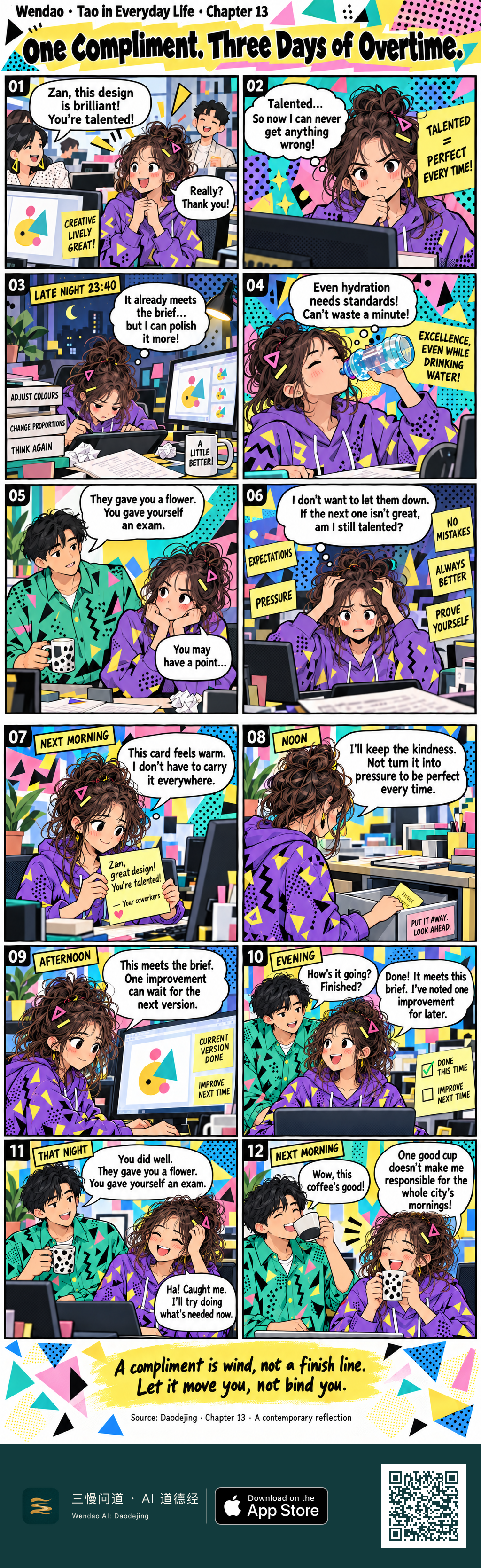
The opening joke happens almost instantly. In the bright office, a smiling woman tells Zan, "Zan, this design is brilliant! You're talented!" while a sticky note beside the monitor adds "CREATIVE / LIVELY / GREAT!" Zan clasps her hands and happily answers, "Really? Thank you!" But in the very next panel her face tightens, her hand moves to her chin, and the colorful Memphis triangles and dots surround a new equation: "TALENTED = PERFECT EVERY TIME!" Nothing hostile has happened around her; the pressure appears in the meaning Zan adds to the praise herself.
That private equation soon becomes visible in her routine. At "LATE NIGHT 23:40," Zan is hunched over a tablet beside a monitor showing the same geometric design, even though she admits, "It already meets the brief... but I can polish it more!" The desk is crowded with papers, crumpled sheets, a lamp, and notes reading "ADJUST COLOURS," "CHANGE PROPORTIONS," and "THINK AGAIN," while her mug promises "A LITTLE BETTER!" The next panel pushes the joke further: she drinks from a large water bottle while thinking, "Even hydration needs standards! Can't waste a minute!"
The turning point comes through a concrete image rather than a lecture. The man in the green patterned shirt sits beside Zan with his spotted mug and tells her, "They gave you a flower. You gave yourself an exam." Zan, resting her face in her hands, concedes, "You may have a point..." Yet the next panel shows that the pressure is still real for her: she grips her hair while notes such as "EXPECTATIONS," "PRESSURE," "NO MISTAKES," "ALWAYS BETTER," and "PROVE YOURSELF" surround her. Her question, "If the next one isn't great, am I still talented?" makes clear that she has begun treating one compliment as a promise she must keep proving.
On the second page, Zan changes what she does with the praise rather than rejecting it. The next morning she holds the card that says, "Zan, great design! You're talented! — Your coworkers" and thinks, "This card feels warm. I don't have to carry it everywhere." At noon she places it in a drawer marked "PUT IT AWAY. LOOK AHEAD." while saying she will keep the kindness without turning it into pressure to be perfect every time. By afternoon, the computer still shows the work, but the nearby notes now separate "CURRENT VERSION DONE" from "IMPROVE NEXT TIME." When her coworker asks whether she has finished, she can answer yes while still keeping one improvement for later.
The ending makes the shift visible through laughter and coffee. That night, the man repeats the flower-and-exam line while Zan laughs and says, "Ha! Caught me. I'll try doing what's needed now." The following morning, they have coffee together; Zan still holds her black-spotted mug. When he says, "Wow, this coffee's good!" Zan jokes, "One good cup doesn't make me responsible for the whole city's mornings!" The final caption, "A compliment is wind, not a finish line. Let it move you, not bind you," offers a contemporary connection to Chapter 13: praise can become heavy when receiving it immediately creates fear of losing it. That is one possible everyday reflection on the passage, not a claim that it is the text's only meaning.
Favor places one in a low position: when you gain it, you are alarmed; when you lose it, you are alarmed. This is what is meant by being alarmed by favor and disgrace.
Daodejing · Chapter 13
English rendering of the Silk B base reading excerpt
The next time someone praises you, you might try receiving just that moment of kindness: say thank you, then return to the task in front of you. If your mind starts writing a sequel called "Now I must always be this good," imagine placing that extra exam in Zan's drawer and keeping any useful improvement for the next version.