Read the comic reflection
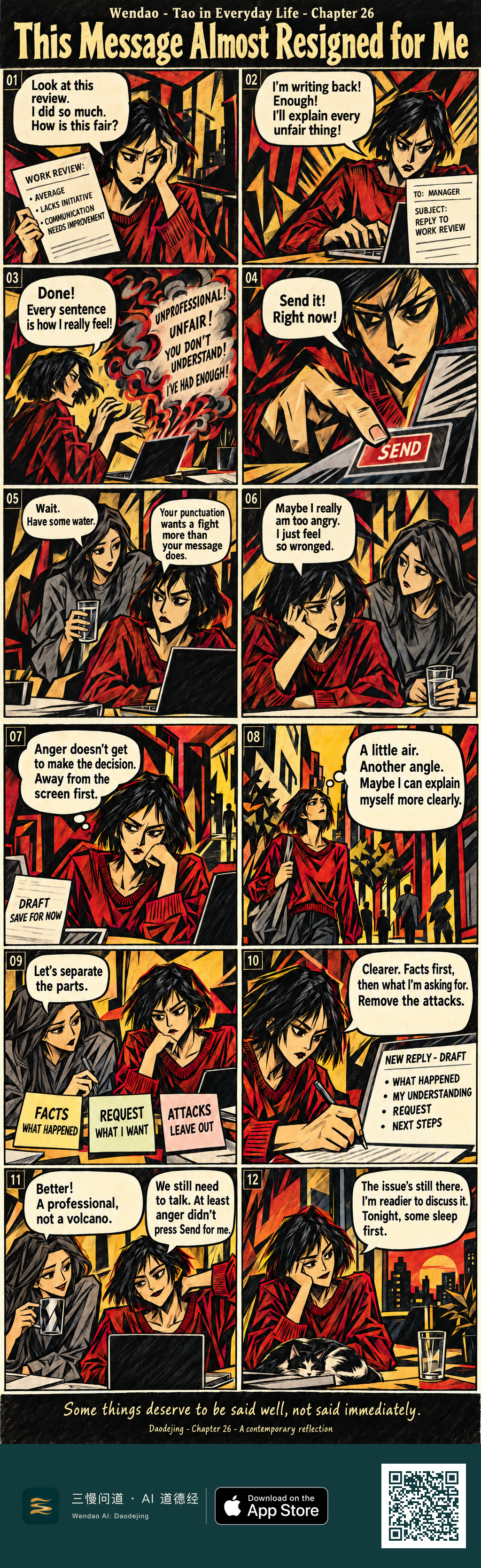
The opening makes the frustration visible before the woman even starts typing. In panel 01, the short-haired woman in a red sweater grips a WORK REVIEW marked "AVERAGE," "LACKS INITIATIVE," and "COMMUNICATION NEEDS IMPROVEMENT" while the black, red, and gold office around her seems almost as angular as her expression. By panel 02 she is at the laptop declaring, "I'm writing back! Enough!" with an email addressed to her manager. Nothing suggests resignation has actually happened; the comedy comes from how quickly an upsetting review is turning into a reply large enough to feel career-sized.
Panels 03 and 04 push that impulse into visual exaggeration. The woman announces, "Done! Every sentence is how I really feel!" while smoky, jagged words erupt beside the laptop: "UNPROFESSIONAL!", "UNFAIR!", "YOU DON'T UNDERSTAND!", and "I'VE HAD ENOUGH!" Then the page cuts to a close-up of her finger hovering over a bright red SEND button as she says, "Send it! Right now!" The finger never presses it. That unpressed button is the first important fact of the story: the anger is real, but the message is still under her control.
The turning point arrives through an ordinary prop rather than a grand speech. Her long-haired friend in a gray sweater appears with a glass of water and says, "Wait. Have some water." The next line supplies the warmest joke on the first page: "Your punctuation wants a fight more than your message does." The woman does not suddenly become cheerful or decide the review was fair. In panel 06 she is still slumped beside the laptop and admits, "Maybe I really am too angry. I just feel so wronged." The change is smaller and more believable: she recognizes the feeling before letting it choose the next action.
The second page turns that pause into visible editing work. Panel 07 shows the reply labeled "DRAFT / SAVE FOR NOW," and panel 08 sends the woman outside for "A little air" and "Another angle." Back at the table, her friend proposes, "Let's separate the parts," beside three cards labeled "FACTS / WHAT HAPPENED," "REQUEST / WHAT I WANT," and "ATTACKS / LEAVE OUT." The categories are slightly funny because they make an emotional explosion look like office stationery, but that is exactly the point of the scene: what was one furious mass can now be sorted into material she wants to communicate and material she does not want to send.
The ending deliberately stops short of a tidy victory. In panel 10 the woman writes a "NEW REPLY - DRAFT" organized as "WHAT HAPPENED," "MY UNDERSTANDING," "REQUEST," and "NEXT STEPS." Her friend jokes, "Better! A professional, not a volcano," and the woman answers that they still need to talk, but "At least anger didn't press Send for me." The final panel keeps the issue unresolved: she rests at the desk with a black-and-white cat, the water glass still nearby, and a sunset outside while saying she is readier to discuss the problem and will sleep first. The supplied line from the Daodejing can be connected to this only as a contemporary reflection: steadiness can give restless action a base. The comic does not say anger is wrong or that conflict should be swallowed; it shows someone making enough room between feeling and action to state the facts and her request more clearly.
The heavy is the root of the light; stillness is the master of restlessness.
Daodejing · Chapter 26
English rendering of the Silk B base reading excerpt
If you have a message you urgently want to send, you could first leave it as a draft and step away from the screen for a few minutes. When you return, try marking its parts as "facts," "request," and "attacks," then decide which parts actually need to travel with the message.