Read the comic reflection
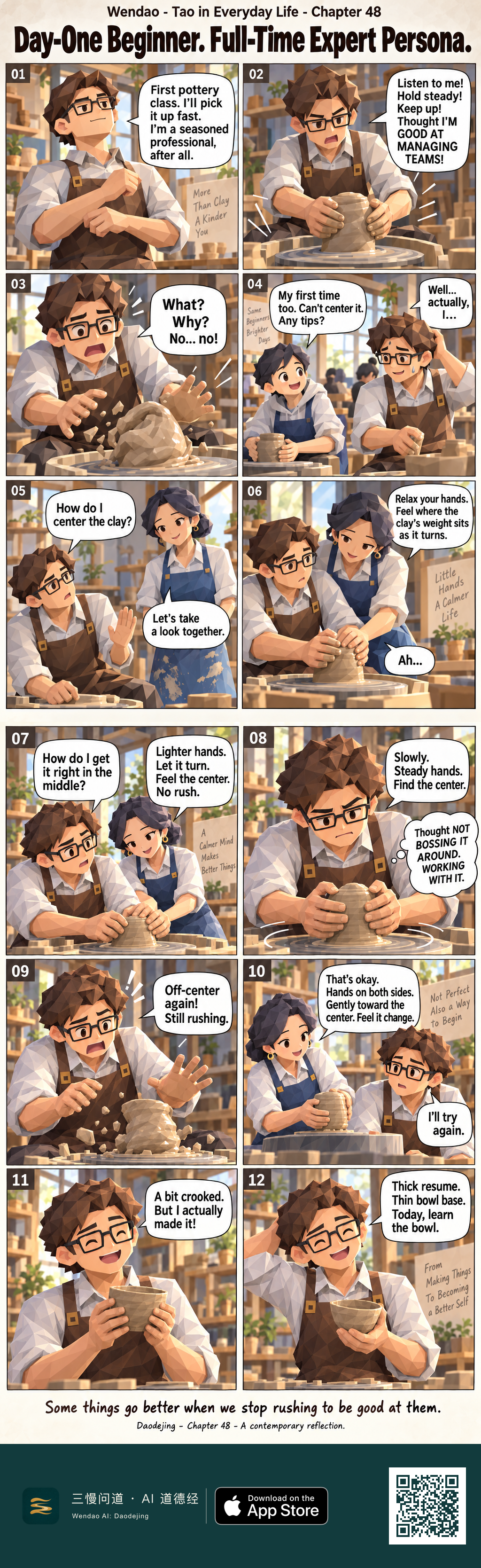
The opening joke is that the man brings his workplace confidence straight into a pottery studio. In his fresh brown apron and glasses, he announces, "First pottery class. I'll pick it up fast. I'm a seasoned professional, after all." One panel later, both hands are gripping the spinning clay while he orders it, "Listen to me! Hold steady! Keep up!" The line about being good at managing teams makes the mismatch even funnier: the clay is not an employee, and his commanding posture cannot persuade it to cooperate. By panel 03, the pot has collapsed into a lumpy heap and bits of clay are flying while his expression changes from certainty to alarm.
The first real turn comes through another beginner rather than the teacher. Holding her own small piece, the blue-aproned classmate cheerfully says, "My first time too. Can't center it. Any tips?" That simple question leaves the man scratching his head and answering, "Well... actually, I..." The confident persona suddenly has nowhere to hide. In the next panel, he does something much more useful than pretending: he raises his hand and asks the teacher, "How do I center the clay?" The physical change matters too. Instead of issuing commands over the wheel, he makes room for someone else to stand beside him and show him what to notice.
The teacher does not magically finish the piece for him. She guides his hands toward the spinning clay and says, "Relax your hands. Feel where the clay's weight sits as it turns." On the next page, the lesson becomes even more concrete: "Lighter hands. Let it turn. Feel the center. No rush." He concentrates hard, repeating, "Slowly. Steady hands. Find the center," while the thought bubble reframes the whole situation as "NOT BOSSING IT AROUND. WORKING WITH IT." The comedy continues because understanding the idea does not produce instant mastery. In panel 09 the clay tilts again, fragments scatter, and he admits, "Off-center again! Still rushing."
That second failure becomes the gentler turning point. The teacher responds, "That's okay. Hands on both sides. Gently toward the center. Feel it change," and the man simply answers, "I'll try again." By panel 11, he is holding a visibly imperfect bowl: its rim is uneven, its shape is a little crooked, and nothing about it looks exhibition-ready. Yet his smile is much more relaxed than the proud expression in the opening panel. His line, "A bit crooked. But I actually made it!" makes the achievement specific. The final joke, "Thick resume. Thin bowl base. Today, learn the bowl," does not erase his professional experience; it just stops asking that experience to prove he should already be good at pottery.
Placed beside the line "For learning, one gains daily; for the Way, one loses daily," the comic works as a contemporary reflection rather than a literal translation. Pottery certainly requires gaining technique, coordination, and experience, but this particular lesson also involves letting some things fall away: the urge to look competent immediately, the instinct to control every movement, and the rush to turn a first attempt into evidence of expertise. The closing caption, "Some things go better when we stop rushing to be good at them," keeps the connection modest. The story does not claim that less is always better than more; it shows one beginner making enough space to learn what the clay is actually doing.
For learning, one gains daily; for the Way, one loses daily.
Daodejing · Chapter 48
English rendering of the Silk B base reading excerpt
The next time you enter a field where you are genuinely new, try replacing one performance of competence with one concrete question. Ask the equivalent of "How do I center the clay?" Then make one attempt, notice what changes, and let today's task be only today's small piece of learning.