Read the comic reflection
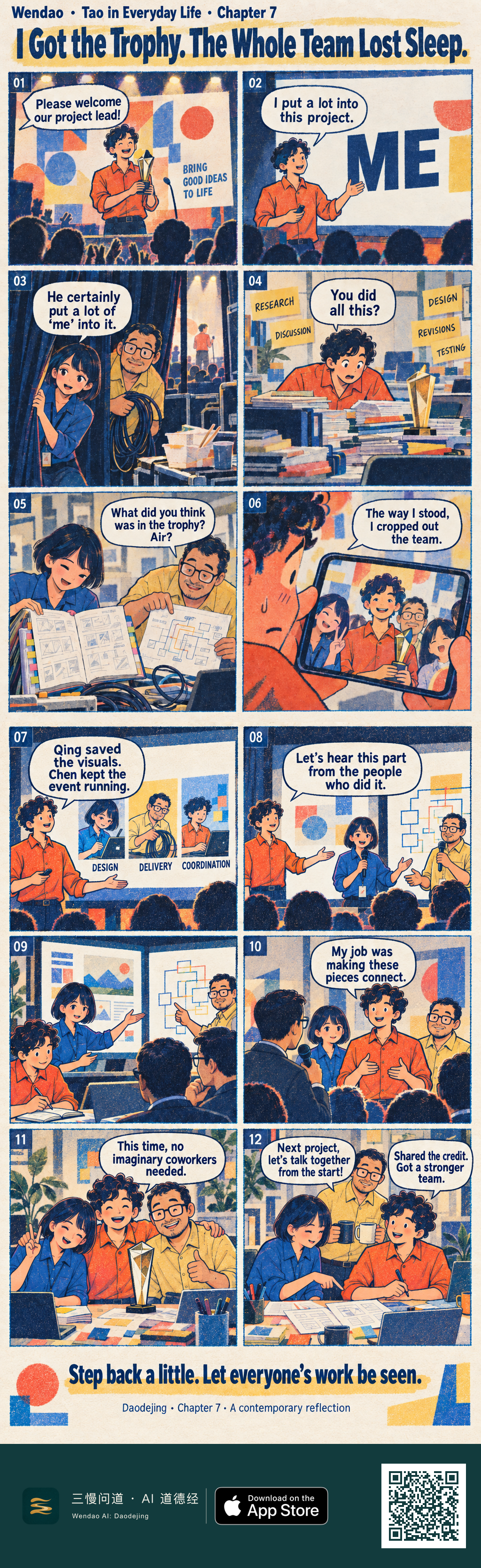
The opening makes its joke visually before anyone corrects the project lead. He stands under bright stage lights with the trophy, while the enormous word "ME" dominates the presentation screen behind him. His line, "I put a lot into this project," is not false, but the composition makes his first-person framing comically oversized. The next panel cuts backstage, where Qing stands beside equipment and Chen is literally holding a thick coil of cable, with takeout containers and production clutter nearby. Qing's remark that he put a lot of "me" into it turns the contrast between polished stage and unseen labour into the first punch line.
The office scenes make that hidden work concrete rather than abstract. The lead sits amid stacks of papers and books, with the trophy still visible nearby, while sticky notes name RESEARCH, DISCUSSION, DESIGN, REVISIONS, and TESTING. Qing and Chen then open plans and diagrams across the desk, and Chen jokes, "What did you think was in the trophy? Air?" The humour works because the award is physically present beside all the evidence of work that made it possible. In the following phone photograph, the lead notices how centrally he has placed himself while teammates are squeezed around him, turning his earlier way of telling the story into a visible problem of composition.
The lower page changes the behaviour rather than merely changing the speech. On the presentation slide, Qing is identified with DESIGN, Chen with DELIVERY, and the lead with COORDINATION. He then steps aside and says, "Let's hear this part from the people who did it." Qing and Chen take the microphones and explain their work while he sits at the side taking notes. Importantly, the comic does not erase his contribution: when questioned later, he says, "My job was making these pieces connect." The correction is therefore not that he did nothing, but that coordination is one real contribution among several real contributions.
The ending makes the new balance visible through objects and body placement. In the new team photograph, Qing, the lead, and Chen stand shoulder to shoulder, with the trophy shared at the centre of the table instead of functioning as a solitary badge. The lead jokes, "This time, no imaginary coworkers needed," a playful reversal of the earlier framing in which the team's labour had almost disappeared from his story. In the final panel, they are back around plans, laptops, pens, sticky notes, and coffee mugs. Chen proposes talking together from the start of the next project, while the lead answers, "Shared the credit. Got a stronger team."
The supplied passage from Chapter 7 speaks of Heaven and Earth enduring because they do not exist only for themselves. The comic uses that idea as a contemporary reflection on collaboration, not as a literal translation of the ancient text. Its closing line, "Step back a little. Let everyone's work be seen," is enacted visually: the lead remains present, names his coordinating role, and still helps connect the work, but no longer occupies the whole frame. The story does not promise that giving credit automatically produces loyalty or success; it simply shows how more accurate recognition can make a shared project feel genuinely shared.
The reason Heaven and Earth can endure and last is that they do not live for themselves; therefore they can endure for a long time.
Daodejing · Chapter 7
English rendering of the Silk B base reading excerpt
Think of one recent result you presented or celebrated. Write down one specific piece that someone else researched, designed, delivered, revised, tested, organized, or supported. In your next update or thank-you, name that contribution clearly while also stating, just as clearly, the part you were responsible for.