Read the comic reflection
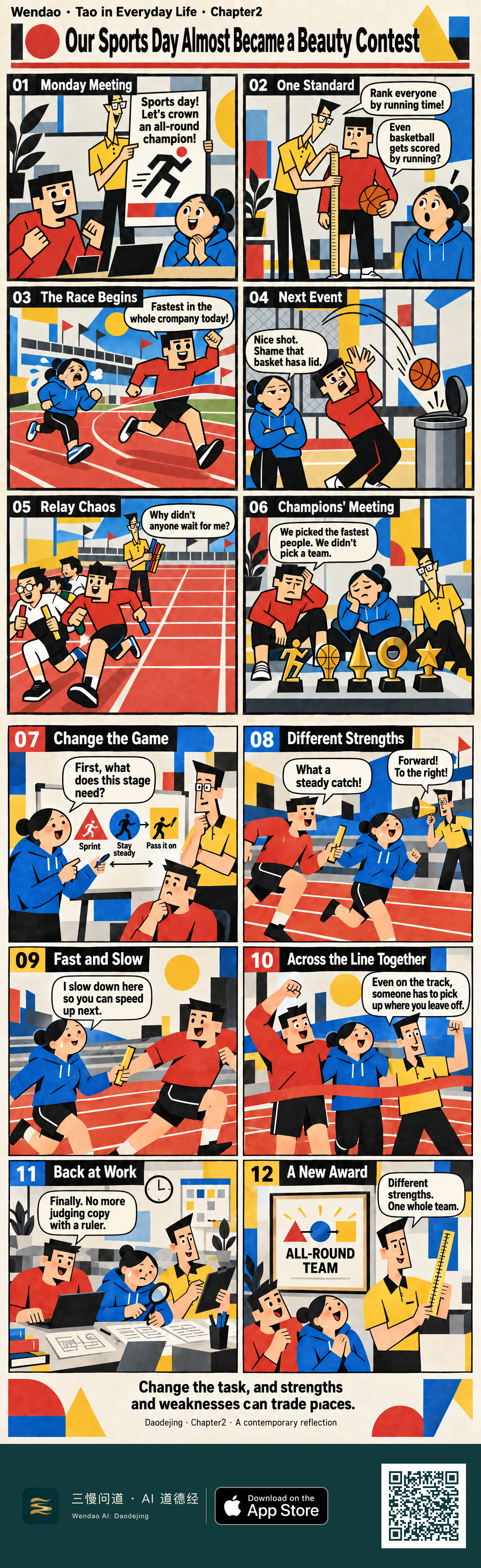
The opening joke is visual before it is philosophical. The tall yellow-shirt man with glasses announces an "all-round champion" while holding a ruler beside the red-shirt man, then proposes ranking everyone by running time. The red-shirt man immediately spots the mismatch: "Even basketball gets scored by running?" He really is fast in the next panel, charging across the track ahead of the blue-hoodie woman, but that strength belongs to a particular task rather than automatically becoming a universal measuring stick.
The basketball panel makes that mismatch concrete. The red-shirt man sends the ball sailing toward what looks like a target, only for the blue-hoodie woman to point out, "Nice shot. Shame that basket has a lid." The object is visibly a lidded trash bin, so the humour comes from applying confidence and athletic energy in the wrong setting, not from denying that he can run. The following relay scene pushes the same problem further: runners rush ahead while the yellow-shirt man is left holding a bundle of batons and asking why nobody waited for him.
The first page ends not with a victory but with three disappointed coworkers sitting behind a row of mismatched trophies. The red-shirt man sums up the problem: "We picked the fastest people. We didn't pick a team." That line turns the story away from individual rankings. The trophies are still there, but their variety now looks slightly absurd beside a group whose actual difficulty is coordination. Nothing in the scene claims that speed is bad; it simply shows that several impressive individual results have not yet solved the shared task.
The turning point comes when the blue-hoodie woman changes the question. In front of a diagram labeled "Sprint," "Stay steady," and "Pass it on," she asks, "First, what does this stage need?" The relay that follows gives those labels physical meaning. She receives a baton steadily, the yellow-shirt man directs from the side with a megaphone, and in the next panel she deliberately says, "I slow down here so you can speed up next." Slow and fast stop behaving like rival labels and become connected parts of one exchange.
By the finish-line panel, all three are crossing together, and the yellow-shirt man observes that someone has to pick up where another person leaves off. Back at work, the joke returns to the original measuring obsession: the red-shirt man works quickly at his laptop, the blue-hoodie woman examines pages with a magnifying glass, and the line "Finally. No more judging copy with a ruler." turns the old standard into an office gag. The final framed certificate reads "ALL-ROUND TEAM," while the yellow-shirt man still holds the ruler and says, "Different strengths. One whole team." Read alongside Chapter 2, this is not a literal translation of the text but a contemporary illustration of relational qualities: what counts as long, short, fast, slow, strong, or useful becomes clearer through contrast, context, and connection.
Long and short give shape to each other.
Daodejing · Chapter 2
English rendering of the Silk B base reading excerpt
Think of one shared task you are working on and name the different stages it actually requires. Before deciding who is "best," ask what each stage needs, then notice whether one person's slower, steadier, or more careful move makes the next person's work easier.