Read the comic reflection
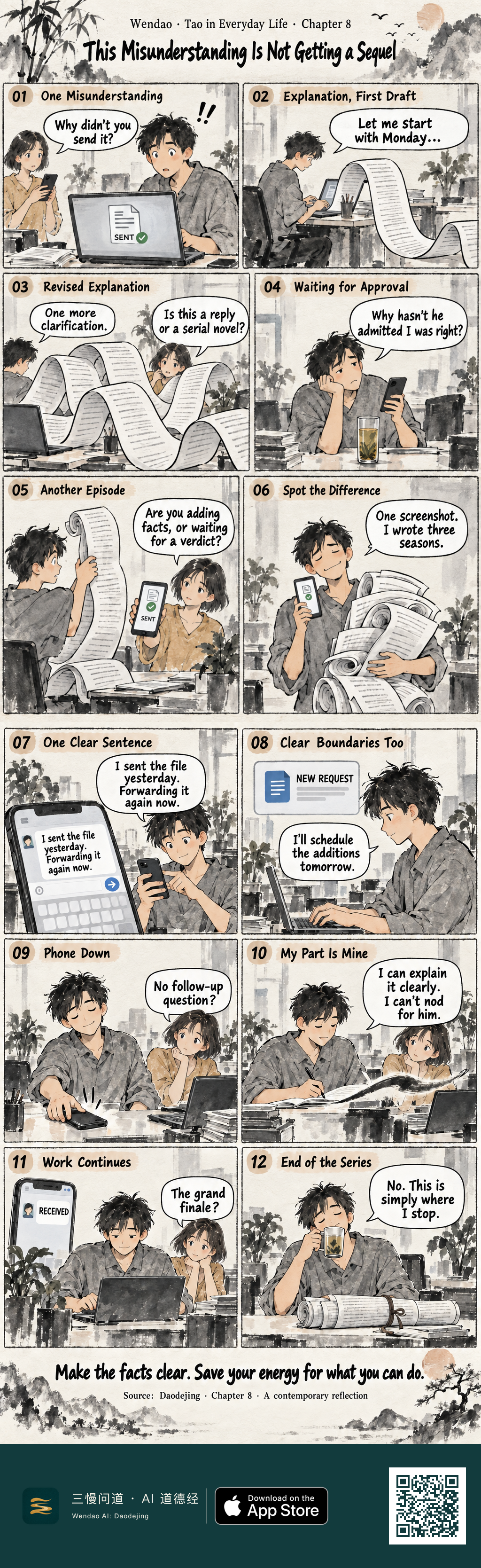
The opening joke is visible before the man even starts defending himself. The woman asks, "Why didn't you send it?" while the laptop directly in front of them already displays "SENT." Instead of letting that small piece of evidence do its job, he begins, "Let me start with Monday..." A single misunderstanding immediately grows into a long paper scroll that curls across the desk. By Panel 03, the scrolls have multiplied so dramatically that the woman's question, "Is this a reply or a serial novel?" becomes both the verbal joke and the visual one.
The middle of the first page shows what has quietly changed. The man is no longer only trying to establish what happened; he is staring at his phone and asking, "Why hasn't he admitted I was right?" The papers keep growing because the desired result has also grown. In Panel 05, the woman holds up the short "SENT" receipt while asking, "Are you adding facts, or waiting for a verdict?" Then Panel 06 makes the contrast deliberately absurd: the man holds one small screenshot in one hand and an armful of rolled explanations in the other, smiling as he admits, "One screenshot. I wrote three seasons."
The second page changes the scale of his response rather than pretending the misunderstanding never existed. In Panel 07, both his speech bubble and the enlarged phone message say, "I sent the file yesterday. Forwarding it again now." The giant paper saga has been replaced by one clear factual sentence and a concrete next step. When a "NEW REQUEST" appears in Panel 08, he does not absorb it silently or treat it as part of the old dispute. He states, "I'll schedule the additions tomorrow," making the boundary visible while continuing the work.
Panels 09 through 11 show that stopping the argument is not the same as withdrawing. The man places his phone down, and the woman, surprised by the lack of another explanatory installment, asks, "No follow-up question?" He answers while writing, "I can explain it clearly. I can't nod for him." The wording keeps responsibility divided: he can make his own communication clear, but he cannot manufacture another person's agreement. The next panel confirms that ordinary life continues—the laptop is open, the work is moving, and the phone gives only the modest acknowledgement "RECEIVED." The woman jokingly asks, "The grand finale?" but the receipt is not presented as an apology, victory, or complete agreement.
The final panel closes the recurring joke with a physical change on the desk. Instead of being buried under loose scrolls, the man calmly drinks tea beside a single long paper roll that has been tied shut. When he says, "No. This is simply where I stop," the comic does not suggest silence, surrender, or refusing to resolve misunderstandings. He has already stated the facts, resent the file, set a schedule for new work, and returned to what he can actually do. Read alongside Chapter 8, the ending offers a contemporary reflection on non-contention: not eliminating clear expression, but reducing the extra struggle to force a particular acknowledgement after one's own part has been done.
Precisely because he does not contend, he is free from blame.
Daodejing · Chapter 8
English rendering of the Silk B base reading excerpt
When you feel an explanation turning into another episode, separate the facts you still need to communicate from the response you hope to receive. State the facts and the next step briefly, keep any necessary boundary clear, and then consider returning your attention to the part that remains yours to do.