Read the comic reflection
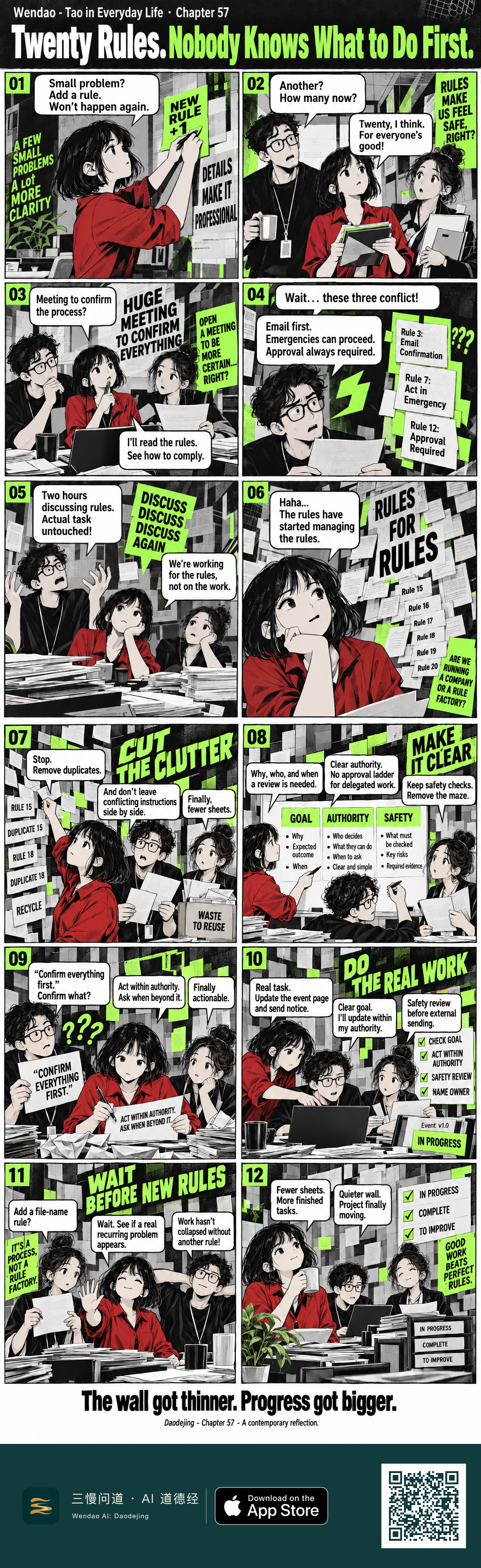
The joke begins without a villain. Gui, in her red shirt, is earnestly pinning yet another sheet to a wall already crowded with instructions: "Small problem? Add a rule. Won’t happen again." A neon-green card announces "NEW RULE +1," while the man with glasses soon asks the obvious question: "Another? How many now?" Gui answers, "Twenty, I think. For everyone’s good!" The humor comes from the gap between that sincere intention and the visual evidence behind them: every attempt to prevent one small mistake has made the wall, and the system, a little thicker.
The next step is no longer simply following rules but studying how to follow them. The three coworkers sit among laptops, mugs, folders, and growing stacks of paper while a huge sign declares "MEETING TO CONFIRM EVERYTHING." Then the man discovers the real puzzle: Rule 3 requires email confirmation, Rule 7 says to act in an emergency, and Rule 12 says approval is required. His startled "Wait... these three conflict!" turns bureaucracy into a logic problem. Before anyone can begin the actual task, they first have to decide which instruction is supposed to govern the others.
The turning point arrives when Gui looks at the multiplying notices and laughs, "The rules have started managing the rules." The second page changes the action instead of adding another sheet. Gui pulls down duplicates, including Rule 15 and Duplicate 15, while the man warns against leaving conflicting instructions side by side and the bun-haired woman celebrates having fewer sheets. They then replace the maze with a board divided into "GOAL," "AUTHORITY," and "SAFETY": why the work exists, who may decide or act, and what genuinely requires checking. The joke shifts from helpless accumulation to practical subtraction.
The cleanup becomes useful when the team rewrites an empty instruction into something executable. The man holds up "CONFIRM EVERYTHING FIRST" and asks, "Confirm what?" Gui replaces it with "Act within authority. Ask when beyond it," while crumpled paper balls on the desk quietly underline how much vague wording has already been discarded. They immediately test the new approach on a real assignment: update the event page and send a notice. The visible checklist is short and concrete—"CHECK GOAL," "ACT WITHIN AUTHORITY," "SAFETY REVIEW," and "NAME OWNER"—and the nearby "Event v1.0" card finally changes to "IN PROGRESS."
The ending does not argue that every rule should disappear. When the bun-haired woman asks, "Add a file-name rule?" Gui does not automatically say yes; she suggests waiting to see whether a real recurring problem appears, and the man jokes that work has not collapsed without another rule. In the last panel, some structure remains, but the wall is quieter and the desk now shows "IN PROGRESS," "COMPLETE," and "TO IMPROVE." Gui says, "Fewer sheets. More finished tasks," and her coworker answers, "Quieter wall. Project finally moving." The closing line, "The wall got thinner. Progress got bigger," connects the office comedy with Chapter 57’s concern about multiplying restrictions: attention once spent maintaining the rule system has been returned to the work itself.
The more prohibitions there are in the world, the poorer the people become.
Daodejing · Chapter 57
English rendering of the Silk B base reading excerpt
Take one real task that is currently slowed by an expanding set of rules. Remove duplicates, state the goal clearly, define what people may do within their authority, and keep only the safety checks that are genuinely necessary. Try working with that simpler structure before deciding whether another rule is actually needed.