Read the comic reflection
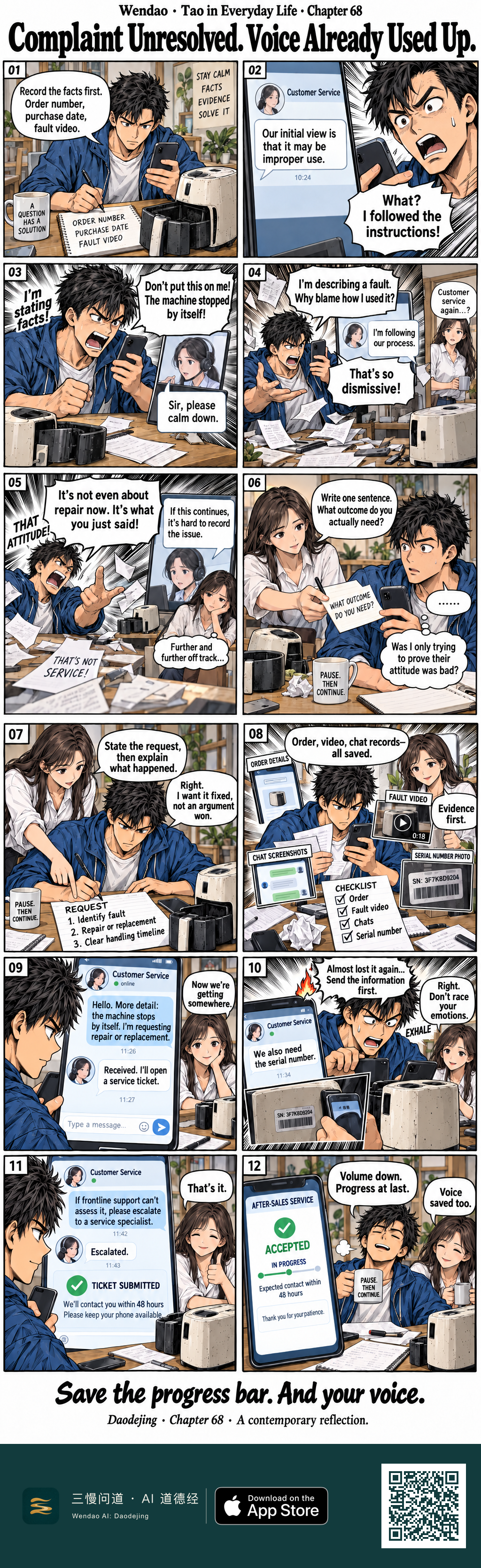
The opening joke is that the man is genuinely well prepared. The broken air fryer is already on the table, his notebook lists "ORDER NUMBER," "PURCHASE DATE," and "FAULT VIDEO," and the wall behind him literally says "STAY CALM / FACTS / EVIDENCE / SOLVE IT." Even his mug optimistically announces "A QUESTION HAS A SOLUTION." Then Customer Service replies, "Our initial view is that it may be improper use," and all that calm preparation detonates into manga speed lines, a sweat drop, wide eyes, and the shout, "What? I followed the instructions!" The problem has not changed, but the visual genre suddenly has.
What slips out of control is not the amount of information but the center of the conversation. The man begins with a concrete statement—"The machine stopped by itself!"—yet soon he is arguing about whether the reply is dismissive and shouting, "It's not even about repair now. It's what you just said!" Papers multiply across the desk while the actual appliance becomes almost background scenery. The friend first appears at the edge asking, "Customer service again...?" and later sits beside the chaos thinking, "Further and further off track..." The joke works because the page makes the detour physically visible: the louder the dispute becomes, the less attention the broken machine seems to receive.
Panel 06 changes the rhythm without pretending the frustration never happened. Instead of joining the argument or giving a vague instruction to calm down, the friend hands over a note and asks, "What outcome do you actually need?" That question becomes the turning point. On the next page, the man writes a practical request: identify the fault, seek repair or replacement, and get a clear handling timeline. He then gathers the order details, fault video, chat screenshots, and serial-number photo into a visible checklist. The shift is small but concrete: the energy that had been going into proving that the other side's attitude was bad is redirected into information another person can actually act on.
The later humor comes from the fact that this new approach does not magically make the man serene. When Customer Service asks for the serial number, a tiny flame appears beside his head and he admits, "Almost lost it again... Send the information first." The friend answers, "Right. Don't race your emotions," while the comic adds the SFX "EXHALE." Having already requested repair or replacement, he sends the extra information and later asks for escalation to a service specialist if frontline support cannot assess the issue. The visual payoff is that flying papers and angry captions are gradually replaced by a submitted ticket, a green check mark, and an orderly progress display.
The ending carefully stops short of claiming that the air fryer has already been fixed. The phone shows "ACCEPTED," "IN PROGRESS," and "Expected contact within 48 hours," while the man finally leans back with the "PAUSE. THEN CONTINUE." mug and says, "Volume down. Progress at last." The friend adds, "Voice saved too," which turns the chapter's original joke into a gentler closing beat. Read alongside the supplied Daodejing passage, the comic suggests a contemporary association rather than a literal translation: handling conflict effectively may sometimes mean reducing the contest itself and putting facts, boundaries, requests, and process back in front. The final footer, "Save the progress bar. And your voice," keeps that idea practical—and keeps the resolution honestly pending.
Those skilled in being warriors are not warlike; those skilled in battle are not angry; those skilled at defeating an enemy do not contend with them; those skilled at employing others place themselves below them.
Daodejing · Chapter 68
English rendering of the Silk B base reading excerpt
The next time a complaint starts turning into an argument, write one sentence first: "What outcome do I actually need?" Then separate the facts, evidence, and requested remedy into distinct notes. If the conversation still stalls, use the appropriate escalation process instead of spending more energy proving whose attitude was worse.