Read the comic reflection
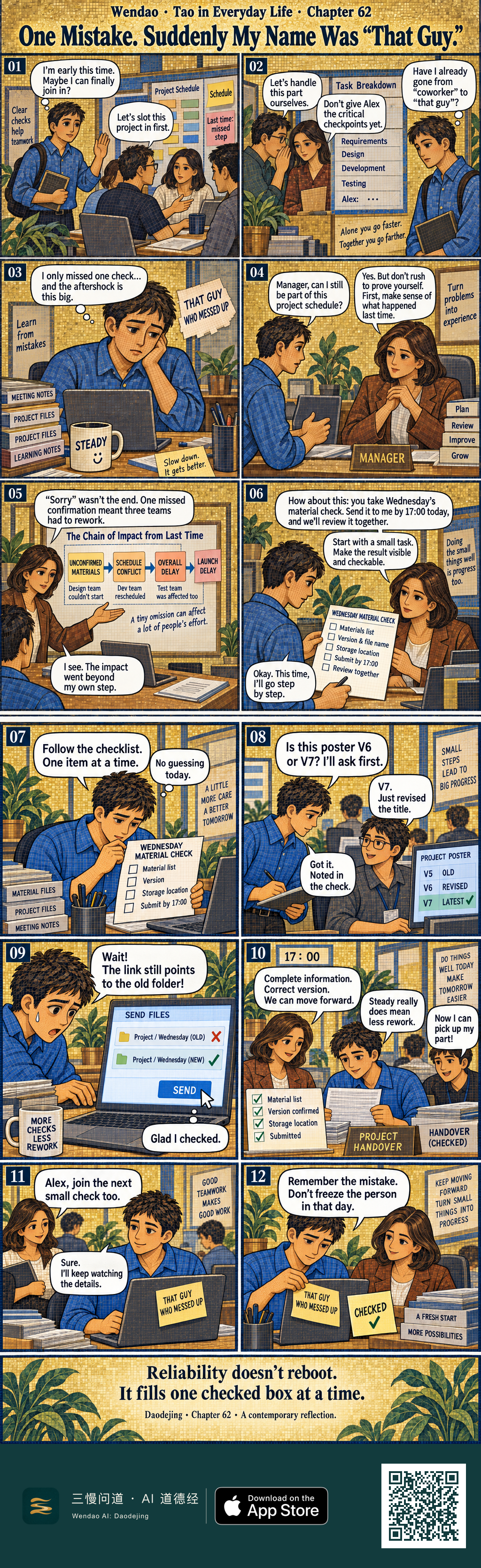
The opening joke has a slightly painful edge. Alex arrives early with his notebook, hoping he can finally join the project again, but the team quietly routes important work around him. A schedule note still records the "missed step," and by the next panel he is wondering whether he has gone from "coworker" to "that guy." The comic never shows anyone publicly attacking him; the awkwardness comes from something more ordinary and recognizable: people are still polite, but they are no longer ready to place critical checkpoints in his hands.
The first real turn comes when Alex asks the manager whether he can still be part of the project. She does not tell him to forget the mistake or rush to prove himself. Instead, they reconstruct what happened. The board titled "The Chain of Impact from Last Time" shows unconfirmed materials leading to a schedule conflict, then an overall delay and finally a launch delay, with design, development and testing all affected. That makes Alex's line, "The impact went beyond my own step," more than an apology: he is beginning to see the mistake from the team's side rather than only from his own embarrassment.
The manager then converts improvement into something concrete. She gives Alex Wednesday's material check and asks him to send it by 17:00 so they can review it together. The checklist names the material list, version, storage location and submission time. On the second page, the humour becomes deliberately mundane: Alex follows the list, refuses to guess whether the poster is V6 or V7, asks a coworker, and writes down that V7 is the latest version. The nearby office slogans about small steps and careful work make the scene feel gently self-aware rather than grand.
The best visual punch line arrives just before Alex sends the files. The cursor is already near the SEND button when he notices that the link still points to the old folder. His startled "Wait!" is followed by the much calmer "Glad I checked," while the mug beside the laptop reads "MORE CHECKS LESS REWORK." At 17:00, the manager confirms that the information is complete and the version is correct, Alex admits that being steady really does mean less rework, and a coworker can immediately pick up the next part. No one gives him a dramatic redemption speech; the checked boxes simply make the handoff work.
The ending keeps that recovery small enough to feel believable. In panel 11, the manager invites Alex to join the next small check, and he answers that he will keep watching the details. In the final panel, the old "THAT GUY WHO MESSED UP" note is being displaced by a new "CHECKED" note, beside books labeled "A FRESH START" and "MORE POSSIBILITIES." The manager's closing reminder, "Remember the mistake. Don't freeze the person in that day," echoes the supplied Daodejing line without pretending the office story is its only possible meaning. The footer makes the comic's contemporary interpretation explicit: reliability does not reboot; it returns one checked box at a time.
If a person is not good, why should they be cast aside?
Daodejing · Chapter 62
English rendering of the Silk B base reading excerpt
If you are tempted to prove that you are "not that person" after a mistake, try replacing one explanation with one visible, checkable action. Make a short checklist, confirm one uncertain detail, deliver one clearly labeled result, and let the next step give other people fresh evidence to work with.