Read the comic reflection
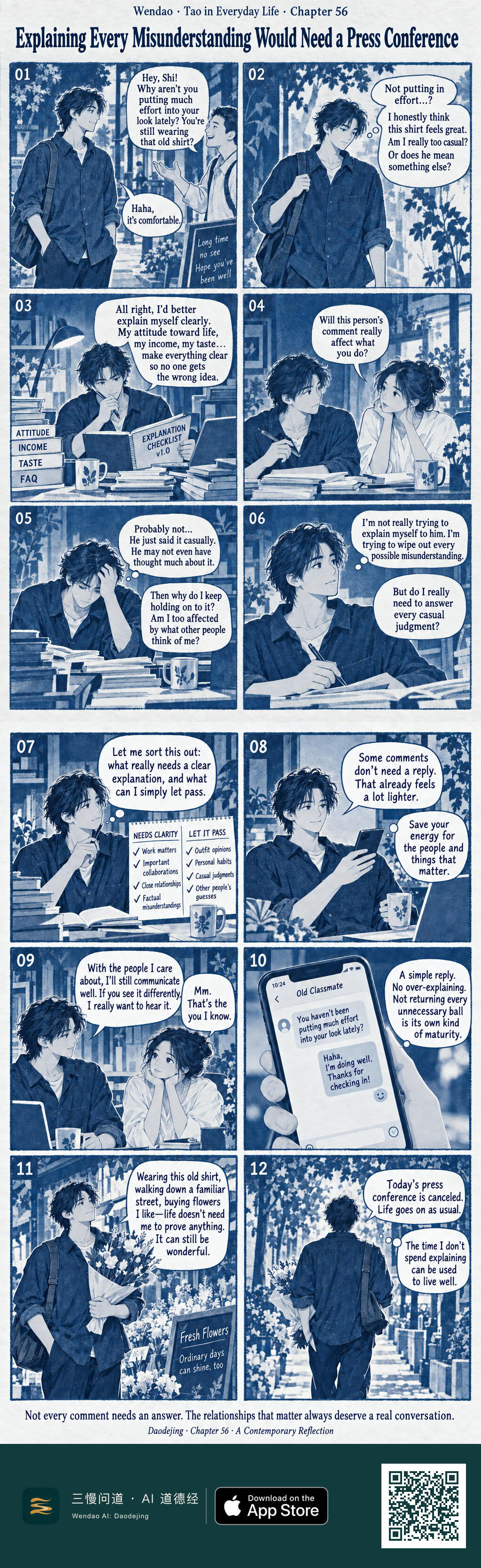
The joke begins with something almost weightless. An acquaintance greets Shi outdoors and asks why he has not been putting much effort into his look lately, pointing out that he is still wearing the same old shirt. Shi simply laughs and says, "It's comfortable." Yet once he is walking alone with his shoulder bag, the comment expands in his head: perhaps he is too casual, perhaps the other man meant something deeper, perhaps there is something he ought to correct. Even the little background sign saying "Long time no see / Hope you've been well" makes the encounter feel ordinary, which is exactly why Shi's private escalation is funny.
Back at the desk, one casual remark has somehow acquired paperwork. Shi sits among stacks of books, a floral mug, a lamp, and a notebook titled "EXPLANATION CHECKLIST v1.0," while the nearby spines read "ATTITUDE," "INCOME," "TASTE," and "FAQ." He is preparing to explain his whole way of living so nobody can get the wrong idea. The turning point arrives when the woman in the white blouse leans toward him and asks, "Will this person's comment really affect what you do?" That practical question cuts through the imagined press conference. In the next panel, with his hand buried in his hair, Shi admits that the speaker may barely have thought about the remark at all, while he is still carrying it.
The second page does not turn Shi into someone who refuses every conversation. Instead, he does what this very earnest character would naturally do: he makes another list. His page divides things into "NEEDS CLARITY" and "LET IT PASS." Work matters, important collaborations, close relationships, and factual misunderstandings belong on one side; outfit opinions, personal habits, casual judgments, and other people's guesses belong on the other. There is a warm visual joke in the method itself: even learning not to explain everything apparently requires Shi to organize the lesson with headings and check marks.
He then tests the distinction in two different relationships. With the woman, Shi says that when he cares about someone, he still wants to communicate well and hear a different view; she answers, "Mm. That's the you I know." With the old classmate on his phone, however, he does not send a defensive essay. The incoming message again questions how much effort he is putting into his appearance, and Shi replies only, "Haha, I'm doing well. Thanks for checking in!" The nearby thought bubble describes the new approach as a simple reply with no over-explaining. The change is therefore not silence for its own sake, but a decision about where fuller conversation is actually worth the energy.
The ending returns Shi to the same old shirt rather than giving him a makeover as proof of growth. He walks along a familiar street carrying flowers he likes, beside a sign reading "Fresh Flowers" and "Ordinary days can shine, too." In the final rear-view panel, bouquet in hand and shoulder bag at his side, he declares, "Today's press conference is canceled. Life goes on as usual," while another thought adds that time not spent explaining can be used to live well. The comic's connection to the supplied line from the Daodejing works as a contemporary reflection on the limits of speech: some misunderstandings deserve clarification, especially where facts, cooperation, or valued relationships are involved, while other passing judgments do not have to be eliminated through ever more words.
Those who know do not speak; those who speak do not know.
Daodejing · Chapter 56
English rendering of the Silk B base reading excerpt
The next time you feel an immediate urge to explain yourself, make two quick columns. Ask whether the issue affects facts, work, cooperation, or a relationship you genuinely value. If it is only a passing judgment or speculation, try leaving it unanswered or giving a brief reply. If it comes from someone important to you, make time for the fuller conversation instead.