Read the comic reflection
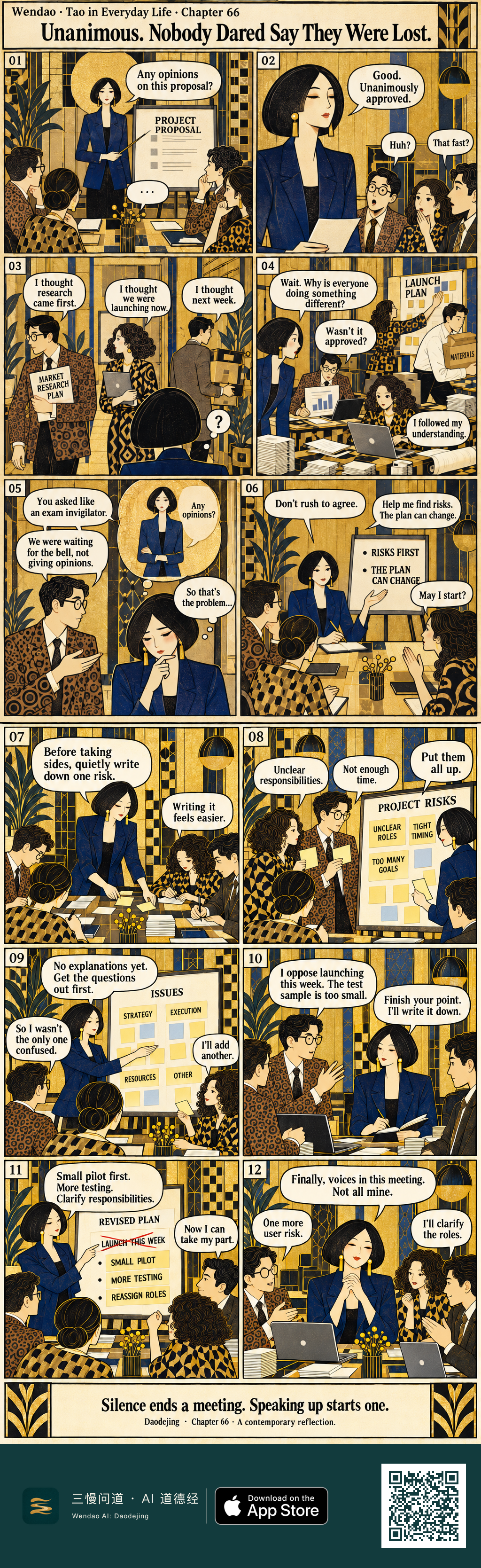
The opening joke is hidden inside an almost comically proper meeting. The leader, in her dark blue jacket and sharp bob, stands beneath a large gold circle and points toward a board labeled "PROJECT PROPOSAL." Around the table, her patterned-outfit colleagues offer nothing but a tiny "..." bubble. One panel later she announces, "Good. Unanimously approved," only for two startled reactions — "Huh?" and "That fast?" — to puncture the apparent consensus. The vote looks unanimous, but the faces make clear that silence and understanding were never the same thing.
The cost of that silence becomes physical in the next panels. The glasses-wearing man carries a "MARKET RESEARCH PLAN" because he thought research came first; the curly-haired woman holds her laptop because she thought they were launching immediately; another man, carrying boxes, says he thought it was happening next week. Soon the office is crowded with charts, paper stacks, laptops, a "LAUNCH PLAN" board and a box marked "MATERIALS." Everyone is working earnestly, which is exactly what makes the confusion funny: they are all moving with confidence in different directions.
The turning point comes when the leader discovers that the problem was not simply the wording of her question. The glasses-wearing colleague tells her, "You asked like an exam invigilator. We were waiting for the bell, not giving opinions." The inset repeats her earlier "Any opinions?" while showing the same upright, formal posture, and her thought — "So that's the problem..." — lands as a small piece of self-recognition. She changes the structure of the conversation, writing "RISKS FIRST" and "THE PLAN CAN CHANGE" on the board and telling the group, "Don't rush to agree. Help me find risks." The immediate reply, "May I start?", shows how quickly a room can feel different when disagreement is visibly permitted.
The second page turns that change into a sequence of concrete actions. First everyone writes quietly, with the curly-haired woman admitting, "Writing it feels easier." Then the notes go onto the "PROJECT RISKS" board: "UNCLEAR ROLES," "TIGHT TIMING" and "TOO MANY GOALS." The leader next organizes an "ISSUES" board into "STRATEGY," "EXECUTION," "RESOURCES" and "OTHER," while insisting, "No explanations yet. Get the questions out first." One colleague realizes, "So I wasn't the only one confused," and another says, "I'll add another." The warm joke here is that the room suddenly contains plenty of opinions once nobody has to pretend to be the first person with a problem.
The clearest test arrives when the glasses-wearing man finally says, "I oppose launching this week. The test sample is too small." Instead of defending the original plan, the leader answers, "Finish your point. I'll write it down." In the next panel, "LAUNCH THIS WEEK" is visibly crossed out and replaced by "SMALL PILOT," "MORE TESTING" and "REASSIGN ROLES," prompting a colleague to say, "Now I can take my part." The final panel completes the reversal: one man adds "One more user risk," the curly-haired woman says, "I'll clarify the roles," and the leader smiles, "Finally, voices in this meeting. Not all mine." The footer — "Silence ends a meeting. Speaking up starts one." — connects naturally with Chapter 66: authority can make more room for others by lowering its own voice and stepping out of the center, without claiming that this office story is a literal or exclusive interpretation of the classical passage.
Therefore, when the sage wishes to stand above the people, he must place his words below them; when he wishes to stand before the people, he must place himself behind them.
Daodejing · Chapter 66
English rendering of the Silk B base reading excerpt
The next time you ask a group for feedback, try giving everyone one quiet minute to write down a single risk before anyone speaks. Invite the risks first, and if someone disagrees, write down their full reason before debating it. Make "you may disagree" visible in the process, not merely polite wording.