Read the comic reflection
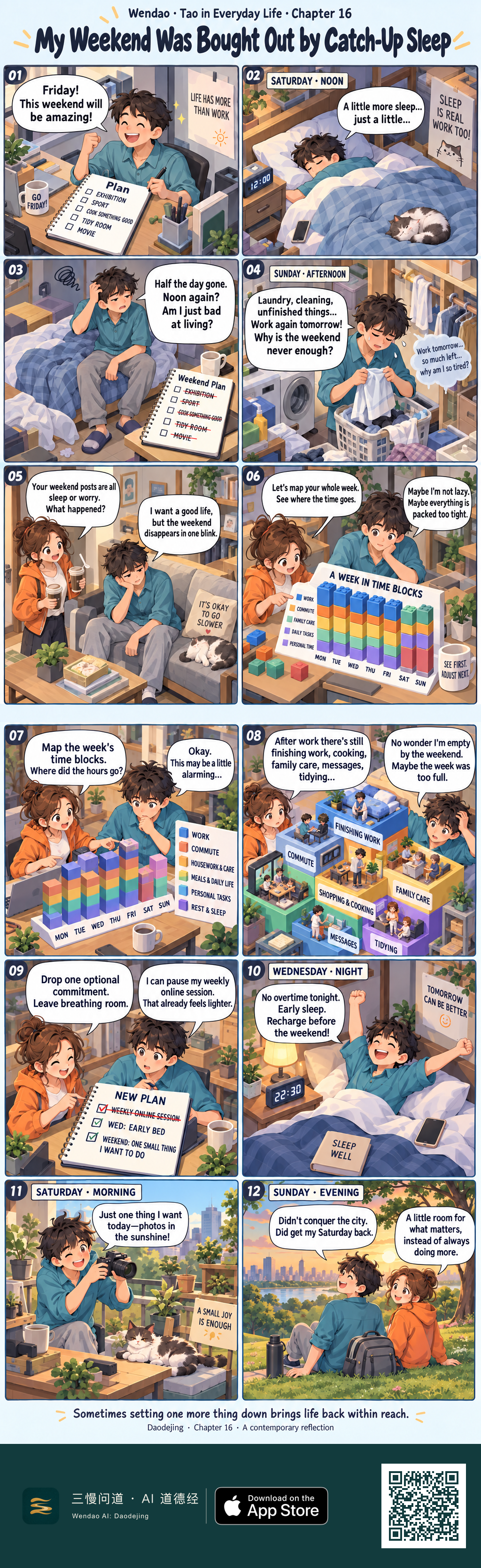
The opening joke is built from a sharp visual reversal. On Friday, the man sits at his desk grinning, fist raised beside a notebook headed "Plan," with EXHIBITION, SPORT, COOK SOMETHING GOOD, TIDY ROOM, and MOVIE all waiting neatly to happen. Even the mug cheers "GO FRIDAY!" and the wall insists "LIFE HAS MORE THAN WORK." One panel later, the clock reads 12:00, he is buried under the blue duvet saying, "A little more sleep... just a little...," and the gray-and-white cat is sleeping beside him with complete professional confidence. The poster "SLEEP IS REAL WORK TOO!" makes the contrast even funnier without turning his tiredness into a diagnosis.
The next panels make the cost of the week concrete rather than abstract. The man wakes to a "Weekend Plan" covered in red crossings and asks, "Am I just bad at living?" Then Sunday afternoon puts him in front of the washing machine with a full laundry basket, hanging clothes, detergent, and unfinished household work while he worries that work starts again tomorrow. When the woman in the orange hoodie arrives carrying two drinks, she does not answer that question for him. Instead, after noticing that his weekend posts are "all sleep or worry," she helps move the conversation from self-judgment to observation.
That change of perspective becomes visible through the colorful time blocks. First, the pair map MON through SUN into WORK, COMMUTE, HOUSEWORK & CARE, MEALS & DAILY LIFE, PERSONAL TASKS, and REST & SLEEP. Then the comic turns those categories into a miniature stacked world: FINISHING WORK sits above COMMUTE, SHOPPING & COOKING, FAMILY CARE, MESSAGES, and TIDYING, with tiny figures still doing things inside every level. The visual joke is that his supposed "free time" looks suspiciously like another office building. His line, "Maybe the week was too full," lands because the picture has already shown the accumulation of necessary work and care.
The turning point is deliberately small. The woman suggests, "Drop one optional commitment. Leave breathing room," and the notebook shows WEEKLY ONLINE SESSION crossed out rather than another ambitious goal added. The replacement plan is modest: "WED: EARLY BED" and "WEEKEND: ONE SMALL THING I WANT TO DO." On Wednesday night, the clock reads 22:30 as the man stretches happily in bed and declares, "No overtime tonight. Early sleep. Recharge before the weekend!" The notebook says "SLEEP WELL," while the wall says "TOMORROW CAN BE BETTER." The comic does not pretend that work, commuting, cooking, care, or tidying disappeared; it shows one optional demand being removed so the remaining week has a little more space.
The ending keeps that smaller scale. On Saturday morning, the man does exactly one wanted thing: he takes his camera into the sunshine while the cat lounges nearby beneath the sign "A SMALL JOY IS ENOUGH." By Sunday evening, he and the woman are sitting on the grass with a backpack and bottle beside them, facing the distant city rather than racing through it. He jokes, "Didn't conquer the city. Did get my Saturday back," and she answers that there can be "a little room for what matters, instead of always doing more." Read alongside "All things arise together, and I observe their return.," this works as a contemporary association rather than a literal illustration: the story watches a crowded cycle closely enough to notice where some return, release, and renewed room might become possible.
All things arise together, and I observe their return.
Daodejing · Chapter 16
English rendering of the Silk B base reading excerpt
Try making a small version of the comic's time-block chart for one ordinary week. Include work, commuting, housework, caring for others, daily tasks, personal tasks, and actual rest. Do not optimize it immediately. First notice what is already taking the space, then see whether one genuinely optional commitment could be paused to leave a little breathing room.