Read the comic reflection
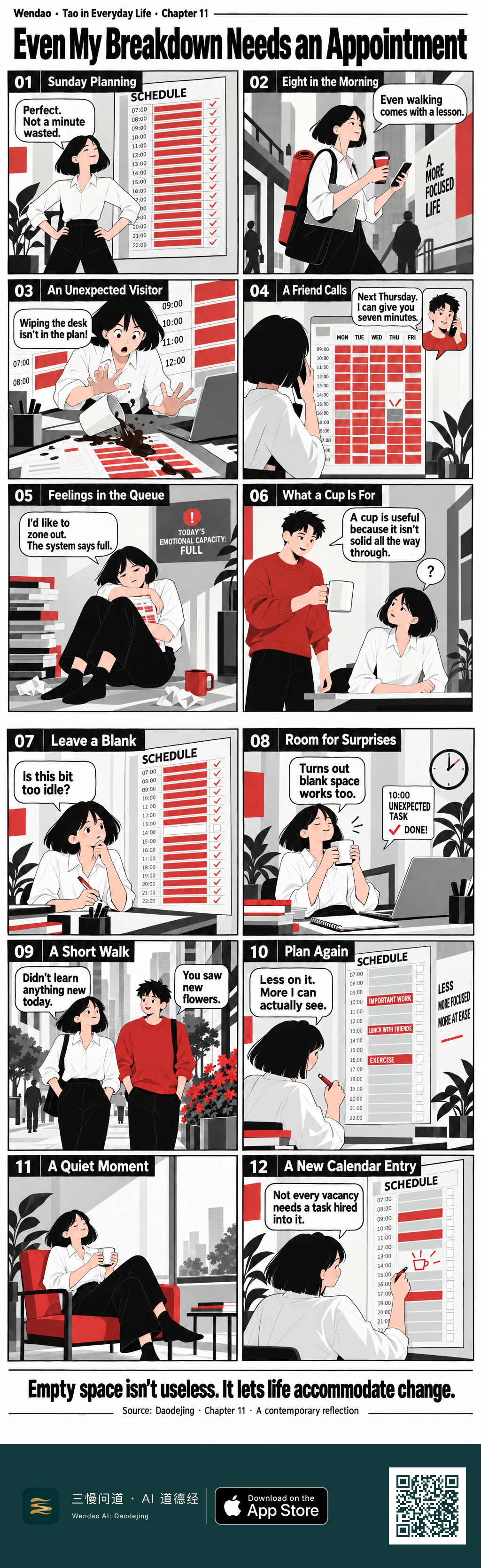
The opening joke is almost entirely visual: everything is full. In panel 01, the woman stands with hands on hips beside a towering SCHEDULE whose hours are packed with red bars and check marks, declaring, "Perfect. Not a minute wasted." Panel 02 pushes the same idea into motion. She walks through the city holding a coffee and phone, with a bag, device, and rolled mat hanging from her, while saying, "Even walking comes with a lesson." The strict black-white-gray grid and red accents make the page look wonderfully organized, which makes her overloaded routine even funnier.
The first crack in that perfect system arrives as something very small and very physical: coffee spills across the desk and over the carefully printed schedule. Her alarmed line, "Wiping the desk isn't in the plan!", treats a puddle like a scheduling emergency. The next panel extends the joke into friendship when she tells the caller, "Next Thursday. I can give you seven minutes." By panel 05, the red blocks are still orderly, but she is curled up on the floor among tissues, books, and a red mug beneath a warning that reads, "TODAY'S EMOTIONAL CAPACITY: FULL." The calendar remains composed while the person using it clearly needs room.
The turning point is not another productivity system but an ordinary empty cup. In panel 06, the short-haired man in the red sweater holds up the white mug and says, "A cup is useful because it isn't solid all the way through." Her small question mark keeps the moment light rather than solemn. On the lower page, she tests the idea literally by leaving one pale gap in an otherwise crowded schedule. Panel 08 then lets an unexpected task fit into that space, marked "10:00 / UNEXPECTED TASK / DONE!" She is shown calmly holding her cup, so the blank is not presented as wasted time but as usable margin.
The visual rhythm loosens after that. In panel 09, the woman and the man walk side by side without phones in their hands, while a bright cluster of red flowers becomes the scene's strongest accent. She says, "Didn't learn anything new today," and he answers, "You saw new flowers." Panel 10 keeps planning intact but reduces the calendar to a few large entries: IMPORTANT WORK, LUNCH WITH FRIENDS, and EXERCISE. The nearby wall reads "LESS / MORE FOCUSED / MORE AT EASE," and panel 11 goes further by removing dialogue altogether: she simply reclines in a red chair with a cup, framed by a window, plants, and open wall space.
The ending does not throw the calendar away. In panel 12, the woman still faces a SCHEDULE with real work blocks on it, but she draws a small red cup inside an empty slot and says, "Not every vacancy needs a task hired into it." The closing line, "Empty space isn't useless. It lets life accommodate change," matches the story's concrete visual shift from a completely packed grid to one that contains both commitments and gaps. This offers a contemporary reflection on the supplied Daodejing line: visible structure can provide practical benefit, while what remains unfilled can provide another kind of use. That connection is a modern reading of the image, not a claim that the ancient sentence has only one meaning.
Thus, what is there provides benefit; what is not there provides use.
Daodejing · Chapter 11
English rendering of the Silk B base reading excerpt
Try choosing one small item in today's or tomorrow's schedule that would be genuinely fine to leave undone. Let that space stay unassigned for a while instead of immediately turning it into another task. A delay, a short walk, a cup of tea, an unexpected request, or simply nothing at all can be allowed to arrive there on its own.