Read the comic reflection
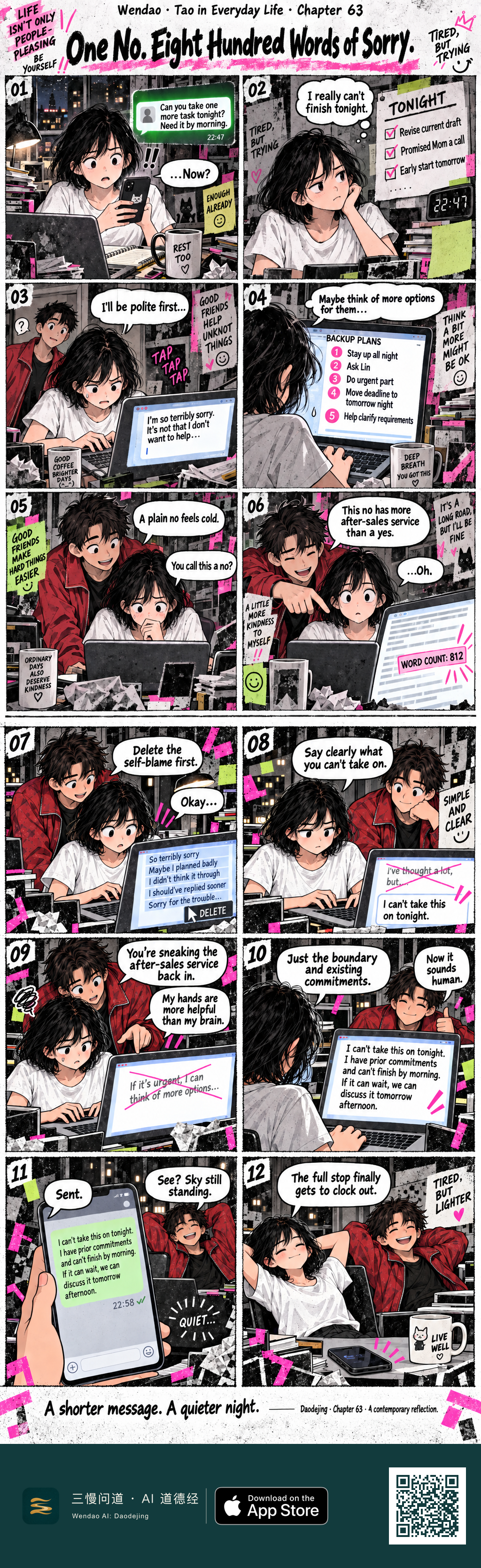
The opening joke comes from an instantly recognizable mismatch. At 22:47, the woman in the white T-shirt is already surrounded by a laptop, notebooks, books, a mug, and the clutter of a very full night when her phone lights up with, "Can you take one more task tonight? Need it by morning." Her startled "...Now?" is followed by the quieter truth in the next panel: "I really can't finish tonight." The checklist beside her makes the conflict concrete—revise the current draft, call Mom as promised, and get an early start tomorrow—yet knowing she has no room does not stop her from preparing to make the refusal sound exceptionally accommodating.
What begins as an explanation quickly becomes another project. She types, "I'm so terribly sorry. It's not that I don't want to help..." while her friend in the red jacket arrives behind her to the comic sound of "TAP TAP TAP." Then she opens a screen titled "BACKUP PLANS" and starts inventing five ways to rescue the situation anyway: stay up all night, ask Lin, do the urgent part, move the deadline, or help clarify requirements. Her worry is not merely about saying no; she is already doing extra work inside the refusal. That is why the friend's question, "You call this a no?", lands so neatly, and why his next joke—"This no has more after-sales service than a yes."—turns the visible "WORD COUNT: 812" into the punch line.
The turning point is not a sudden switch to toughness. It is editing. On the second page, her friend first says, "Delete the self-blame first," and the screen shows a whole cluster of apologetic lines selected for deletion: "So terribly sorry," "Maybe I planned badly," "I didn't think it through," "I should've replied sooner," and "Sorry for the trouble..." Then he asks her to "Say clearly what you can't take on." A vague lead-in—"I've thought a lot, but..."—is crossed out and replaced with the plain sentence, "I can't take this on tonight." When she immediately starts adding, "If it's urgent, I can think of more options...", he catches the habit returning and calls it "the after-sales service" sneaking back in.
By panel 10, the message has become much shorter without becoming hostile. The woman says, "Just the boundary and existing commitments," while her friend answers, "Now it sounds human." On the laptop, the final wording is specific and ordinary: "I can't take this on tonight. I have prior commitments and can't finish by morning. If it can wait, we can discuss it tomorrow afternoon." The sentence does not attack the requester, and it does not offer five compensating plans. It simply names what she cannot do, why the timing does not work, and when a later conversation would actually be possible.
In panel 11 she finally sends the message at 22:58. The phone displays the same short reply, the room goes "QUIET...", and her friend laughs, "See? Sky still standing." Nothing dramatic happens, which is precisely the final joke: the catastrophe her long draft seemed designed to prevent never arrives on the page. In the last panel, both characters lean back with relieved smiles, the phone lies dark on the desk, the mug says "LIVE WELL," and a note reads "TIRED, BUT LIGHTER." Her line, "The full stop finally gets to clock out," gives the punctuation its own tiny workday. The comic connects naturally with the chapter's line about light promises and underestimated difficulty: making both yes and no match what can really be done can keep commitments clearer and more credible. That is a contemporary reflection on the passage, not the only possible reading of it.
Those who promise lightly are bound to be little trusted; those who take many things as easy are bound to meet with many difficulties.
Daodejing · Chapter 63
English rendering of the Silk B base reading excerpt
The next time a last-minute request arrives, try deleting one sentence of self-blame and one compensation you cannot realistically carry. Keep only what matters: whether you can do it, what you can actually take on, and when you could reasonably continue. Then see whether the shorter message already makes the boundary clear.