Read the comic reflection
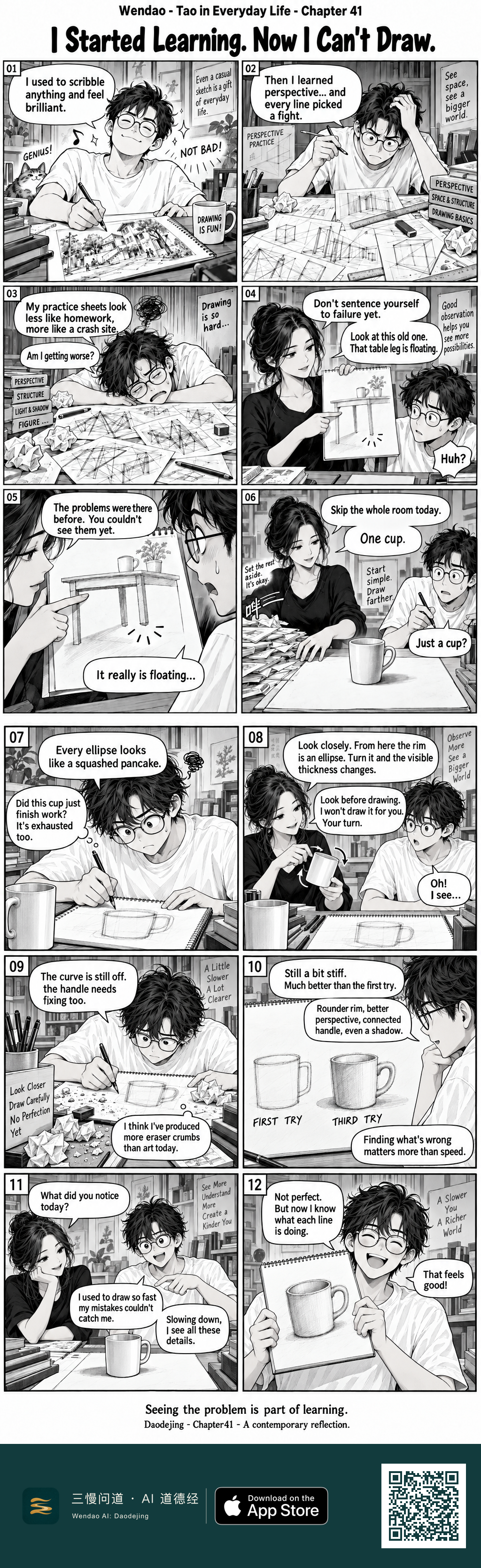
The opening makes the contradiction of learning more and feeling less capable immediately visible. In panel 01, the young man in a white T-shirt and round glasses smiles over a lively street sketch while a cat sits nearby, the mug declares "DRAWING IS FUN!", and handwritten praise such as "GENIUS!" and "NOT BAD!" surrounds him. One panel later, the mood flips: perspective books, rulers, construction lines, crumpled paper, and a crowded desk replace that easy confidence. He grips his hair and says that after learning perspective, "every line picked a fight." The joke works because nothing dramatic has happened except that he has learned enough to notice how unruly those lines really are.
Panel 03 pushes the frustration into visual comedy. The young man collapses across a table buried under perspective diagrams, discarded sheets, pencils, erasers, and books labeled "PERSPECTIVE," "STRUCTURE," "LIGHT & SHADOW," and "FIGURE...." His description of the practice sheets as "more like a crash site" is almost literal in the composition. The turning point arrives when the woman in the dark top produces one of his older drawings. Instead of telling him he has suddenly become worse, she points to a table leg that appears to float. His surprised "Huh?" becomes important: the flaw was already there, but now he has the eyes to recognize it.
The woman does not repair the old drawing for him or add another complicated lesson. She reduces the task to the real cup sitting on the table: "Skip the whole room today. One cup." In panel 07, his first attempt makes the rim look like a flattened pancake, and his thought bubble jokes that the cup seems exhausted after finishing work. In panel 08, she physically rotates a mug and asks him to notice how the rim remains an ellipse while its visible thickness changes with the angle. She explicitly refuses to draw it for him. The action shifts the lesson from collecting more instructions to looking more carefully at the object already in front of him.
The next panels show improvement as a messy process rather than a magical correction. He studies the curve, adjusts the handle connection, erases repeatedly, and ends up surrounded by so many crumbs and crumpled scraps that he jokes he has produced more eraser debris than art. Panel 10 places the "FIRST TRY" beside the "THIRD TRY," making the changes concrete: the later cup has a rounder rim, clearer perspective, a more convincing handle connection, and a shadow. His comment that finding what is wrong matters more than speed shows a new kind of progress. He is no longer measuring success only by whether a drawing looks finished quickly.
The ending keeps the result deliberately imperfect. When the woman asks what he noticed, he jokes that he used to draw so fast that his mistakes could not catch him; now, by slowing down, he can see more details. In the final panel he beams while holding up the cup sketch and says, "Not perfect. But now I know what each line is doing. That feels good!" The closing caption, "Seeing the problem is part of learning," connects naturally with the chapter's Daoist excerpt without claiming the comic is a literal interpretation. One possible contemporary reflection is that progress can temporarily feel like retreat when greater understanding makes previously invisible problems visible.
Therefore an established saying goes: The bright Way seems dim; advancing on the Way seems like retreating; the level Way seems rough.
Daodejing · Chapter 41
English rendering of the Silk B base reading excerpt
If something recently feels harder the more you learn about it, try shrinking the task to the size of one cup. Observe one specific problem, change one thing, and compare before and after. The aim is not to force a perfect result, but to see whether you can describe more clearly what changed and why.