Read the comic reflection
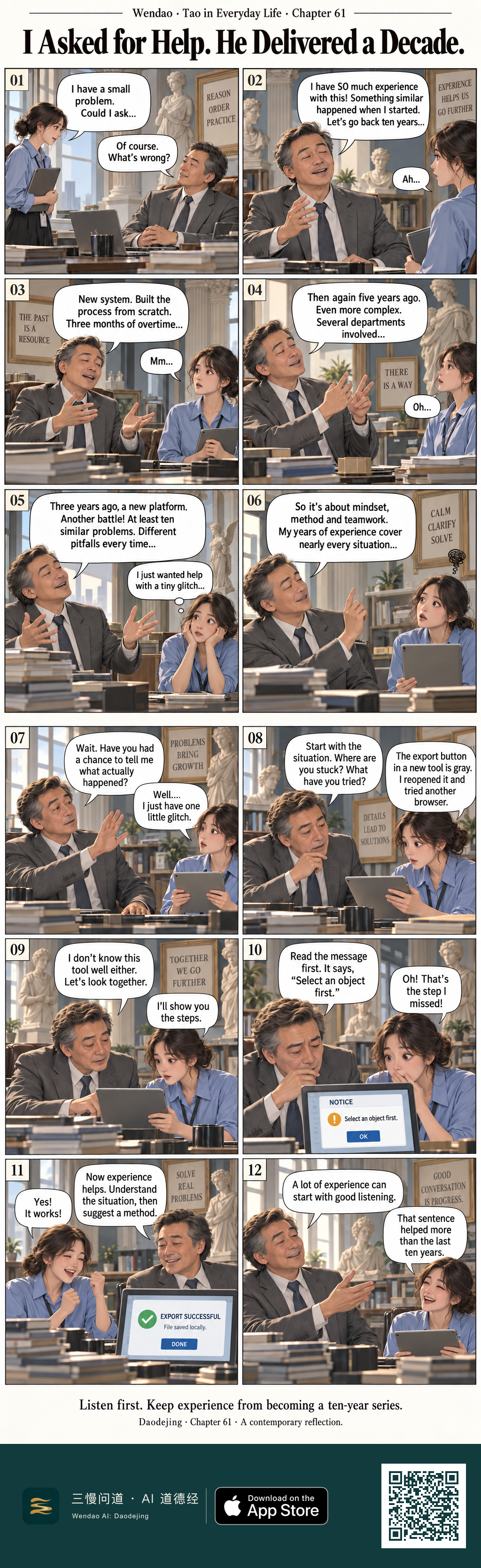
The opening joke comes from a grand mismatch of scale. In a stately gray office filled with classical columns, statues, books and plaques such as "REASON / ORDER / PRACTICE," the younger woman approaches with her tablet and says she has a small problem. The older man in the gray suit welcomes the question, but almost immediately turns it into a retrospective: he has "SO much experience," and before she can explain the glitch, he is already taking her back ten years. His increasingly expansive hand gestures make the conversation look like a formal lecture, while her replies shrink to "Ah...," "Mm..." and "Oh..." as the actual problem drifts farther away.
By panels 05 and 06, the visual joke has become especially clear. The man is still confidently cataloguing old systems, new platforms, battles, pitfalls, mindset, method and teamwork, while the woman has moved from politely holding the tablet to resting her face in her hands. Her thought bubble—"I just wanted help with a tiny glitch..."—lands because nothing suggests that the man is deliberately showing off; he simply recognized something familiar too quickly and let his experience arrive before her explanation. The plaque "CALM / CLARIFY / SOLVE" quietly echoes a process the conversation itself has not yet followed.
The real turning point arrives in panel 07 when the man raises a hand and asks, "Wait. Have you had a chance to tell me what actually happened?" From there, the physical rhythm changes. Instead of leaning back and narrating his past, he leans toward the tablet and asks where she is stuck and what she has already tried. She finally gets to explain that the export button in a new tool is gray, and that she has reopened the program and tried another browser. The office remains just as grand, but the conversation becomes smaller, more specific and more useful.
The strongest shift comes when the man admits, "I don't know this tool well either. Let's look together." The two characters now bend over the same screen rather than facing each other across a lecture. The solution is wonderfully unheroic: a notice simply says, "Select an object first." The woman's startled "Oh! That's the step I missed!" is followed by a green check mark and "EXPORT SUCCESSFUL / File saved locally. / DONE." After a decade of stories, one line on the screen resolves the problem, which gives the scene its warmest punch line.
The ending gently redirects the meaning of experience instead of dismissing it. The man says that experience becomes useful after understanding the situation and later adds, "A lot of experience can start with good listening." The woman laughs and answers, "That sentence helped more than the last ten years." The footer—"Listen first. Keep experience from becoming a ten-year series."—turns the entire two-page arc into affectionate self-correction. Read alongside the supplied passage, the comic suggests a limited parallel: someone with greater experience or status can sometimes make room by taking the lower position first, listening closely enough for the other person's actual situation to appear before offering what they know.
If all are to obtain what they desire, then the greater should take the lower position.
Daodejing · Chapter 61
English rendering of the Silk B base reading excerpt
The next time someone asks for help, delay the similar-story reflex for two questions: "Where exactly are you stuck?" and "What have you already tried?" Once the situation is clear, offer only the part of your experience that fits. You may not need ten years of stories when one attentive minute will do.