Read the comic reflection
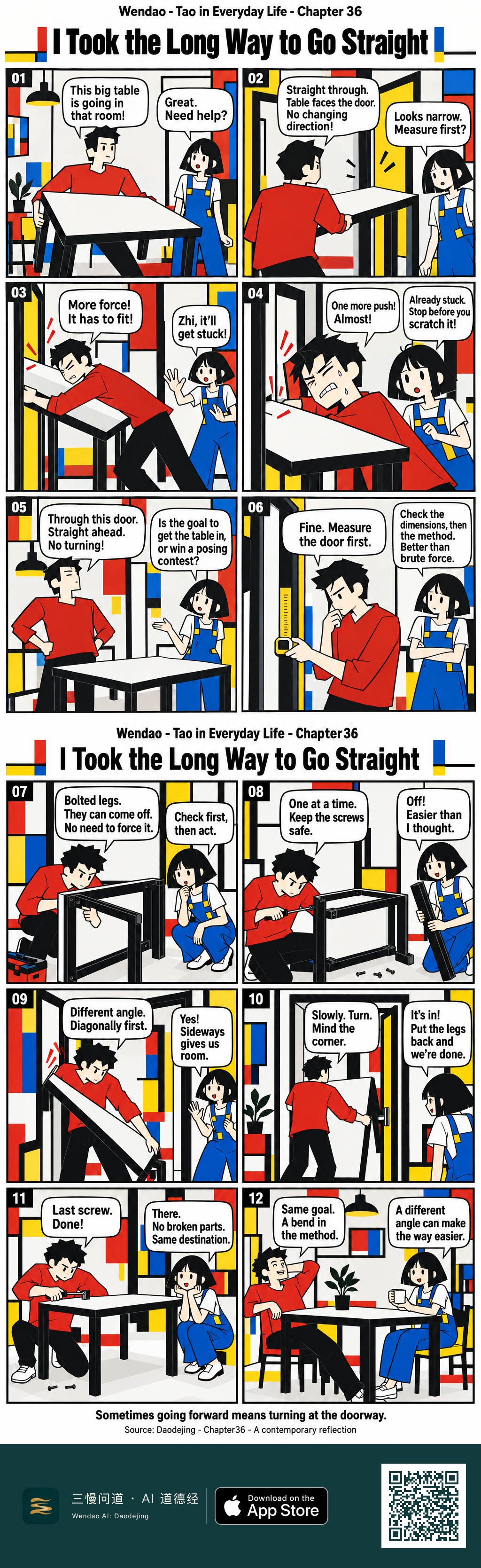
The opening joke is built into the geometry. Zhi, in his red shirt, grips an oversized white rectangular table and declares that it will go straight into the room with the tabletop facing the door and "No changing direction!" The black doorway, table legs, and red-blue-yellow blocks make everything look rigidly square, while the woman in blue overalls calmly asks whether they should measure first. Zhi instead pushes harder, turning a simple furniture problem into a contest between one stubbornly straight line and one obviously narrow opening.
Panels 03 through 06 make the failed strategy increasingly physical without anyone being hurt. Zhi leans his whole body into the table, insists that "It has to fit," and then tries "One more push" even after the tabletop is visibly wedged at the doorway. His companion warns that it will get stuck and tells him to stop before scratching it. The turning point arrives when the argument about force finally gives way to the yellow tape measure in Zhi's hands. The joke is that the heroic breakthrough is not more strength at all; it is checking the dimensions.
The lower page turns that change of mind into practical teamwork. Zhi crouches beside the black table frame and notices that the legs are bolted on, while his companion kneels beside him and reinforces the new rhythm: "Check first, then act." In the next panel he removes the fasteners one at a time with a hand tool, loose screws visible on the floor, while she holds a detached black leg. The furniture itself has not become smaller by magic; they have simply looked closely enough to discover which parts can safely change.
Once the legs are off, the same tabletop that failed head-on is tilted diagonally. Zhi carries it at an angle while the woman spots the available space and says, "Sideways gives us room." At the doorway he slows down, turns, and watches the corner instead of charging forward. Afterward he reattaches the table, announcing "Last screw. Done!" while his companion celebrates that there are no broken parts and the destination is unchanged. A couple of loose screws remain visible on the floor; the drawing does not explain whether they are spare fasteners.
The final panel completes the change in mood as well as the furniture move. The table is safely assembled inside the room, Zhi is relaxed in a chair, his companion sits opposite with a cup, and a green potted plant now rests on the tabletop. Their closing lines distinguish the goal from the method: "Same goal. A bend in the method" and "A different angle can make the way easier." Read alongside Chapter 36, this offers a limited contemporary echo of "the soft and weak overcome the strong": flexibility here does not mean abandoning the destination, but using measurement, disassembly, angling, patience, and cooperation instead of treating brute force as proof of commitment.
The soft and weak overcome the strong.
Daodejing · Chapter 36
English rendering of the Silk B base reading excerpt
When a small task refuses to move despite repeated effort, try Zhi's later approach: pause, measure the constraint, inspect what can safely change, and ask whether the goal truly requires the method you started with. You may be able to keep the destination while changing the angle.